
























लेसन 6 · The Atmosphere and Flight Basics
The standard atmosphere
Derive and use the International Standard Atmosphere: hydrostatic balance, temperature layers, pressure and density formulas, a worked example and a runnable ISA table.
The real atmosphere changes with place, season and time of day. If every aircraft designer and pilot used a different air, nobody could compare performance numbers. So the world uses a single reference: the International Standard Atmosphere (ISA), an idealized, dry-air model with fixed temperature layers. In this lesson you will derive its pressure formula from first principles and then use it.
What you will learn
- The ISA sea-level reference values and its temperature layers.
- How the hydrostatic equation and the gas law combine to give pressure and density.
- How to compute T, p, ρ and the speed of sound at any height up to 20 km.
- How a pressure altimeter turns a pressure into an altitude.
Key terms
ISA: the International Standard Atmosphere, a reference model with fixed sea-level values and temperature gradients.
Hydrostatic equation: dp = −ρ g dh, which says pressure drops with height by the weight of the air layer.
Gradient layer: a layer where temperature changes linearly with height (the lapse rate is constant).
Isothermal layer: a layer with constant temperature.
Pressure altitude: the altitude in the ISA at which the ambient pressure would occur.
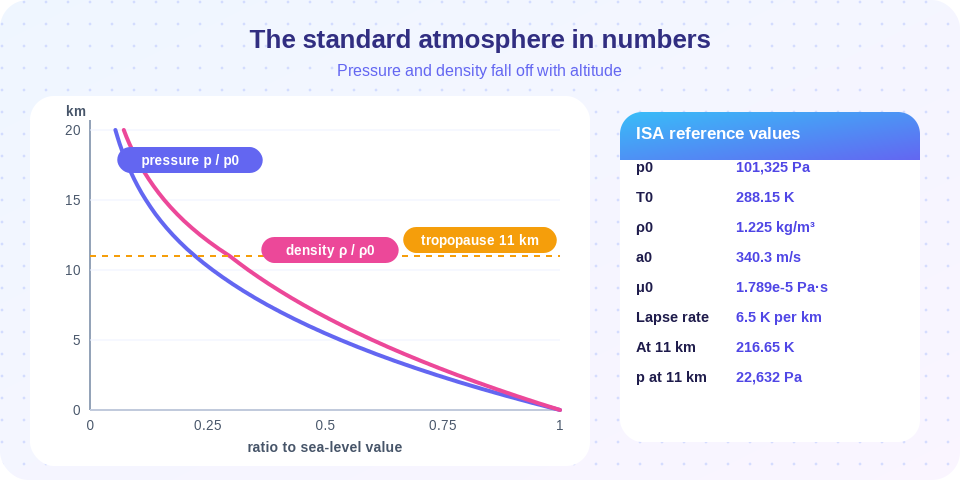
The reference values
At sea level (mean sea level, h = 0) the ISA fixes:
| Quantity | Value |
|---|---|
| Temperature T₀ | 288.15 K (15 °C) |
| Pressure p₀ | 101,325 Pa |
| Density ρ₀ | 1.225 kg/m³ |
| Speed of sound a₀ | 340.3 m/s |
| Dynamic viscosity μ₀ | 1.789 × 10⁻⁵ Pa·s |
| Gravity g₀ | 9.80665 m/s² |
| Gas constant R (dry air) | 287.053 J/(kg·K) |
Temperature then follows layers: it falls at 6.5 K per km from the ground to 11 km (the tropopause), stays at 216.65 K from 11 to 20 km, and then rises at 1 K per km up to 32 km. (This course uses up to 20 km.)
Deriving the pressure formula
Take a thin horizontal slab of air with thickness dh. The pressure below the slab must support the pressure above plus the slab's weight, so
dp = −ρ g dh
Use the gas law p = ρ R T to replace ρ with p/(R T):
dp / p = −(g / (R T)) dh
Now there are two cases.
Gradient layer (T = T₁ + L·(h − h₁), with L = −0.0065 K/m in the troposphere). Integrating gives
p / p₁ = (T / T₁)^( −g / (L R) )
and, for the troposphere, −g / (L R) = 9.80665 / (0.0065 × 287.053) = 5.2559. So
p = p₀ (T / T₀)^5.2559, with T = 288.15 − 0.0065 h
Isothermal layer (T constant). The integral is simpler and gives an exponential:
p = p₁ · exp( −g (h − h₁) / (R T) )
At the tropopause, h = 11,000 m: T = 216.65 K and p = 22,632 Pa. The density follows from ρ = p / (R T), and the speed of sound from a = √(γ R T) with γ = 1.4.
Worked example: 3,000 m. T = 288.15 − 0.0065 × 3000 = 268.65 K. Then T / T₀ = 0.9323, and raising it to the power 5.2559 gives 0.692. So p ≈ 70.1 kPa. The density is ρ = 70,100 / (287.053 × 268.65) ≈ 0.909 kg/m³, and the speed of sound is √(1.4 × 287.053 × 268.65) ≈ 328.6 m/s.
From pressure to altitude
Invert the troposphere formula and you get the pressure altitude:
h = (T₀ / 0.0065) · [ 1 − (p / p₀)^(1 / 5.2559) ]
This is how a pressure altimeter works. It is really a barometer with a scale labeled in meters or feet. When the pilot sets the local sea-level pressure (called QNH) on the altimeter's subscale, it indicates height above mean sea level; when the pilot sets the standard 1013.25 hPa, it indicates pressure altitude, which is the "flight level" used by airliners above a transition altitude.
Common misconceptions
"ISA describes the real air." It is a convention. On a hot day the real air at 5 km can be 10 K warmer than ISA, and the real density is lower. Aircraft performance charts correct for this with an ISA deviation.
"Pressure falls linearly with altitude." It falls roughly exponentially, with a "scale height" of about 7 to 8 km for the lower atmosphere. Linear approximations only work over a few hundred meters.
Try it
Press Run (or Ctrl + Enter) to see the result here.
Program input · what you'd type while the program runs
Type the answers before you press Run, one per line. Each time the program reads a line (with input()), it gets the next line from this box.
Press Run (or Ctrl + Enter) to see the result here.
Program input · what you'd type while the program runs
Type the answers before you press Run, one per line. Each time the program reads a line (with input()), it gets the next line from this box.
Check your understanding
Quick check · 5 questions
of 5 answered You scored / 5 · perfect!
-
1. What are the ISA sea-level temperature and pressure?
ISA is anchored at 15 °C (288.15 K) and 101,325 Pa, which gives a density of 1.225 kg/m³. -
2. Which equation is the starting point for the pressure-altitude relation?
The hydrostatic balance dp = −ρ g dh, combined with p = ρRT, gives the ISA pressure formulas. -
3. What is the ISA temperature at 11 km?
288.15 − 6.5 × 11 = 216.65 K, which is −56.5 °C. -
4. Between 11 and 20 km the ISA temperature is:
That region is an isothermal layer, so pressure falls exponentially with height. -
5. A pilot sets 1013.25 hPa on the altimeter subscale. It now shows:
With the standard setting, the altimeter reads altitude in the ISA that matches the measured pressure.
Summary
- ISA fixes sea-level values (288.15 K, 101,325 Pa, 1.225 kg/m³) and temperature layers.
- Hydrostatics plus the gas law give
p = p₀ (T/T₀)^5.2559in the troposphere and an exponential above 11 km. - Density comes from ρ = p/(RT); speed of sound from a = √(γRT).
- An altimeter is a barometer calibrated with the ISA formula.
अपनी प्रगति ट्रैक करें
मुफ़्त अकाउंट बनाएँ, लेसन पूरे के रूप में चिह्नित करें और किसी भी डिवाइस पर वहीं से शुरू करें जहाँ छोड़ा था।