
























Lección 35 · Practice and Review
A pronunciation practice routine and mini-project
Build a short daily pronunciation routine with listening, shadowing and self-recording, then complete a two-week mini-project on one short text.
Knowing the rules is a start, but your mouth and ears learn through practice. Short, regular sessions usually work better than one long session once in a while. In this lesson you will build a routine and complete a small project.
Important: this website cannot hear you, record you or grade your speech. The tools below are timers and checklists. To check your voice, use the recorder on your own phone or computer, or ask a teacher or friend to listen.
Listen
Copy
Check
What you will learn
- A 15-minute session plan
- How to choose good practice material
- How to listen to your own recording
- How to run a two-week mini-project
The four steps
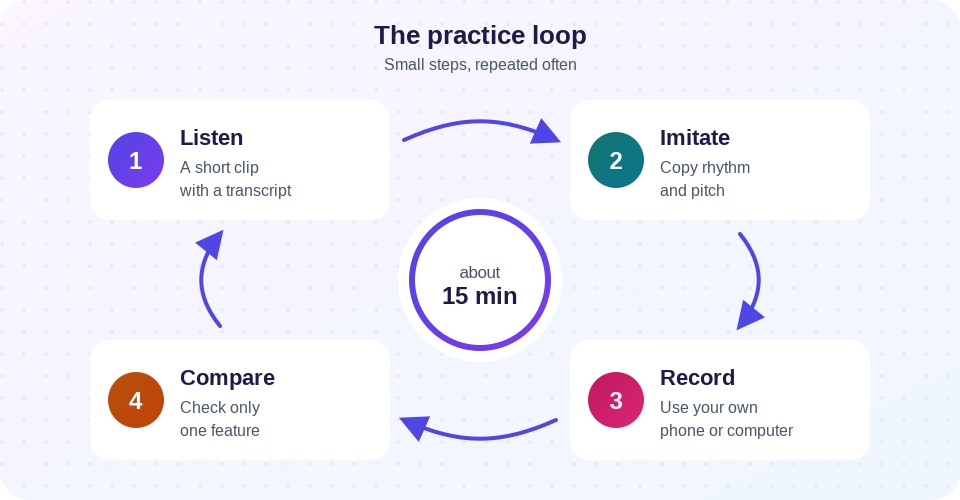
- Listen. Choose a clip of 10 to 30 seconds with a transcript. Listen several times without speaking. Mark the stressed words and the main peaks.
- Imitate. Play one sentence, pause and say it. Copy the rhythm and pitch, not only the sounds.
- Record. Say the whole passage while recording on your own device.
- Compare. Listen to the original and your version. Check one feature only, such as final consonants.
Shadowing means speaking along with a recording, slightly behind it. Start with slow, clear speech. If you cannot keep up, shorten the clip.
Choosing material
Good practice material is:
- short enough to repeat many times;
- spoken in the accent you chose as a model (see accents);
- interesting to you;
- supplied with a transcript or captions you can check.
Use material that you have permission to use. Public broadcasts, learner materials and your teacher's recordings are all possible. If you do not have a clip, read the practice text below and check words in a dictionary with audio.
What to check
| Week focus | Question to ask | Lesson to review |
|---|---|---|
| word stress | Is the right syllable long and clear? | two syllables |
| sentence stress | Do the content words stand out? | sentence stress |
| weak forms | Are "a, of, to" light? | weak forms |
| linking | Do words flow inside a phrase? | linking |
| intonation | Does my pitch move on the nucleus? | tones |
Listening to your own voice may feel strange at first. That is normal. Be a fair coach: write one thing you did well and one thing to work on.
A practice text
Here is an original short text for the project.
On Saturday I went to the market for some bread and a bag of apples. The woman at the stall asked me if I wanted anything else. I said I didn't, but then I saw the cherries. "Well," I said, "maybe just a few." She smiled and gave me a handful for free.
A possible stress outline for the first sentence: On SATurday I WENT to the MARket for some BREAD and a BAG of APples.
Notice the weak forms in "to the", "for some" and "bag of". "Asked me" may lose its /k/ in fast speech. "Well," could take a fall-rise, because the speaker is hesitating.
Mini-project: two weeks, one text
| Days | Task |
|---|---|
| 1 | Record a first version without practice and keep it |
| 2-3 | Mark stress and check every new word |
| 4-6 | Practice weak forms and linking |
| 7 | Record again and compare with day 1 |
| 8-10 | Work on intonation, especially the quotations |
| 11-13 | Shadow a model reading or practice with a friend |
| 14 | Record a final version and write three observations |
If you do not have a model reading, ask a teacher or a fluent speaker to read the text. Your own judgement is also useful: listen for clear stress and easy words to follow.
At the end, ask a listener to tell you which words were hardest to understand. This real feedback is worth more than any checklist. Then choose your next text and focus.
Keeping a notebook
Write the date, the clip, your focus and two notes. Over weeks you will see patterns, such as the same words causing trouble. Make cards for those words and review them. Do not try to fix everything at once.
Common mistakes
- Practicing for an hour once a month rather than a few minutes often.
- Trying to correct all features in one session.
- Never listening to your recording.
- Thinking a computer voice or a website can judge your pronunciation.
Try it
The timer guides one 15-minute session. Record on your own device during the record step.
Use the checklist to track the mini-project. It is not saved when you leave the page.
Check your understanding
Quick check · 4 questions
of 4 answered You scored / 4 · perfect!
-
1. Which plan usually works better?
Frequent practice builds habits. -
2. What does shadowing mean?
You follow slightly behind the audio. -
3. How many features should you compare at once?
One focus is easier to hear and fix. -
4. Can this website grade your voice?
Record yourself or ask a listener.
Summary
- Use a loop: listen, imitate, record and compare.
- Pick short material with a transcript.
- Check one feature at a time.
- A two-week project shows your progress.
- Real listeners give the most useful feedback.
Sigue tu progreso
Crea una cuenta gratis para marcar lecciones y retomar donde lo dejaste en cualquier dispositivo.