
























Lección 11 · Consonant Sounds
The Consonant Map
Read an English consonant chart by place, manner and voicing, see all 24 consonants with example words and practice sorting them yourself.
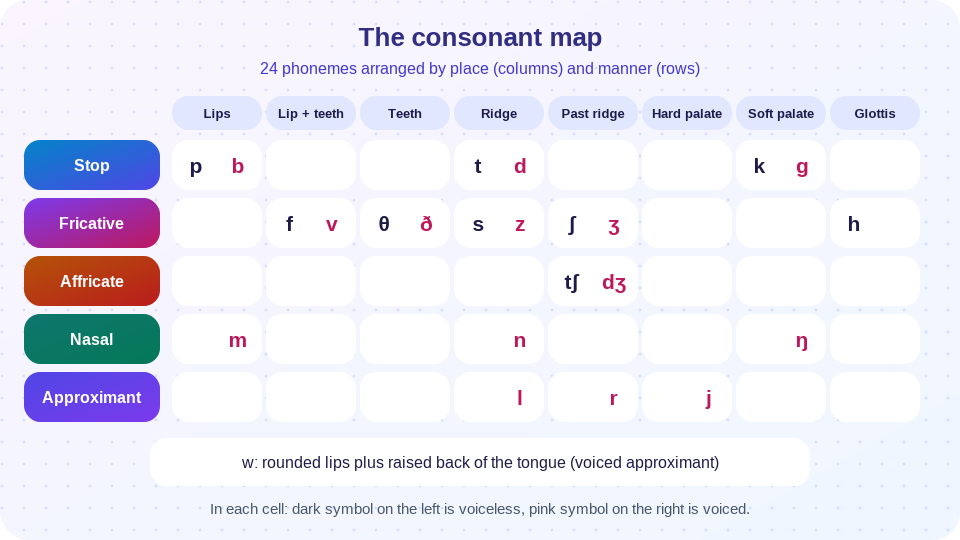
English has 24 consonant phonemes in the usual description. That sounds like a lot to learn one by one. It is much easier when you see them arranged by where and how they are made.
You met voice, place and manner in how speech sounds are made. This chapter uses those three ideas to organize the whole set.
Where?
How?
What you will learn
- The five manners of English consonants
- The places of articulation from lips to throat
- Which consonants form voiced and voiceless pairs
- How to use the chart to diagnose a problem sound
- Which lesson covers each group
The five manners
| Manner | What the air does | Sounds | Example words |
|---|---|---|---|
| Stop (plosive) | fully blocked, then released | /p b t d k g/ | pea, bee, tea, key |
| Fricative | pushed through a narrow gap, noisy | /f v θ ð s z ʃ ʒ h/ | fine, vine, thin, see, ship, hat |
| Affricate | a stop that releases into a fricative | /tʃ dʒ/ | chin, jam |
| Nasal | mouth blocked, air through the nose | /m n ŋ/ | map, net, sing |
| Approximant | narrowed, but without friction noise | /l r j w/ | leg, red, yes, wet |
The sound /l/ is often called a lateral approximant, because air flows past the sides of the tongue.
The places
Move from the front of the mouth to the back:
- Both lips: /p b m/
- Lip and teeth: /f v/
- Tongue and teeth: /θ ð/
- Tooth ridge: /t d s z n l/
- Just behind the ridge: /ʃ ʒ tʃ dʒ r/
- Hard palate: /j/
- Soft palate: /k g ŋ/
- Throat (glottis): /h/
The sound /w/ uses two places at once: the lips round while the back of the tongue rises. A chart often lists it separately.
Voiced and voiceless pairs
There are eight common pairs. In each, the mouth position is nearly the same:
| Voiceless | /p/ | /t/ | /k/ | /f/ | /θ/ | /s/ | /ʃ/ | /tʃ/ |
|---|---|---|---|---|---|---|---|---|
| Voiced | /b/ | /d/ | /g/ | /v/ | /ð/ | /z/ | /ʒ/ | /dʒ/ |
That is 16 sounds in pairs. The other eight are /h m n ŋ l r j w/. Together they make 24.
Using the chart to find a problem
When a listener mishears you, find both sounds on the chart and ask what differs.
| Confusion | What differs | What to practice |
|---|---|---|
| "vest" heard as "best" | manner: fricative against stop | keep a small gap, do not close the lips fully |
| "sheep" heard as "seep" | place: farther back | pull the tongue back and round the lips a little |
| "thin" heard as "tin" | manner: friction against a stop | keep air flowing past the teeth |
| "coat" heard as "goat" | voicing | release with a puff and delay the voice |
A one-feature difference is often the easiest to fix, because you only need to change one thing.
Worked example: describe /dʒ/
The first sound of "jam" is voiced. Its place is just behind the tooth ridge. Its manner is affricate: the tongue fully blocks the air, then releases slowly into a noisy gap. Remove the voice and you get /tʃ/ as in "chin".
Where the lessons go next
This chapter has these lessons:
| Lesson | Sounds |
|---|---|
| Stop consonants | /p b t d k g/ |
| F, V, TH and H | /f v θ ð h/ |
| Hissing sounds, CH and J | /s z ʃ ʒ tʃ dʒ/ |
| Nasals, L, R, W and Y | /m n ŋ l r w j/ |
Practice: sort the consonants
Reading the chart in two directions
Read across a row to compare sounds that share a manner. In the stop row, the only thing that changes from /p/ to /k/ is the place. Say "pa, ta, ka" and feel the block move backward.
Read down a column to compare sounds that share a place. At the tooth ridge you have /t d/ (stops), /s z/ (fricatives), /n/ (nasal) and /l/ (lateral). Say "ta, sa, na, la" and notice that your tongue stays in the same general area while the airflow changes.
This two-way reading is a quick self-test. If you can make one member of a row or column well, use it as a starting point for its neighbor. For example, many learners have a good /t/ and need /s/. Say /t/, then release the air slowly instead of in one burst, and let it hiss.
Sounds that are often new
The sounds that are new for you depend on your first language. Learners often work on these: /θ ð/, /v/ and /w/, /l/ and /r/, /ʃ/ and /tʃ/, /ŋ/ at the end of words, and final voiced sounds such as /b d g z/. Compare each one with your own language before you decide which to practice. Your language may already have some of them.
Common mistakes
- Counting letters: "sh" and "ng" are single sounds, and "x" is often two.
- Thinking a chart position is a fixed point. Neighbors pull sounds forward and back.
- Practicing only one member of a pair.
- Assuming a consonant sounds the same at the end of a word as at the start.
Check your understanding
Quick check · 5 questions
of 5 answered You scored / 5 · perfect!
-
1. Which consonant is made with both lips?
/m/ is a bilabial nasal. -
2. What is an affricate?
/tʃ/ and /dʒ/ work this way. -
3. Which pair differs only in voicing?
They share place and manner. -
4. How many consonant phonemes are in the usual English list?
Letters and sounds are counted differently. -
5. Which sound is lateral?
Air passes the sides of the tongue.
Summary
- English has 24 consonant phonemes in the usual description.
- Describe each by voice, place and manner.
- Five manners: stop, fricative, affricate, nasal and approximant.
- Eight pairs differ mainly in voicing.
- Find the feature that differs to fix a confusion.
Sigue tu progreso
Crea una cuenta gratis para marcar lecciones y retomar donde lo dejaste en cualquier dispositivo.