
























Lektion 33 · Practice and Review
Building a Self-Practice Speaking Plan
Practice speaking English on your own with shadowing, self-talk, retelling and recording, arranged into a realistic weekly plan you can keep.
You can improve a lot without a partner. Speaking is a skill that grows when your mouth and memory use the language often. Reading and listening help, but they do not replace saying words aloud.
This lesson gives you methods that need only your voice, and sometimes a recording device. It also helps you make a plan that you can really keep. This website cannot hear, grade or score you, so you will check your own speaking, and ask a person when you can.
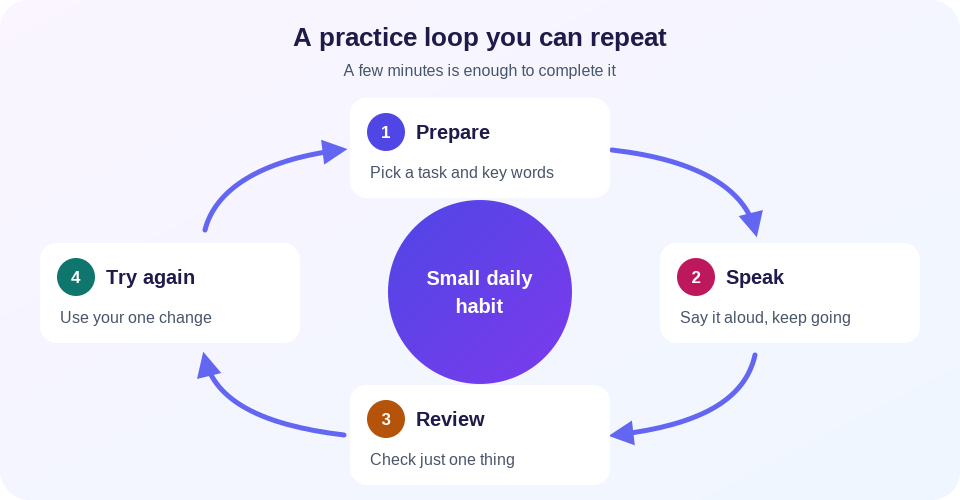
Practice alone
Check yourself
Add people
What you will learn
- Use five solo speaking methods.
- Review a recording without being too hard on yourself.
- Plan a week of short sessions.
- Know when you need feedback from other people.
Five methods
Self-talk
Describe what you are doing: "I'm cutting the onions. Next I'll heat the pan." Or plan tomorrow aloud. When you meet a missing word, say it another way and look it up later.
Shadowing
Choose a short clip with a clear speaker and, ideally, a transcript that you are allowed to use. Listen once for meaning. Then play it again and speak along, a moment behind, copying rhythm and stress. Use the same clip several times. Pick speech you understand quite well; very hard audio is difficult to copy.
Retelling
Read or listen to something short. Close it and tell the main points in your own words. Check what you missed, then retell it. This trains you to build sentences instead of repeating them.
Repeated talking
Speak about one topic three times: first for two minutes, then for ninety seconds, then for one minute. Each time you know what you want to say, so you can work on saying it more smoothly. See the tasks in Role-Play Practice Sets.
Phrase practice
Take one useful phrase, such as "Could you say that another way?" Say it, then use it in three situations you imagine. Come back to it a few days later.
Reviewing your recording
Listening to your own voice can feel strange at first. That is normal. Listen with one question at a time:
| Listening round | Question |
|---|---|
| One | Did I express my meaning? |
| Two | Where did I pause for a long time, and why? |
| Three | Choose one language point, such as past tense or word stress. |
Write one thing that went well and one thing to try. Then record again. Your accent is part of you. The usual goal is to be clear and comfortable, not to copy one particular voice.
Keep recordings private and delete them when you no longer need them. Do not record other people without their permission; laws differ.
A weekly plan
Short, frequent practice is often easier to keep than one long session. Here is an example, which you should change to suit your life.
| Day | Time | Task |
|---|---|---|
| Monday | 10 min | Shadow a short clip |
| Tuesday | 10 min | Retell what you heard |
| Wednesday | 5 min | Self-talk while doing a routine task |
| Thursday | 10 min | Three rounds on one topic |
| Friday | 10 min | Role-play a phone call or meeting |
| Weekend | Optional | Speak with another person if you can |
A tiny minimum, such as two minutes, can keep the habit going on a busy day. Missing a day is not failure. Restart with the next one.
Setting goals you can check
"Speak better" is hard to check. "Give a one-minute update without reading my notes" is something you can try and see. Choose a goal for two weeks, note your first attempt, practice and try the same task again. Compare them honestly.
Getting human feedback
You may not notice some of your own mistakes. A teacher, conversation partner or study group can tell you what was unclear. If you use an app or a speech-to-text tool, treat its results as hints; they can be wrong, especially with accents or noise. For online partners, protect your personal information, and stop if anything makes you uncomfortable. Learners under eighteen should ask a parent or trusted adult before joining any online exchange.
Keeping a phrase notebook
Keep one page, on paper or on your device, with three columns: what I wanted to say, how I said it and a better way. Fill it in after each session with one or two items only. Check the better way in a good learner's dictionary or ask a person you trust, so that you do not practice an error. At the end of the week, close the page and try to say each idea again.
If a method bores you, change the topic before you give up on the method. Cooking, sport, games, family traditions and your work can all give you plenty to say. Interest makes it easier to keep talking.
Common mistakes
- Only silent study. Say words aloud, even quietly.
- Collecting many phrases without using any of them. Use a few often.
- Making a plan that is too large to keep. Start small.
- Judging a recording on every point at once. Choose one focus.
Try it
Check your understanding
Quick check · 4 questions
of 4 answered You scored / 4 · perfect!
-
1. What is shadowing?
Shadowing copies the rhythm and stress of a speaker as you listen. -
2. How should you review a recording?
One focus at a time is manageable and useful. -
3. Which goal is easiest to check?
It describes a task that you can try and compare. -
4. What should you remember about speech-to-text tools?
Noise, accents and tool limits can cause errors.
Summary
- Self-talk, shadowing, retelling, repeated talking and phrase practice work without a partner.
- Review with one question per listen.
- Keep sessions short and goals checkable.
- Add human feedback when you can, and stay safe online.
Next: Role-Play Practice Sets
Verfolge deinen Fortschritt
Erstelle ein kostenloses Konto, hake Lektionen ab und mach auf jedem Gerät dort weiter, wo du aufgehört hast.