
























Lektion 23 · Telephone and Online Calls
Phone Call Basics in English
Learn to start, handle and end a phone call in English, give names and numbers clearly, and ask the caller to repeat without feeling awkward.
A phone call removes many clues. You cannot see the other person's face or hands, the sound may be poor, and you have little time to think. That is why many learners find calls harder than talking face to face.
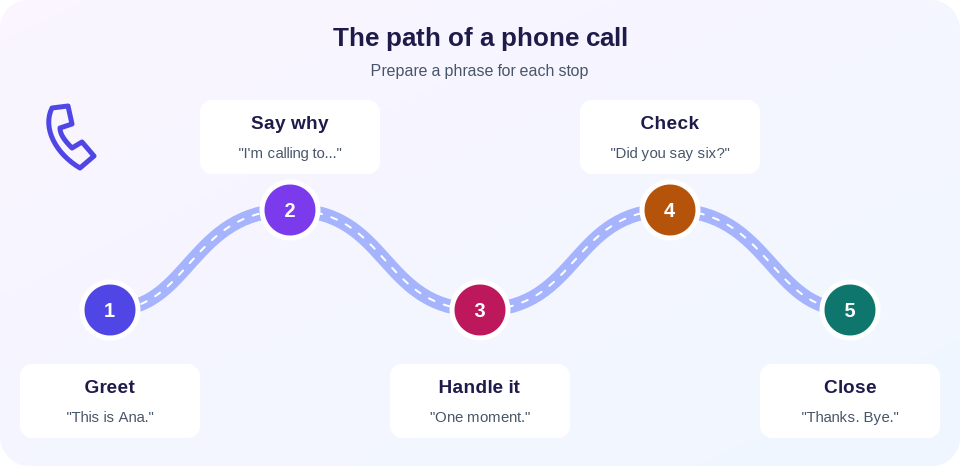
The good news is that calls follow a fairly predictable path. If you know the stages and a few phrases for each, much of the call is prepared before you dial.
Before you call
During the call
Before you hang up
What you will learn
- Open a call you make and a call you receive.
- Say why you are calling.
- Give numbers, times and spellings clearly.
- Ask for repetition and end the call smoothly.
Opening the call
Phone greetings differ between countries and workplaces. These patterns are useful in many English-speaking settings.
| Situation | Phrase |
|---|---|
| Answering at work | Good morning, Green Street Clinic. This is Ana. |
| Answering your own phone | Hello? |
| Saying who you are | Hi, this is Karim. |
| Formal | Good afternoon. My name is Karim Aziz. |
| Asking for someone | Could I speak to Mrs. Lee, please? |
| Checking the caller | May I ask who's calling? |
| You are the person asked for | Speaking. / This is she. / This is he. |
On the phone, say "This is Karim," not "I am Karim." To check who is there, ask "Is this Ana?" "Speaking" is a quick way to say "I am the person you asked for."
Say why you are calling
Give your reason soon after the greeting.
- "I'm calling about my appointment on Thursday."
- "I'm calling to ask about your opening hours."
- "I wonder if you could help me with an order."
Use "about" before a noun and "to" before a verb: "calling about a bill," "calling to pay a bill."
Waiting and transfers
- "One moment, please."
- "Could you hold on for a second?"
- "I'll put you through." (connect you to another person)
- "I'm afraid she's not available at the moment."
- "I think you have the wrong number."
If you called the wrong number, say "Sorry, I must have the wrong number."
Numbers, times and spelling
Say phone numbers in small groups with short pauses. The digit 0 is often "zero" or "oh." Some speakers say "double five" for 55, especially in British English. For international calls, repeat the whole number once.
Some numbers sound very similar. Compare "thirteen" and "thirty." In the first, the stress is usually on "teen": thir-TEEN. In the second, it is on the first part: THIR-ty. If there is a risk, check digit by digit: "That's one-three, thirteen?"
For times, repeat clearly: "Three fifteen in the afternoon." If you are in different time zones, say whose time you mean: "Three o'clock your time."
To spell, give letters slowly and use a word for any letter that could be confused: "B for Bravo," "M for Mike," "N for November." The international spelling alphabet uses these words, but a simple word you both know also works.
When you cannot hear or understand
- "Sorry, I didn't catch that."
- "Could you say that again, please?"
- "Could you speak a bit more slowly?"
- "Sorry, the line is bad. Can you hear me?"
- "Did you say Tuesday or Thursday?"
The last one is especially useful, because the other person only needs to confirm one word. If you still cannot understand, offer another way: "Could you send me that in a message?"
Closing the call
Do not hang up the moment you have your information. Signal that you are finishing.
"So that's Thursday at three fifteen. Is that right?" "Yes, that's right." "Great. Thanks for your help. Bye."
Other closings are "That's everything, thank you" and "I'll let you go now." Wait for the other person's reply.
A model call
Clerk: Good morning, City Library. This is Joe.
Dina: Hi, this is Dina Salem. I'm calling about a book I reserved.
Clerk: Sure. Could you spell your last name?
Dina: S for Sierra, A, L, E, M for Mike.
Clerk: Thanks. It's ready. We're open until six today.
Dina: Sorry, did you say six or seven?
Clerk: Six.
Dina: Great, I'll come before six. Thank you. Bye.
Dina names herself, gives a reason, checks one detail and repeats it.
Practice without a real call
Sit back to back with a practice partner, or turn your chair away, so that you cannot use gestures. One person is the caller and the other answers. Try to complete a booking with a name, a date and a number. Check the notes afterwards. If you are alone, read both roles aloud, then cover the clerk's lines and answer them from memory. Never make test calls to businesses or emergency services just to practice. For a real emergency, call your local emergency number and follow the operator's questions.
Common mistakes
- "I am Dina" sounds like a face-to-face introduction. On the phone, say "This is Dina."
- "Can you repeat again?" doubles the idea. Say "Could you repeat that?" or "Could you say that again?"
- Pretending that you understood. It can lead to a wrong time or address. Check instead.
- Saying "Wait" by itself. "One moment, please" is kinder.
Try it
Match the situation to a phrase.
Check your understanding
Quick check · 4 questions
of 4 answered You scored / 4 · perfect!
-
1. Which is the most natural way to give your name on the phone?
"This is..." is the usual phrase on the phone. -
2. A caller asks for you. What can you say?
"Speaking" means you are the person asked for. -
3. What is a good way to check an unclear day?
It asks the person to confirm just the uncertain word. -
4. What does "I'll put you through" mean?
"Put through" means connect a caller.
Summary
- A call often has five stages: greet, give your reason, handle the request, check details and close.
- Use "This is..." and "Speaking."
- Say numbers in groups and confirm similar sounds.
- Ask for repetition instead of guessing.
Verfolge deinen Fortschritt
Erstelle ein kostenloses Konto, hake Lektionen ab und mach auf jedem Gerät dort weiter, wo du aufgehört hast.