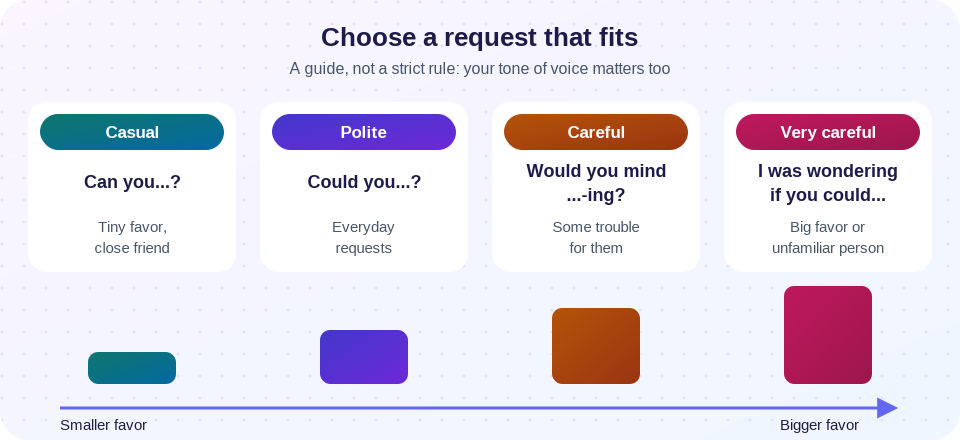
Make requests in English that sound polite and clear, choose the right level of formality, ask permission, offer help and reply when the answer is no.
"Open the window." The words are correct, but said to a stranger they may sound like an order. English speakers often soften requests with question forms and a few extra words.
The goal is not to use the longest phrase. It is to choose a form that fits the size of the favor and your relationship with the person.
Bigger favors and less familiar listeners usually call for softer wording.
These are guides, not strict rules. Your voice matters too. A friendly voice can make a simple request sound kind, and an annoyed voice can make a long phrase sound sharp.
Add please to many requests: "Could you send it today, please?"
"Would you mind opening the window?" means "Would it bother you to open the window?"
To agree: "Not at all." / "No, of course not." / "Sure, no problem."
To refuse: "I'd rather not, because it's cold in here."
A plain "Yes" can be confusing, because it could mean "Yes, I mind." In everyday speech, some people say "Sure" to mean "Of course I'll help." Clear words such as "Of course I can" avoid doubt.
Look at the verb form: would you mind + -ing: "Would you mind waiting?"
Practice shows how the same need changes shape. You need help with a form.
To a close friend: "Can you look at this form with me?"
To a classmate you know a little: "Could you help me with this form if you have a minute?"
To an office worker you have never met: "Excuse me, I was wondering if you could help me with this form."
The need is the same, but the length and softness change. Now try it with a ride, a pen and a place to sit. Say all three versions aloud and notice which feels natural. If you are unsure about a place or group, begin a little more politely and copy the style that others use with you.
<!doctypehtml><style>body{font-family: system-ui, sans-serif;margin: 0;padding: 14px;background:linear-gradient(135deg, #faf5ff, #eff6ff);color: #1e1b4b;}.card{background: #fff;border-radius: 14px;padding: 14px 16px;box-shadow: 0 6px 18px rgba(49, 46, 129, .12);margin-bottom: 10px;}button{font: inherit;border: 1px solid #c7d2fe;background: #eef2ff;color: #1e1b4b;border-radius: 10px;padding: 8px 12px;margin: 4px 4px 0 0;cursor: pointer;text-align: left;}button.main{background:linear-gradient(135deg, #4f46e5, #7c3aed);color: #fff;border: 0;}button.good{background: #d1fae5;border-color: #10b981;}button.bad{background: #fee2e2;border-color: #ef4444;}input, select{font: inherit;padding: 6px 8px;border: 1px solid #a5b4fc;border-radius: 8px;max-width: 100%;}.muted{color: #475569;font-size: 14px;}.fb{margin-top: 8px;min-height: 1.4em;}</style><divclass="card"><divid="n"class="muted"></div><pid="q"></p><divid="opts"></div><divid="fb"class="fb"></div></div><buttonclass="main"id="next"type="button">Next situation</button><script>const data =[["You want a close friend to pass you a spoon.",["Can you pass me a spoon?","I would be most grateful if you would consider passing a spoon.","Spoon."],0,"A short, friendly request fits a tiny favor."],["You want a manager you do not know well to give you a day off.",["I was wondering if I could take Friday off.","I'm not coming Friday.","Give me Friday."],0,"A careful form suits a bigger request."],["Someone asks, \"Would you mind if I sat here?\" The seat is free.",["Not at all, go ahead.","Yes, I would.","Never."],0,"\"Not at all\" means you do not object."],["You see someone struggling with heavy bags.",["Can I give you a hand?","Grab the bags without speaking","Tell them they are slow"],0,"Offer first and wait for the answer."]];const$=(id)=> document.getElementById(id);constmake=(tag, text, cls)=>{const el = document.createElement(tag);
el.textContent = text;if(cls) el.className = cls;return el;};let i =0, right =0, answered =false;functionshow(){const[question, options, best, why]= data[i];
answered =false;$('n').textContent ='Situation '+(i +1)+' of '+ data.length +' | Best first choices: '+ right;$('q').textContent = question;$('fb').textContent ='';$('opts').replaceChildren();const order = options.map((_, k)=> k).sort(()=> Math.random()-0.5);
order.forEach((k)=>{const b =make('button', options[k]);
b.type ='button';
b.style.display ='block';
b.onclick=()=>{
b.className = k === best ?'good':'bad';if(!answered && k === best) right++;
answered =true;$('fb').textContent = k === best ?'Good choice. '+ why :'Not the best fit here. Try another one.';$('n').textContent ='Situation '+(i +1)+' of '+ data.length +' | Best first choices: '+ right;};$('opts').append(b);});}$('next').onclick=()=>{ i =(i +1)% data.length;if(i ===0) right =0;show();};show();</script>
Complete the request phrases.
Request gap fill
<!doctypehtml><style>body{font-family: system-ui, sans-serif;margin: 0;padding: 14px;background:linear-gradient(135deg, #faf5ff, #eff6ff);color: #1e1b4b;}.card{background: #fff;border-radius: 14px;padding: 14px 16px;box-shadow: 0 6px 18px rgba(49, 46, 129, .12);margin-bottom: 10px;}button{font: inherit;border: 1px solid #c7d2fe;background: #eef2ff;color: #1e1b4b;border-radius: 10px;padding: 8px 12px;margin: 4px 4px 0 0;cursor: pointer;text-align: left;}button.main{background:linear-gradient(135deg, #4f46e5, #7c3aed);color: #fff;border: 0;}button.good{background: #d1fae5;border-color: #10b981;}button.bad{background: #fee2e2;border-color: #ef4444;}input, select{font: inherit;padding: 6px 8px;border: 1px solid #a5b4fc;border-radius: 8px;max-width: 100%;}.muted{color: #475569;font-size: 14px;}.fb{margin-top: 8px;min-height: 1.4em;}</style><pclass="muted">Type the missing words, then press Check. Other answers can be natural too: this exercise only knows the ones from this lesson.</p><divid="list"></div><buttonclass="main"id="check"type="button">Check</button><buttonid="show"type="button">Show answers</button><divid="fb"class="fb"></div><script>const data =[["Would you mind","the door? (close)",["closing","shutting"],"use the -ing form"],["Could I","your dictionary for a minute?",["borrow","use"],"take and give back"],["Could you","me your umbrella?",["lend"],"the person who gives does this"],["Can I give you a","with those boxes?",["hand"],"part of your arm"],["I was","if you could help me.",["wondering"],"a soft way to begin a request"]];const$=(id)=> document.getElementById(id);constmake=(tag, text, cls)=>{const el = document.createElement(tag);
el.textContent = text;if(cls) el.className = cls;return el;};constclean=(s)=> s.toLowerCase().replace(/[\u2019']/g,"'").replace(/[.,!?]/g,'').replace(/\s+/g,' ').trim();const inputs = data.map(([before, after, accepted, hint])=>{const card =make('div','','card');const input = document.createElement('input');
input.size =14;
input.setAttribute('aria-label','Missing words. Hint: '+ hint);
card.append(before +' ', input,' '+ after,make('div','Hint: '+ hint,'muted'));$('list').append(card);return input;});$('check').onclick=()=>{let right =0;
inputs.forEach((input, i)=>{const ok = data[i][2].some((a)=>clean(a)===clean(input.value));
input.style.background = ok ?'#d1fae5':'#fee2e2';if(ok) right++;});$('fb').textContent = right +' of '+ data.length +' match the lesson answers.';};$('show').onclick=()=>{$('fb').textContent ='Lesson answers: '+ data.map((d, i)=>(i +1)+') '+ d[2][0]).join(' ');};</script>