
























第 20 课 · Nouns, Gender and Definiteness
Dual and Plural: Counting Nouns
Learn Arabic singular, dual and plural: the -ān dual, sound masculine and feminine plurals, common broken plurals, and how non-human plurals agree.
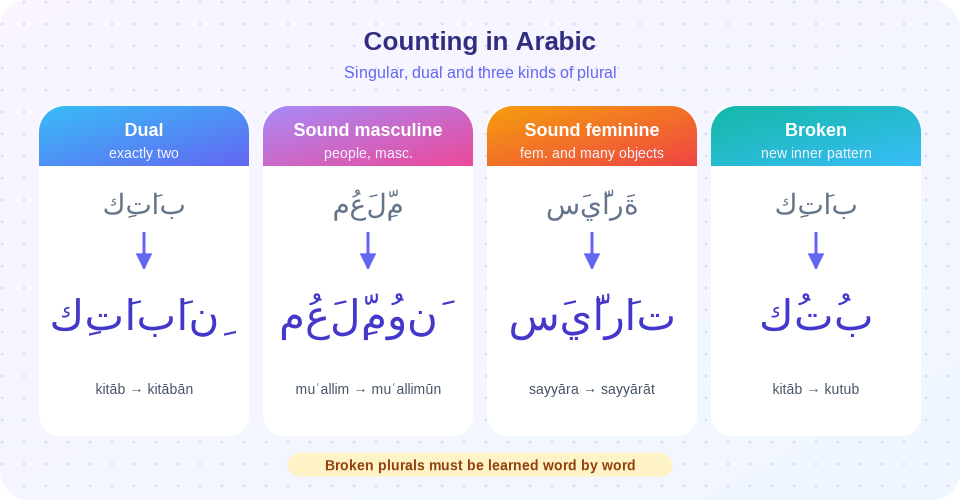
When English speakers count, they have two choices: one thing or more than one. Arabic has a third choice, built into the noun itself: exactly two. That extra number, the dual, shows up in everyday phrases like "two books" or "both parents". Arabic also has more than one way to make a plural, and one of them, the broken plural, reshapes the noun's inner vowels. It sounds complicated, but there are only four patterns to recognize: the dual, the sound masculine plural, the sound feminine plural and the broken plural. This lesson shows you each of them with a set of high-frequency words.
What you will learn
- How to form the dual and when to use it.
- How the sound masculine and sound feminine plurals work.
- Twelve common broken plurals.
- Which plural type a noun is likely to take.
- The surprising agreement rule for non-human plurals.
Key terms
Dual: the number for exactly two of something.
Sound plural: a plural made by adding an ending to the singular, which stays intact.
Broken plural: a plural made by changing the noun's internal vowels and sometimes its letters.
Human / non-human: this distinction affects agreement of adjectives and verbs.
Collective noun: a noun for a group that uses the singular for the whole group.
The dual: exactly two
To make the dual, add the ending ـَانِ (-ān) to the singular noun. The ending is used when the noun is the subject of a sentence. After a preposition or as an object it changes to ـَيْنِ (-ayn).
| Singular | Dual (subject) | Dual (after a preposition) | Meaning |
|---|---|---|---|
| كِتَاب kitāb | كِتَابَانِ kitābān | كِتَابَيْنِ kitābayn | two books |
| بَيْت bayt | بَيْتَانِ baytān | بَيْتَيْنِ baytayn | two houses |
| وَلَد walad | وَلَدَانِ waladān | وَلَدَيْنِ waladayn | two boys |
| مَدْرَسَة madrasa | مَدْرَسَتَانِ madrastān | مَدْرَسَتَيْنِ madrastayn | two schools |
For feminine nouns with ة, the ة becomes ت before the dual ending: مَدْرَسَة → مَدْرَسَتَانِ.
The dual already means two, so you do not add the word for "two": kitābān is "two books", and no further number is needed. The dual is also used for pairs that occur naturally: وَالِدَانِ (wālidān, "parents"), عَيْنَانِ (ʿaynān, "two eyes").
In everyday spoken dialects, the dual is less common than in MSA, but it is a hallmark of correct formal Arabic and you will see it in news and writing.
Sound masculine plural: -ūn and -īn
For many nouns that name male people, especially jobs and active roles, the plural adds ـُونَ (-ūn) for the subject or ـِينَ (-īn) after a preposition or as an object.
| Singular | Plural (subject) | Plural (other) | Meaning |
|---|---|---|---|
| مُعَلِّم muʿallim | مُعَلِّمُونَ muʿallimūn | مُعَلِّمِينَ muʿallimīn | teachers |
| مُهَنْدِس muhandis | مُهَنْدِسُونَ muhandisūn | مُهَنْدِسِينَ muhandisīn | engineers |
| مُسْلِم muslim | مُسْلِمُونَ muslimūn | مُسْلِمِينَ muslimīn | Muslims |
| مِصْرِيّ miṣrī | مِصْرِيُّونَ miṣriyyūn | مِصْرِيِّينَ miṣriyyīn | Egyptians |
The singular stays whole; you simply attach an ending. This is the "sound" part of the name.
Sound feminine plural: -āt
The ending ـَات (-āt) makes the plural of most nouns that end in ة, and of many other feminine and borrowed words. Drop the ة and add -āt.
| Singular | Plural | Meaning |
|---|---|---|
| مُعَلِّمَة muʿallima | مُعَلِّمَات muʿallimāt | female teachers |
| طَالِبَة ṭāliba | طَالِبَات ṭālibāt | female students |
| سَيَّارَة sayyāra | سَيَّارَات sayyārāt | cars |
| طَاوِلَة ṭāwila | طَاوِلَات ṭāwilāt | tables |
You can also use -āt for many everyday words that are not feminine by nature, especially loanwords. Do not read "feminine" in the name as meaning only women: the ending covers many things.
Broken plurals
A large share of Arabic nouns, including some of the most common words, form their plural by reshaping the word. The consonants of the root stay, but the vowels, and sometimes extra letters, change. The word is "broken" and rebuilt, which is where the name comes from.
| Singular | Plural | Meaning |
|---|---|---|
| كِتَاب kitāb | كُتُب kutub | book(s) |
| بَيْت bayt | بُيُوت buyūt | house(s) |
| وَلَد walad | أَوْلَاد awlād | boy(s), children |
| رَجُل rajul | رِجَال rijāl | man, men |
| بِنْت bint | بَنَات banāt | girl(s) |
| قَلَم qalam | أَقْلَام aqlām | pen(s) |
| بَاب bāb | أَبْوَاب abwāb | door(s) |
| مَدْرَسَة madrasa | مَدَارِس madāris | school(s) |
| مَدِينَة madīna | مُدُن mudun | city, cities |
| صَدِيق ṣadīq | أَصْدِقَاء aṣdiqāʾ | friend(s) |
| طَالِب ṭālib | طُلَّاب ṭullāb | student(s) |
| كَلْب kalb | كِلَاب kilāb | dog(s) |
Notice that the roots in the table are plainly visible. kutub and kitāb share k-t-b; buyūt and bayt share b-y-t. When you meet a new plural, look for the root; the rest is a pattern.
There are a few dozen patterns, and they follow tendencies by the shape of the singular, but there is no reliable way to predict the plural completely. The practical advice: learn the plural with the singular from the start, and treat it like an irregular English plural (child, children; foot, feet). The patterns will emerge as you meet more examples. Some words even have two plurals with slightly different meanings.
Which type should I expect?
| Noun | Likely plural |
|---|---|
| A job or role, male persons (muʿallim) | sound masculine, -ūn / -īn |
| A feminine noun in ة (sayyāra) | sound feminine, -āt |
| A short everyday noun (kitāb, bayt, walad) | broken |
| A borrowed word (tilifūn, kumbyūtar) | sound feminine, -āt |
| Anything else | check a dictionary |
Dictionaries list the plural after the singular, so get used to reading the plural in the entry.
Agreement: the plural of things is "she"
Here is a rule that surprises beginners. A plural of things and animals (non-human) takes feminine singular agreement for its adjectives:
- الْكُتُبُ جَدِيدَةٌ (al-kutubu jadīda): The books are new. The adjective is feminine singular, جَدِيدَة, not a plural.
- السَّيَّارَاتُ كَبِيرَةٌ (as-sayyārātu kabīra): The cars are big.
A plural of people, by contrast, takes a plural adjective:
- الطُّلَّابُ كَثِيرُونَ (aṭ-ṭullābu kathīrūn): The students are many.
- الْمُعَلِّمُونَ جَدِيدُونَ (al-muʿallimūna jadīdūn): The teachers are new.
The dual takes a dual adjective: كِتَابَانِ جَدِيدَانِ (kitābāni jadīdān), "two new books". The next lesson shows how adjectives work in full.
Think of the non-human plural as "a group, which counts as one thing, grammatically feminine". That mental picture makes the rule easier to remember than a list.
Plurals in simple sentences
Putting the plurals into sentences shows how they behave. Consider these three:
- الْوَلَدَانِ فِي الْبَيْتِ. (al-waladāni fī l-bayt.) The two boys are in the house. The dual subject takes the dual ending -ān.
- الْكُتُبُ عَلَى الطَّاوِلَةِ. (al-kutubu ʿalā ṭ-ṭāwila.) The books are on the table. ʿalā means "on"; the sun letter ط in aṭ-ṭāwila swallows the l.
- الْمُعَلِّمُونَ فِي الْمَدْرَسَةِ. (al-muʿallimūna fī l-madrasa.) The teachers are in the school. Here the sound masculine plural names men.
Pay attention to what comes after the subject: a short phrase with fī ("in") or ʿalā ("on") makes a full sentence with no verb. You will meet more prepositions in Chapter 6.
Reading plurals in a dictionary
Learners' dictionaries list the plural right after the singular, often shortened, for example "kitāb, pl. kutub". Real dictionaries printed in Arabic list the plural in Arabic script, so the skill of recognizing broken plural shapes pays off. A practical method is to group your flashcards by pattern: put kutub, rusul and ʿuyūn in one pile and aqlām, abwāb and awlād in another. Plural shapes repeat, and seeing two or three examples side by side makes the pattern visible, so the next noun of the same shape feels familiar.
Try it
Press Run (or Ctrl + Enter) to see the result here.
Program input · what you'd type while the program runs
Type the answers before you press Run, one per line. Each time the program reads a line (with input()), it gets the next line from this box.
The first three functions follow rules, so a short program can build the forms. The last list cannot be generated, which is exactly the point about broken plurals: they live in the dictionary.
A note on word order and counting
Because the dual already means "two", Arabic does not need a number word beside it. For three or more, Arabic uses number words with special rules for the noun that follows, which Chapter 6 covers. For now, practice by naming pairs and groups in your surroundings: kitābān on your desk, kutub on the shelf, ʿaynān in your face.
Common misconceptions
"The dual is only for pairs of body parts." It is a regular number, usable with any noun, and it appears in news and formal writing all the time.
"Broken plurals are irregular, so they cannot be learned." They follow patterns; you learn them gradually, plural by plural, as you learn irregular plurals in any language.
"Plural nouns always take plural adjectives." Not when they are things: non-human plurals take feminine singular adjectives.
"Sound masculine plural is only for males." It is mainly used for male human nouns; other nouns take other plurals.
Check your understanding
Quick check · 5 questions
of 5 answered You scored / 5 · perfect!
-
1. What is the dual of كِتَاب?
The dual adds -ān: kitābān, two books. -
2. What is the sound masculine plural of مُعَلِّم?
Add -ūn for male teachers: muʿallimūn. -
3. Which plural is broken?
Buyūt reshapes bayt from the inside. -
4. How do you say 'The books are new'?
A plural of things takes a feminine singular adjective. -
5. What happens to ة in the dual?
Madrasa becomes madrastān: ة turns into ت.
Summary
- Arabic has singular, dual (-ān / -ayn) and plural.
- Plurals come in three styles: sound masculine (-ūn / -īn), sound feminine (-āt) and broken.
- Broken plurals reshape the word; learn each with its singular.
- Plurals of things take feminine singular adjectives; plurals of people take plural adjectives.
- Check a dictionary for the plural when you learn a word.