
























Bài 27 · Habits and Energy
How Habits Form
See how repeated actions become automatic, learn to spot the cue, routine and reward behind a habit, and use that simple map to change what you do each day.
Planning takes thought. If you had to decide every day whether to brush your teeth, check your calendar or pack your bag, you would spend a lot of effort on small things. Habits carry many of these actions for you.
A habit is an action that you have learned to do in a certain situation with little conscious decision. Habits can help your goals or work against them. This chapter shows how to shape them, and how to manage the energy behind your day.
What you will learn
- How repetition makes actions more automatic
- A three-part map: cue, routine and reward
- How to investigate one of your own habits
- Why there is no fixed number of days for a new habit
Repetition in a stable situation
When you repeat an action in the same kind of situation, your mind starts to link the two. At first you must remember and decide. Later, the situation itself reminds you. You sit in the car and reach for the seat belt. You make your morning drink and then open the news.
The situation matters. This is one reason habits can feel different when your life changes. A move, a new job or a school break removes familiar signals. Some good habits may fade, and it can also be a useful moment to design new ones.
Cue, routine, reward
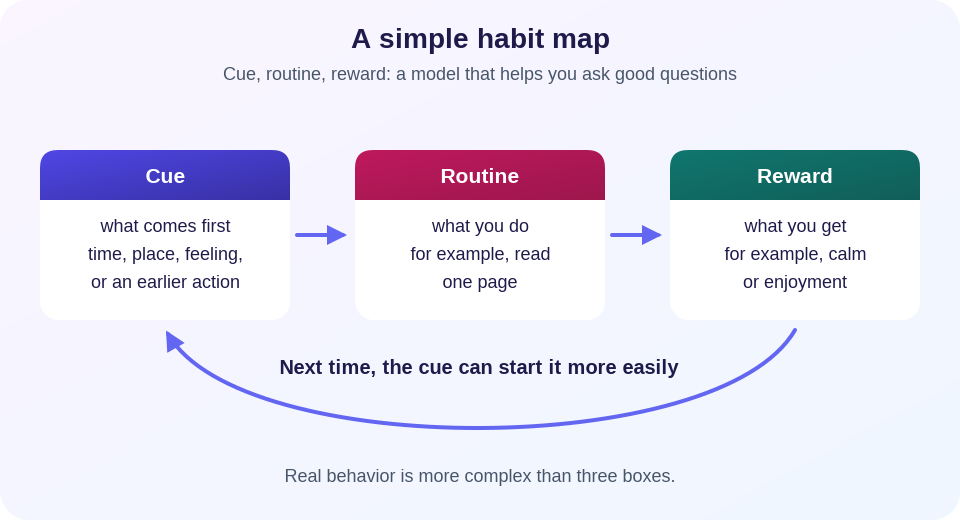
A common way to describe a habit uses three parts.
| Part | Meaning | Example |
|---|---|---|
| Cue | What comes just before and starts the action | You sit down on the sofa after work |
| Routine | What you do | You scroll on your phone |
| Reward | What you get from it | A feeling of relief or something new to see |
This is a simplified model. Real behavior is more complex, and one habit can have several cues. Still, the map helps you ask good questions.
Common kinds of cues
- Time: it is 9 p.m.
- Place: you enter the kitchen.
- Previous action: you finish lunch.
- Feeling: you feel bored or stressed.
- People: a certain friend arrives.
- Object: you see your phone or your sketchbook.
Investigate one habit
Pick one habit that you want to understand. For several days, whenever you notice it, write down:
- What time is it?
- Where are you?
- What did you just do?
- How do you feel?
- Who is with you?
Look for what repeats. Then guess what the reward might be. Is it rest, company, a taste, a change of activity or escape from a hard task? Test your guess. If you think you want a break more than the phone, try a different break at the same cue and see whether the urge fades.
Example: Jun's afternoon snack
Jun buys a snack at 3 p.m. every day. His notes show that he usually has just finished a long task and has been sitting alone. He tries a short walk and a chat with a colleague. On many days, that gives him what he wanted: a pause and company. On other days he is simply hungry, so he eats something. His notes helped him tell the two apart. The aim was never to ignore hunger.
Change the parts
Once you have a rough map, you can try changes.
- Change the cue. Move the object that starts the habit, or avoid the trigger when you can.
- Change the routine. Keep the cue and choose another action that meets a similar need.
- Change the ease. Add steps to an unwanted routine and remove steps from a wanted one.
- Change the reward. Make the new action pleasant or satisfying soon after you do it.
Test one change at a time, so you can tell what helped.
Start with habits that already help
Not every habit is a problem. Take a moment to list a few that already serve you, such as packing your bag at night or checking your calendar over breakfast. Notice their cues and rewards too. They show you which kinds of signals work well in your life. They can also become starting points for new habits, as you will see in the next lesson.
A habit is also not good or bad just because it looks that way from outside. Reading the news with your morning drink may be a calm start for one person and a long delay for another. Judge a habit by what it does to the things you care about.
How long does it take?
You may hear that a habit forms in 21 days. Do not rely on a fixed number. The time varies widely between people and actions. Drinking a glass of water after breakfast is usually simpler to repeat than a long exercise session. What you can watch is your own experience: do you need fewer reminders than before? Does the action start more easily?
Missing one day does not erase your learning. Return at the next chance.
Some behaviors, such as problems with alcohol, drugs, gambling or eating, are much more than ordinary habits. A simple habit map is not enough. Please seek help from a qualified health professional or a suitable support service.
Common mistakes
- Expecting every habit to become automatic after a set number of days.
- Trying to change a habit without noticing when and why it happens.
- Changing many parts at once, so you cannot see what worked.
- Judging yourself instead of observing. Notes work best when they are honest.
Try it
Decide which part of the habit map each example shows.
Check your understanding
Quick check · 4 questions
of 4 answered You scored / 4 · perfect!
-
1. What best describes a habit?
Repetition in a situation can make an action more automatic. -
2. In the habit map, what is the cue?
Cues can be times, places, feelings, people, objects or earlier actions. -
3. How long does it take to form a new habit?
There is no single fixed number that fits every habit. -
4. Why test one change at a time?
A single change gives you clearer information.
Summary
- Repeating an action in a stable situation can make it more automatic.
- Cue, routine and reward is a simple, useful map.
- Notes on time, place, previous action, feeling and people help you find patterns.
- Try changing one part at a time.
- The time needed to form a habit varies widely.
Theo dõi tiến độ của bạn
Tạo tài khoản miễn phí để đánh dấu bài đã học và tiếp tục từ chỗ bạn dừng lại trên mọi thiết bị.