
























Bài 22 · Continuous Models with ODEs
Growth, decay and Euler's method
Model growth, decay and Newton's law of cooling with dy/dt = k·y, then learn Euler's method to solve any first-order ODE step by step on a computer.
Some things change at a speed proportional to how much of them there is. A bigger colony of bacteria produces more new bacteria per hour. A bigger dose of medicine in the blood is cleared faster. A hotter cup of coffee loses heat faster. This single idea gives the most useful ODE in science, dy/dt = k·y, and in this lesson you will solve it twice: once with a formula, and once with a few lines of code that work on almost any ODE.
What you will learn
- How to turn "rate proportional to size" into
dy/dt = k·yand solve it. - How to find half-life, doubling time and Newton's cooling curve.
- How Euler's method builds a solution from the slope alone.
- Why a smaller step size gives a smaller error.
Key terms
Rate constant (k): the number that says how strongly the current size drives the change. Its unit is 1 per unit of time.
Half-life: the time for a decaying quantity to fall to half its value.
Step size (h): the time jump used by a numerical method.
Euler's method: the rule y_new = y_old + h · f(t_old, y_old).
Exponential growth and decay
Suppose the population y of a bacterial colony grows at a rate proportional to its size: dy/dt = k·y with k > 0. Try the guess y = y₀·e^(k·t). Its derivative is k·y₀·e^(k·t), which is exactly k·y. At t = 0 it equals y₀, so it matches the starting value. That is the solution:
y(t) = y₀ · e^(k·t)
When k < 0 the same formula describes decay. A medicine with a half-life of 5 hours has e^(k·5) = 1/2, so k = −ln(2)/5 ≈ −0.139 per hour. Starting with 200 mg, after 10 hours (two half-lives) 50 mg remain. For growth, the doubling time is ln(2)/k: if k = 0.3 per hour the colony doubles every 2.31 hours.
Newton's law of cooling
A cup of coffee at 90 °C in a 20 °C room cools faster when the gap is large. The natural model is that the rate is proportional to the gap, not the temperature: dT/dt = −k·(T − T_room). Let u = T − T_room. Then du/dt = −k·u, the decay model again, so
T(t) = T_room + (T₀ − T_room) · e^(−k·t)
With k = 0.05 per minute: T(10) = 20 + 70·e^(−0.5) ≈ 62.5 °C. Notice that the temperature approaches 20 °C but never goes below it, which is physically sensible.
Euler's method: following the slope
Most ODEs have no formula-shaped solution, so we need a method that uses only the rule for the slope. Leonhard Euler's idea (1768) is as simple as walking on a hillside: stand at a point, look at the slope there, take a small step in that direction, then repeat.
For dy/dt = f(t, y) with y(t₀) = y₀:
y₁ = y₀ + h · f(t₀, y₀), then t₁ = t₀ + h, and so on.
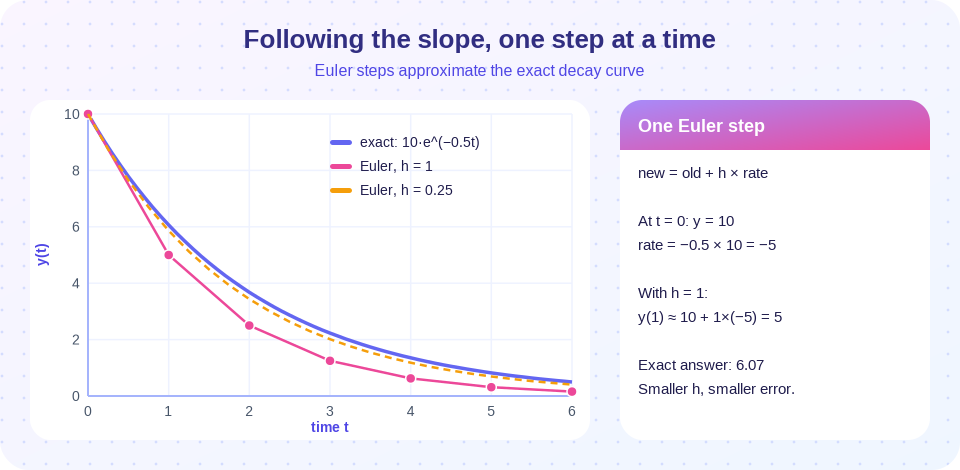
Worked example. dy/dt = −0.5·y, y(0) = 10, step h = 1. The slope at the start is −0.5 × 10 = −5, so y(1) ≈ 10 − 5 = 5. The next slope is −2.5, so y(2) ≈ 2.5. The exact answer at t = 1 is 10·e^(−0.5) = 6.07. Euler undershoots, because the true curve flattens during the step while Euler uses the steep starting slope all the way.
Halve the step to h = 0.5: y(0.5) = 10 − 0.5×5 = 7.5, y(1) = 7.5 − 0.5×3.75 = 5.625. Closer to 6.07. Euler's method is first order: halving h roughly halves the final error. You will see this in the second demo below.
Press Run (or Ctrl + Enter) to see the result here.
Program input · what you'd type while the program runs
Type the answers before you press Run, one per line. Each time the program reads a line (with input()), it gets the next line from this box.
Common misconceptions
"A smaller step is always better." Only until round-off error and computing time start to matter. For a smooth ODE, h = 0.001 is already far more precise than the data you could measure.
"Cooling is proportional to temperature." It is proportional to the temperature difference from the surroundings. A cup at room temperature does not cool at all.
"The Euler answer is exact if the ODE is linear." No. Euler has a built-in error even for the simplest ODE, as the table below shows.
How the error behaves
Run the next demo. It solves the decay problem at time t = 6 with several step sizes and prints the error. If the method is first order, each halving of h should roughly halve the error. Then it models the cooling coffee with SciPy's solver and uses the formula to answer "when does it reach 60 °C?" in two ways.
Press Run (or Ctrl + Enter) to see the result here.
Program input · what you'd type while the program runs
Type the answers before you press Run, one per line. Each time the program reads a line (with input()), it gets the next line from this box.
Explore the step size yourself
Drag the slider. Large steps give a jagged, inaccurate polyline. Small steps make it hug the curve.
Check your understanding
Quick check · 5 questions
of 5 answered You scored / 5 · perfect!
-
1. A drug has a half-life of 5 hours. How much of a 200 mg dose remains after 10 hours?
Ten hours is two half-lives, so the amount is halved twice: 200 to 100 to 50 mg. -
2. Which ODE describes Newton's law of cooling for a body at temperature T in surroundings at T_room?
The rate of cooling is proportional to the temperature difference between the object and its surroundings. -
3. One Euler step for dy/dt = -0.5 y from y = 10 with h = 1 gives:
y_new = 10 + 1 * (-0.5 * 10) = 5. The exact value 6.07 is higher, so the Euler step undershoots. -
4. Euler's method is first order. What happens to the error when you halve the step size?
First-order means the error is proportional to h, so halving h roughly halves the error. -
5. A colony grows with k = 0.3 per hour. Its doubling time is about:
Doubling time is ln(2)/k = 0.693/0.3 = 2.31 hours.
Summary
dy/dt = k·yhas the solutiony = y₀·e^(k·t): growth fork > 0, decay fork < 0.- Half-life is
ln(2)/|k|; Newton's cooling is the same model applied to the gapT − T_room. - Euler's method:
y_new = y_old + h·f(t_old, y_old). It only needs the slope rule. - Euler is first order, so halving
hroughly halves the error.
Theo dõi tiến độ của bạn
Tạo tài khoản miễn phí để đánh dấu bài đã học và tiếp tục từ chỗ bạn dừng lại trên mọi thiết bị.