
























Bài 12 · Calculus of Variations
Functionals and the Euler-Lagrange Equation
Derive the Euler-Lagrange equation from the idea of a stationary functional, learn the special cases and Beltrami identity, and check solutions with symbolic and numerical Python.
This lesson derives the most important equation of the course. We take a functional S[y] = ∫ L(y, y′, x) dx, perturb the path slightly, demand that the first-order change vanish, and obtain a differential equation that the extremal path must obey. Later, with x replaced by time and y by a generalized coordinate, the same equation becomes the equation of motion of a mechanical system.
What you will learn
- How to derive the Euler-Lagrange equation with a variation
εη(x). - The meaning of the "fundamental lemma" that justifies the last step.
- Special cases:
Lindependent ofyor ofx(the Beltrami identity). - How to verify an extremal symbolically and numerically.
Key terms
The Euler-Lagrange equation is ∂L/∂y − d/dx(∂L/∂y′) = 0. A first integral is a quantity, derived from it, that is constant along the extremal. The fundamental lemma: if ∫ f(x) η(x) dx = 0 for every smooth η vanishing at the ends, then f ≡ 0.
The derivation
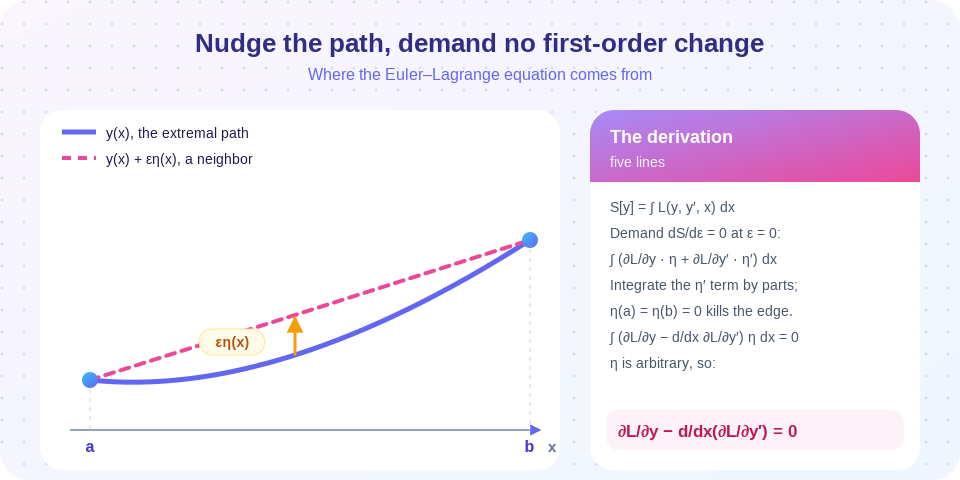
Let y(x) be an extremal with y(a) and y(b) fixed. Consider the neighbor ỹ(x) = y(x) + ε η(x) with η(a) = η(b) = 0. Then
S(ε) = ∫ₐᵇ L(y + εη, y′ + εη′, x) dx
dS/dε at ε = 0 = ∫ₐᵇ ( ∂L/∂y · η + ∂L/∂y′ · η′ ) dx
The second term contains η′. Integrate it by parts:
∫ₐᵇ ∂L/∂y′ · η′ dx = [ ∂L/∂y′ · η ]ₐᵇ − ∫ₐᵇ d/dx(∂L/∂y′) · η dx
The boundary term vanishes because η(a) = η(b) = 0. Therefore
dS/dε at ε = 0 = ∫ₐᵇ ( ∂L/∂y − d/dx ∂L/∂y′ ) η dx = 0
This must hold for every admissible η. By the fundamental lemma the bracket must vanish at every x:
∂L/∂y − d/dx (∂L/∂y′) = 0
That is the Euler-Lagrange equation. Note the order: take partial derivatives first, treating y and y′ as independent, then differentiate ∂L/∂y′ totally with respect to x. For several unknown functions yᵢ(x) there is one equation per function.
Two useful special cases
L does not depend on y. Then ∂L/∂y = 0, so d/dx(∂L/∂y′) = 0 and
∂L/∂y′ = constant
A first integral appears for free; in mechanics it will be momentum conservation.
L does not depend explicitly on x. Multiply the equation by y′ and combine terms. This gives the Beltrami identity:
L − y′ ∂L/∂y′ = constant
In mechanics, with x → t, this will be conservation of energy.
Worked example: shortest path. For L = √(1 + y′²), L has no y, so ∂L/∂y′ = y′/√(1 + y′²) is constant. That implies y′ is constant: the extremal is a straight line. The EL equation gives y″ = 0, as expected.
Worked example: a spring-like functional. For L = y′² + y² we get ∂L/∂y = 2y and d/dx(2y′) = 2y″, so 2y − 2y″ = 0, that is y″ = y. With y(0) = 0, y(1) = 1 the solution is y = sinh x / sinh 1.
A worked example with numbers
Find the curve through (0, 0) and (1, 1) that minimizes J[y] = ∫₀¹ (y′)² dx. Here L = y′², so ∂L/∂y = 0 and ∂L/∂y′ = 2y′. The Euler-Lagrange equation says d/dx(2y′) = 0, hence y″ = 0, and the straight line y = x with J = 1.
Now test it by brute force. Perturb the line by η(x) = ε sin(πx), which vanishes at both ends. Then y′ = 1 + επ cos(πx) and
J(ε) = ∫₀¹ (1 + επ cos πx)² dx = 1 + 0 + ε²π² · ½ = 1 + ε²π²/2
because the cross term integrates to 0 over the interval. At ε = 0.1 this is 1 + 0.0493 = 1.0493, larger than 1, and the change is of second order in ε. The first-order term is exactly what must vanish at an extremal; the surviving second-order term is positive, so this extremal is actually a minimum.
The logic step by step
- Write the varied curve
y + εηand expandJto first order inε. - Integrate the
η′term by parts. The boundary term vanishes becauseη = 0at both ends. - What remains is
∫ [∂L/∂y − d/dx(∂L/∂y′)] η dx = 0for every admissibleη. - The fundamental lemma then forces the bracket to be zero everywhere.
Step 4 is not obvious. If the bracket were positive at some point, you could choose a narrow bump η there and make the integral positive, a contradiction. This argument is usually credited to Lagrange, who sent it to Euler in 1755 and introduced the δ notation; Euler's own 1744 derivation used geometric differences and is much messier. Euler later adopted the name "calculus of variations" for the subject.
Choosing the right first integral
If L has no explicit x, the Beltrami identity L − y′ ∂L/∂y′ = const holds. For L = y′² it gives y′² − 2y′² = −y′² = const, so y′ is constant: the same straight line, found in one line. If L has no explicit y, then ∂L/∂y′ = const. Always check which symmetry applies before differentiating.
Common misconceptions
"Stationary means minimum." The EL equation only finds stationary paths. Some are maxima or saddle points, and you need a second-variation test (or physical reasoning) to know which.
"d/dx and ∂/∂x can be swapped." In d/dx(∂L/∂y′) you must include the dependence of y and y′ on x; the partial derivative ∂/∂x would only see explicit x.
"The endpoint condition does not matter." It is essential: it kills the boundary term. Free endpoints give extra natural boundary conditions.
Try it
Let SymPy derive the Euler-Lagrange equations for the two Lagrangians above and solve the second.
Press Run (or Ctrl + Enter) to see the result here.
Program input · what you'd type while the program runs
Type the answers before you press Run, one per line. Each time the program reads a line (with input()), it gets the next line from this box.
Now check numerically that the analytic extremal really minimizes the functional. We discretize y on a grid, hold the endpoints fixed, and let an optimizer minimize S = ∫(y′² + y²) dx. It should land on sinh x / sinh 1.
Press Run (or Ctrl + Enter) to see the result here.
Program input · what you'd type while the program runs
Type the answers before you press Run, one per line. Each time the program reads a line (with input()), it gets the next line from this box.
Check your understanding
Quick check · 6 questions
of 6 answered You scored / 6 · perfect!
-
1. What is the Euler-Lagrange equation for L(y, y′, x)?
The integration by parts produces the minus sign. -
2. Why does the boundary term [∂L/∂y′ · η] vanish?
The varied paths share the endpoints, so η(a) = η(b) = 0. -
3. If L does not contain y, which quantity is constant along the extremal?
The EL equation reduces to d/dx(∂L/∂y′) = 0. -
4. For L = √(1 + y′²), the extremal is:
∂L/∂y′ constant forces y′ constant. -
5. For L = y′² + y², what differential equation do we get?
∂L/∂y = 2y and d/dx(2y′) = 2y″, so 2y − 2y″ = 0. -
6. What does the Beltrami identity say, when L has no explicit x?
It is a first integral of the Euler-Lagrange equation in that case.
Summary
- Vary the path
y → y + εηwith fixed ends, demanddS/dε = 0, integrate by parts and apply the fundamental lemma. - The result is
∂L/∂y − d/dx(∂L/∂y′) = 0, one equation for each unknown function. - No
yinLgives a conserved∂L/∂y′; no explicitxgives the Beltrami identityL − y′ ∂L/∂y′ = const. - Symbolic and numerical checks agree with hand derivations.
Theo dõi tiến độ của bạn
Tạo tài khoản miễn phí để đánh dấu bài đã học và tiếp tục từ chỗ bạn dừng lại trên mọi thiết bị.