
























บทเรียนที่ 20 · First Cases
How Russian Cases Work
Learn what Russian cases are, meet all six with their key questions, and see why word endings, not word order, show who does what in a sentence.
In English, word order tells you who does what. "The dog sees the cat" and "The cat sees the dog" mean different things. Russian mostly uses a different tool: it changes the end of the word. These forms are called cases.
Cases look scary at first because there are six of them. You do not need all of them today. In this chapter you will learn the idea, and then three very useful cases, one at a time.
What you will learn
- What a case is and why Russian uses cases
- The names of the six cases and the questions they answer
- How to tell the dictionary form from other forms
- A calm plan for learning cases
An ending shows the job
Compare these two sentences. The stress mark (´) shows the stressed syllable. It is a learning aid, and normal Russian text does not use it.
| Russian | Meaning |
|---|---|
| Ма́ма ви́дит А́нну. | Mom sees Anna. |
| Ма́му ви́дит А́нна. | Anna sees Mom. |
The name А́нна ends in -а when Anna does the action. It ends in -у when someone does something to her. The word ма́ма behaves the same way. In the second sentence, "mom" comes first, but she is not the one who sees. The ending -у tells you that.
This is why Russian word order is flexible. The order often changes the focus or the emphasis. The endings keep the basic meaning clear.
A neutral sentence usually has the same order as English: who, then the action, then the object. Start with that order. Learn to understand other orders as you read.
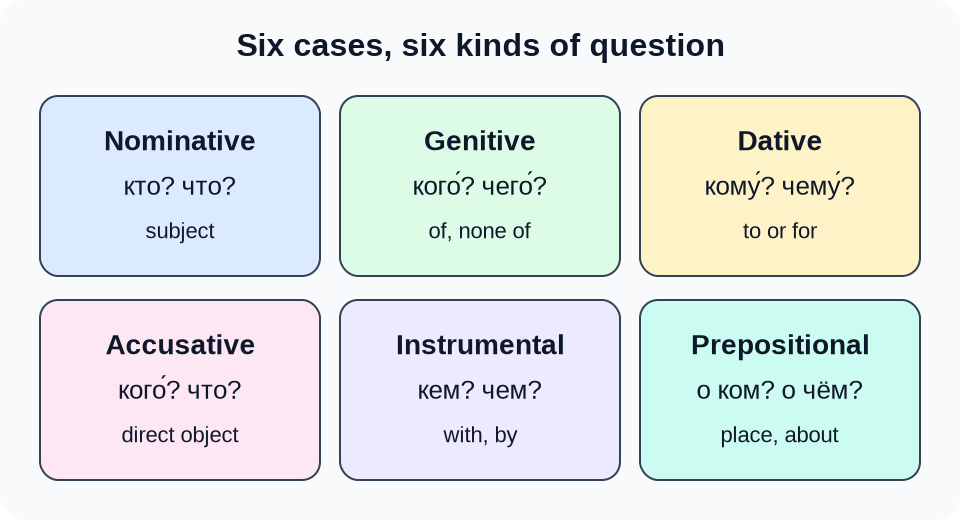
The six cases
| Case | Russian name | Key question | Common job |
|---|---|---|---|
| Nominative | имени́тельный | кто? что? (who? what?) | the subject, the dictionary form |
| Genitive | роди́тельный | кого́? чего́? | "of", absence, possession |
| Dative | да́тельный | кому́? чему́? | "to" or "for" someone |
| Accusative | вини́тельный | кого́? что? | direct object, direction |
| Instrumental | твори́тельный | кем? чем? | "with", "by means of" |
| Prepositional | предло́жный | о ком? о чём? | location, "about" |
Кто asks about people and animals. Что asks about things. Russian learners often use these questions to name a case. For example, if a word answers кому́?, it is dative.
The nominative: your starting point
The nominative is the form you find in a dictionary. You use it for the subject, the person or thing that does the action or that you describe.
- Студе́нт чита́ет. (The student is reading.)
- Кни́га лежи́т здесь. (The book is lying here.)
- Окно́ большо́е. (The window is big.)
- Э́то Москва́. (This is Moscow.)
You also use it after э́то (this is) and when you name things.
What triggers a case?
Usually something in the sentence asks for a case. There are three common triggers.
- The job of the word. A direct object takes the accusative: Я чита́ю кни́гу.
- A preposition. The word без (without) asks for the genitive: чай без са́хара.
- A set phrase or verb. Some verbs need a certain case. For example, помога́ть (to help) takes the dative: помога́ть ма́ме.
Some prepositions can take two different cases, with a change in meaning. You will meet this with в and на.
| Phrase | Case | Meaning |
|---|---|---|
| Я в шко́ле. | prepositional | I am at school. (location) |
| Я иду́ в шко́лу. | accusative | I am going to school. (direction) |
Other words change too
Nouns are not the only words with cases. Pronouns and adjectives change as well. English does this a little: "I" becomes "me". Russian я (I) becomes меня́ (me) or мне (to me).
- Я зна́ю Ива́на. (I know Ivan.)
- Ива́н зна́ет меня́. (Ivan knows me.)
- Да́йте мне, пожа́луйста, меню́. (Please give me the menu.)
A calm plan
- Learn one case and one job at a time.
- Memorize short phrases, such as в Москве́ and без молока́. A phrase gives you the ending for free.
- Check gender first. The ending often depends on it. A masculine noun, a feminine noun and a neuter noun can change in different ways.
- Accept mistakes. People will usually still understand you.
This chapter teaches the accusative, the prepositional and the genitive. The dative and instrumental appear here only so that you can recognize their names.
Worked example: take a sentence apart
Here is a method you can use on any short sentence. Take this one: Студе́нт чита́ет кни́гу в па́рке. (The student is reading a book in the park.)
- Find the verb. It is чита́ет (is reading). Verbs do not take cases.
- Ask who does it. The student does. Студе́нт is in the dictionary form, so it is nominative.
- Ask what receives the action. The book does. The dictionary form is кни́га, but you see кни́гу. This is accusative.
- Look for prepositions. You see в before па́рке. The dictionary form is парк. The phrase tells you where, so it is prepositional.
Now change one part at a time. Notice that only the part with the new job needs a new form.
| Sentence | What changed |
|---|---|
| Студе́нт чита́ет газе́ту в па́рке. | The object is now a newspaper. |
| Студе́нтка чита́ет газе́ту в па́рке. | The reader is now a female student. |
| Студе́нтка чита́ет газе́ту в кафе́. | The place is now a café, which never changes. |
How to study a new noun
When you add a noun to your vocabulary list, write three things: the dictionary form with its stress, its gender, and one short phrase that uses another form. For example, write шко́ла, feminine, в шко́ле. For вода́, write feminine and стака́н воды́. After a few weeks, you will have a collection of phrases that already contain the endings.
When you read, do not stop at every unknown ending. First find the verb and the people. Then ask which case question each remaining noun answers. A rough answer is enough for understanding. Exact endings become more important when you speak and write, and they improve with repeated practice.
Common mistakes
- Using the dictionary form everywhere. Say Я ви́жу ма́му, not "Я ви́жу ма́ма".
- Guessing the subject from word order alone. Check the endings.
- Trying to memorize every table at once. Phrases first, tables second.
- Thinking a preposition always takes the same case. В and на have two patterns.
Try it
Check your understanding
Quick check · 4 questions
of 4 answered You scored / 4 · perfect!
-
1. What does a Russian case mainly change?
A case is a form of a noun, pronoun or adjective that shows its job. -
2. Which form do you find in a dictionary?
Dictionaries list nouns in the nominative singular when a singular exists. -
3. In "Ма́му ви́дит А́нна", who sees?
Анна has the nominative ending -а, so she is the subject. Маму is the object. -
4. How many cases does this course list for Russian?
Nominative, genitive, dative, accusative, instrumental and prepositional.
Summary
- Cases show the job of a word, mostly through its ending.
- The six cases are nominative, genitive, dative, accusative, instrumental and prepositional.
- The nominative is the dictionary form and the usual form of the subject.
- Jobs, prepositions and some verbs trigger cases.
- Learn useful phrases first, then the patterns behind them.
ติดตามความคืบหน้าของคุณ
สร้างบัญชีฟรีเพื่อติ๊กบทเรียนที่เรียนแล้วและเรียนต่อจากจุดเดิมได้บนทุกอุปกรณ์