
























บทเรียนที่ 11 · Greetings and Introductions
Saying hello and goodbye
Learn how to say hello and goodbye in Russian, from здравствуйте and привет to до свидания and пока, with sound guides and tips on when to use each one.
A good greeting is often the first Russian you will use with a real person. Russian has a polite greeting and a casual one, plus greetings for different times of day. In this lesson you learn which one fits which moment.
What you will learn
- how to greet people politely and casually
- greetings for morning, day and evening
- several ways to say goodbye
- which phrases not to mix up
Hello
| Russian | Sound guide | Use |
|---|---|---|
| Здра́вствуйте | ZDRAST-vooy-tye | polite, or to more than one person |
| Здра́вствуй | ZDRAST-vooy | to one person you call ты |
| Приве́т | pri-VYET | casual "hi" |
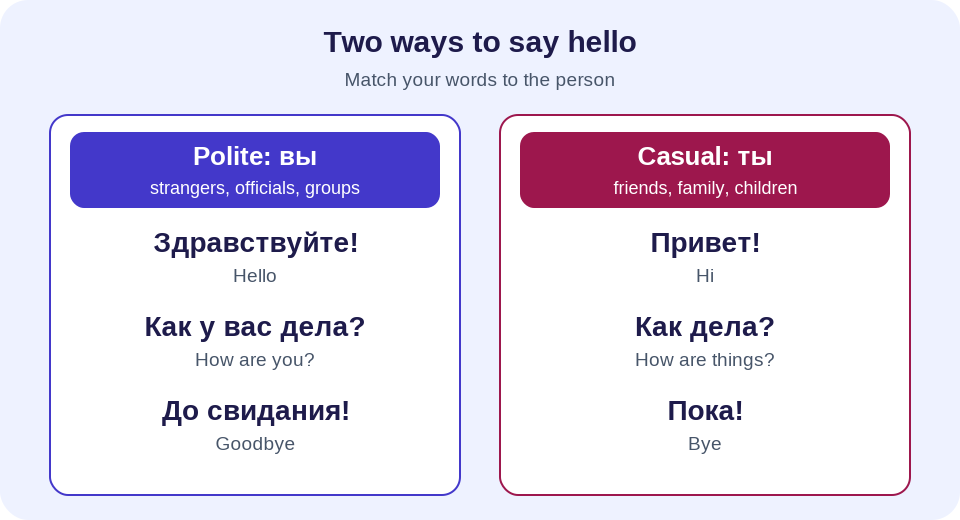
Здравствуйте is the safe choice with strangers, older people, teachers, shop staff and officials. It is long, so practice it in parts: ZDRAST, then vooy, then tye. Remember that the first в is silent.
Привет is for friends, family, children and classmates your own age.
Greetings by time of day
| Russian | Sound guide | Meaning |
|---|---|---|
| До́брое у́тро | DOB-ra-ye OO-tra | good morning |
| До́брый день | DOB-ryy dyen | good day, good afternoon |
| До́брый ве́чер | DOB-ryy VYE-chir | good evening |
These are polite and also friendly. До́брый день is very common in shops, offices and messages.
Look at добрый ("kind, good"). Its ending changes: доброе утро but добрый день. That happens because утро and день have different grammatical genders. You will learn this in chapter 4.
Goodbye
| Russian | Sound guide | Meaning |
|---|---|---|
| До свида́ния | da svi-DA-ni-ya | goodbye (polite, neutral) |
| Пока́ | pa-KA | bye (casual) |
| До за́втра | da ZAF-tra | see you tomorrow |
| До встре́чи | da FSTRYE-chi | see you |
| Уви́димся | oo-VEE-dim-sa | we'll see each other, see you |
| Всего́ до́брого | fsi-VO DOB-ra-va | all the best |
| Споко́йной но́чи | spa-KOY-nay NO-chi | good night |
До свидания literally refers to meeting again. Спокойной ночи is said when someone is going to bed, or when you part late in the evening before sleep. Do not use it as a greeting.
Notice the sound rules from chapter 2 at work. In завтра, the в sounds like f before т. In всего доброго, both г letters in the endings sound like v.
Short dialogues
At a hotel desk:
А: Здравствуйте! ZDRAST-vooy-tye "Hello!"
Б: Добрый вечер! DOB-ryy VYE-chir "Good evening!"
Between friends:
А: Привет, Саша! "Hi, Sasha!"
Б: Привет! "Hi!"
А: Ну, пока. До завтра! "Well, bye. See you tomorrow!"
Б: Пока! "Bye!"
The small word ну works like "well" in speech.
Manners around greetings
Customs vary between families, workplaces and regions. In general, a polite greeting is welcome when you enter a small shop or an office, or meet your neighbor. Many people in Russia greet each other once a day, and a second formal hello to the same person later that day may sound unusual. If you are not sure, watch what others do.
Practice routine
Think of five people you could meet tomorrow: a friend, a teacher, a bus driver, a child and a new colleague. For each person, choose a hello and a goodbye. Say them aloud.
Worked example: one short visit
Follow a learner, Lina, through a visit to a small shop. At each step she picks a phrase from the lesson.
- She walks in during the afternoon. She does not know the seller, so she chooses a polite greeting: Здра́вствуйте! or До́брый день! Both work.
- The seller answers. The answer may be the same greeting or another polite one. She does not need to repeat hers.
- She leaves. She says До свида́ния! If the visit felt friendly, Всего́ до́брого! is a warm choice.
Now change one detail: the seller is her close friend. Lina would say Приве́т! when she arrives and Пока́! when she leaves.
Saying it smoothly
Long greetings get easier when you build them from the end. For До свида́ния, say ni-ya, then DA-ni-ya, then svi-DA-ni-ya, and finally da svi-DA-ni-ya. The short word до has no stress of its own, so it joins the next word.
In До́брое у́тро, there are two stressed syllables, one in each word. Keep both clear and let everything else be light.
Greetings in writing
Messages and emails use many of the same phrases. Здравствуйте or Добрый день is a common way to open a polite message. Add the person's name when you know it, for example Здравствуйте, Анна Петровна! Friends often just write Привет! In both cases a comma goes before the name.
Review the time of day
There is no exact minute at which morning ends or evening begins. Use your common sense, as you would in your own language. If you are unsure, Здравствуйте works at any hour.
Common mistakes
Saying привет to a stranger or an official. It can sound too familiar. Use здравствуйте.
Using спокойной ночи to say hello in the evening. Use добрый вечер.
Mixing up the endings. Say доброе утро, but добрый день and добрый вечер.
Try it
Which phrase fits the situation?
Build the phrases.
Check your understanding
Quick check · 5 questions
of 5 answered You scored / 5 · perfect!
-
1. Which greeting is the safest for a stranger?
Здравствуйте is polite and suits strangers. -
2. What does пока mean in this lesson?
Пока is a casual goodbye. -
3. When do you say спокойной ночи?
It means good night. -
4. Which is correct?
Утро is a neuter noun, so the adjective is доброе. -
5. Which letter is silent in здравствуйте?
The first в is not pronounced.
Summary
- Use здравствуйте for polite hellos and привет for casual ones.
- Доброе утро, добрый день and добрый вечер follow the time of day.
- До свидания is neutral and пока is casual.
- Спокойной ночи is for bedtime.
- When in doubt, choose the polite form.
ติดตามความคืบหน้าของคุณ
สร้างบัญชีฟรีเพื่อติ๊กบทเรียนที่เรียนแล้วและเรียนต่อจากจุดเดิมได้บนทุกอุปกรณ์