
























บทเรียนที่ 15 · Transformers
Three-Phase Transformers and Autotransformers
Learn star and delta transformer connections, line and phase relations, 30-degree phase shift, vector groups like Dyn11, and the autotransformer with its copper and iron savings.
Power systems are three-phase, so most of the transformers you will meet are three-phase too. They have the same physics as a single-phase unit, three times over, plus a new question: how are the three windings on each side connected? The choice of star or delta changes the voltage and current ratios, introduces phase shifts, and affects how harmonics and faults behave.
The second half of this lesson covers the autotransformer, a clever one-winding variant that saves material when the voltage ratio is close to 1.
What you will learn
- The relations between line and phase quantities for star and delta.
- How to find the voltage ratio of Yy, Dd, Yd and Dy transformers.
- What the 30° phase shift and a vector group code such as Dyn11 mean.
- How an autotransformer works and how much it saves.
Key terms
Line quantities: voltage between two lines (VL) and current in a line (IL).
Phase quantities: voltage across (Vph) and current through (Iph) one winding.
Star (Y) and delta (Δ): the two ways to join three windings.
Vector group: a code such as Dyn11 giving the connections and the phase displacement.
Autotransformer: a transformer in which part of one winding is common to the primary and secondary.
Three-phase transformer construction
A three-phase transformer can be built as a bank of three single-phase transformers, or as one unit on a single three-limb core whose three legs carry the three phases (the three fluxes add to zero, so no return limb is needed). A single core uses less iron, costs less and is smaller. A bank is easier to transport and a spare single-phase unit is cheaper to keep.
Line and phase quantities
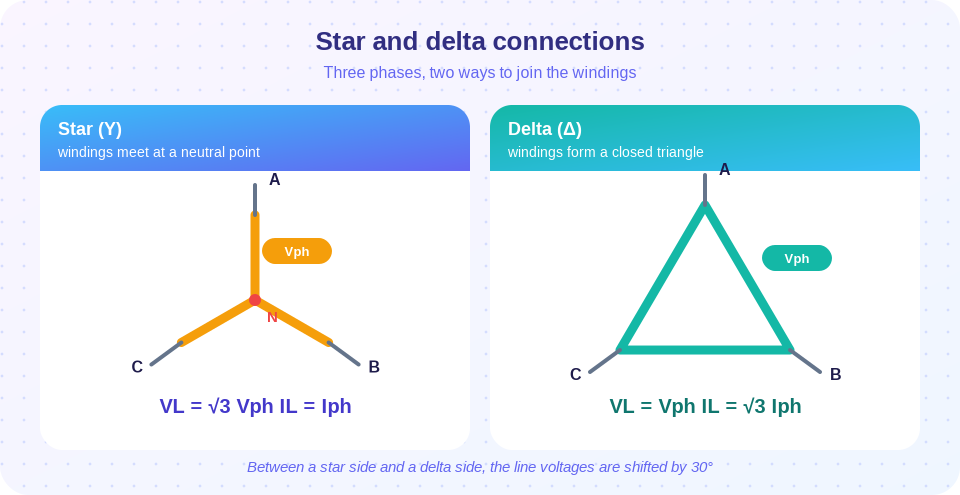
For a star connection: VL = √3 Vph and IL = Iph.
For a delta connection: VL = Vph and IL = √3 Iph.
In both cases, the total apparent power is S = √3 VL IL.
Voltage ratios
Let N1/N2 be the turns ratio of one phase (the winding ratio). The ratio of line voltages depends on the connections:
| Connection (primary-secondary) | Line voltage ratio |
|---|---|
| Y-y, D-d | N1 / N2 |
| Y-d | √3 N1 / N2 |
| D-y | N1 / (√3 N2) |
Worked example. A 1000 kVA, 11 kV / 400 V, Dyn11 transformer (the letters are explained below):
- HV line current:
1000×10³ / (√3 × 11 000) = 52.5 A; in a delta, the phase current is52.5/√3 = 30.3 A. - LV line current:
1000×10³ / (√3 × 400) = 1443 A. - LV phase voltage (star):
400 / √3 = 231 V. - HV phase voltage (delta):
11 000 V. - Phase turns ratio:
11 000 / 231 = 47.6.
Why use delta?
A delta winding provides a path for third-harmonic currents (the magnetizing current contains a strong third harmonic, lesson 3). In a delta they circulate within the loop, so the flux stays sinusoidal and the output voltage is clean. A Y-y transformer without a delta tertiary winding does not give this path unless the neutral is grounded, and can suffer distorted voltages. A delta also carries the unbalanced load of one phase better. The star side, with a neutral, supplies both single-phase and three-phase loads: line-to-neutral 231 V and line-to-line 400 V.
Phase shift and vector groups
Between a delta winding and a star winding, the line voltages are shifted by 30°. Y-y and D-d connections have no shift. A vector group code gives:
- A capital letter for the HV connection (
D,Y) and a lowercase letter for the LV (d,y), withnif the LV neutral is brought out. - A number, the "clock hour" of the LV phasor when the HV phasor points at 12. Each hour is 30°, and the LV lags the HV by that angle.
Dyn11 means: HV delta, LV star with neutral, LV leading HV by 30° (11 o'clock). It is the standard distribution transformer in many countries. Yd1 has the LV lagging by 30°.
Parallel operation of two transformers needs the same voltage ratio, the same polarity and vector group (same phase displacement), the same phase sequence and similar per-unit impedance (otherwise one takes more than its share).
The autotransformer
An autotransformer has a single winding with a tap. The source connects across the whole winding and the load across part of it. Take a step-down unit with voltages V1 (input) and V2 (output):
- The upper part (series part) carries the input current
I1. - The lower part (common part) carries
I2 − I1.
Only part of the power is transferred by transformer action; the rest passes directly by conduction. The transformed power is:
S_transformed = (V1 − V2) × I1 = S_load × (1 − V2/V1)
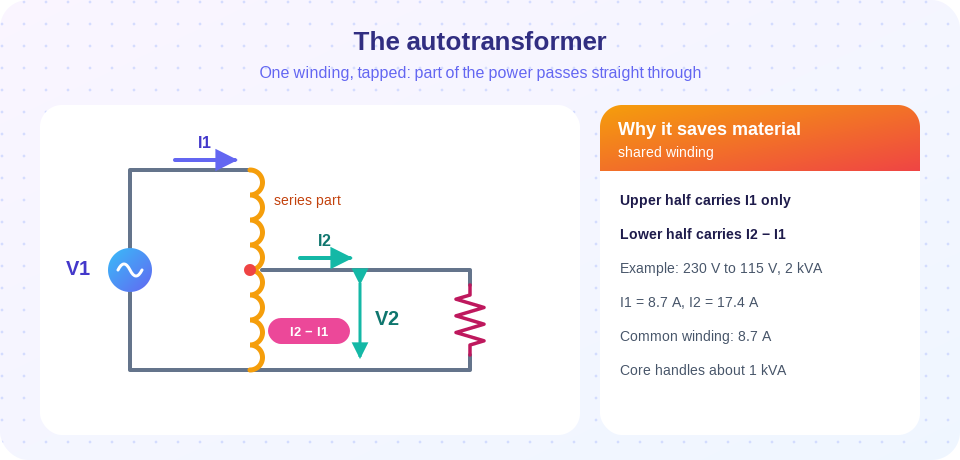
Worked example. 230 V to 115 V, a 2 kVA load:
I2 = 2000 / 115 = 17.4 A,I1 = 2000 / 230 = 8.7 A.- Common winding current:
17.4 − 8.7 = 8.7 A. - Transformed power:
(230 − 115) × 8.7 = 1000 VA. A two-winding transformer for the same job would need a2 kVAcore.
The saving 1 − V2/V1 is large when the voltages are close (for example 400 kV to 220 kV grid interconnections save about 45 %) and vanishes at large ratios. The drawbacks: no electrical isolation (a fault on the high side can put dangerous voltage on the low side) and low impedance, which increases fault current. Typical uses: grid interconnection, motor starters, and the adjustable variac.
Common misconceptions
"Delta and star line voltages are in phase." A D-y or Y-d transformer shifts them by 30°; parallel units must have the same shift.
"An autotransformer is always cheaper." It saves material at ratios near 1, but it gives no isolation, so for safety some applications require two windings.
"Delta winding current equals line current." In delta IL = √3 Iph.
Try it
Press Run (or Ctrl + Enter) to see the result here.
Program input · what you'd type while the program runs
Type the answers before you press Run, one per line. Each time the program reads a line (with input()), it gets the next line from this box.
Press Run (or Ctrl + Enter) to see the result here.
Program input · what you'd type while the program runs
Type the answers before you press Run, one per line. Each time the program reads a line (with input()), it gets the next line from this box.
Check your understanding
Quick check · 5 questions
of 5 answered You scored / 5 · perfect!
-
1. In a delta connection, the line current is:
In delta VL = Vph and IL = √3 Iph. -
2. A 400 V (line) star-connected winding has a phase voltage of about:
Vph = VL/√3 = 400/1.732 = 231 V. -
3. A 750 kVA three-phase transformer has a 6.6 kV line voltage on the HV side. What is the HV line current?
IL = S/(√3 VL) = 750 000 / (1.732 × 6600) = 65.6 A. -
4. Why does a delta winding help with the third-harmonic magnetizing current?
Triplen harmonic currents are in phase in all three windings and can circulate in the delta loop. -
5. An autotransformer converts 400 V to 300 V. What fraction of the load power is transformed (not conducted)?
1 − V2/V1 = 1 − 300/400 = 0.25.
Summary
- Star:
VL = √3 Vph,IL = Iph. Delta:VL = Vph,IL = √3 Iph.S = √3 VL IL. - Y-d and D-y connections shift the line voltages by 30° and change the line ratio by
√3; Dyn11 is a common distribution group. - Delta windings give a path for third-harmonic magnetizing currents.
- An autotransformer transforms only the fraction
1 − V2/V1of the power, saving copper and iron, but gives no isolation.
ติดตามความคืบหน้าของคุณ
สร้างบัญชีฟรีเพื่อติ๊กบทเรียนที่เรียนแล้วและเรียนต่อจากจุดเดิมได้บนทุกอุปกรณ์