
























บทเรียนที่ 37 · Rigid Bodies and Small Oscillations
Chapter 8 Review: Rigid Bodies and Small Oscillations
Review of normal modes, the inertia tensor, principal axes and Euler's equations, with a one-page picture, a chain-of-masses check and ten questions.
Both halves of this chapter come down to the same step: take a symmetric matrix and find its eigenvalues and eigenvectors. For oscillations the matrix pair (K, M) gives frequencies and mode shapes. For rotation the inertia tensor I gives principal moments and principal axes. If you remember that, the formulas follow.
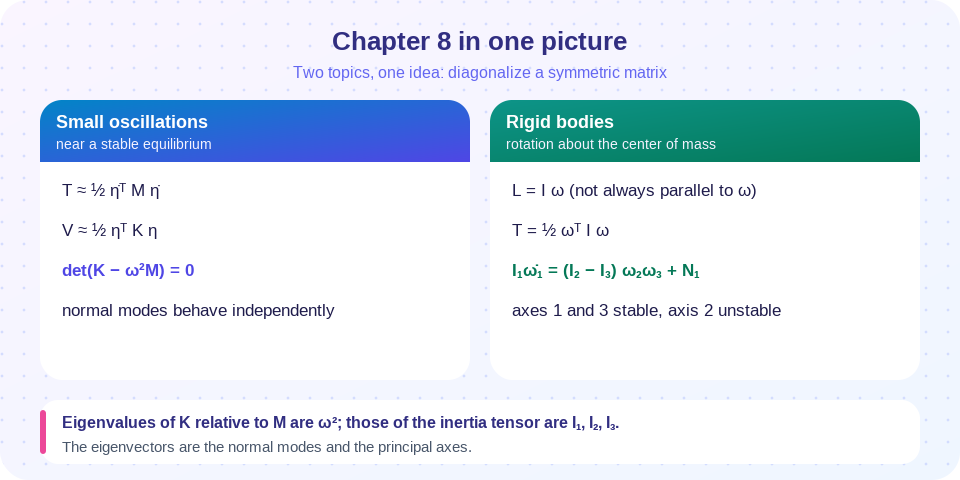
Recap table
| Topic | Key formulas | What to remember |
|---|---|---|
| Linearizing | T ≈ ½η̇ᵀMη̇, V ≈ ½ηᵀKη |
K = ∂²V/∂q∂q and M evaluated at the equilibrium |
| Normal modes | det(K − ω²M) = 0 |
n modes; independent oscillators |
| Stability | sign of ω² |
negative = unstable; zero = rigid motion |
| Inertia tensor | Iᵢⱼ = Σ m(r²δᵢⱼ − rᵢrⱼ) |
symmetric; eigenvectors = principal axes |
| Rotation | T = ½ωᵀIω, L = Iω |
L ∥ ω only on principal axes |
| Parallel axis | I = I_cm + M(d²𝟙 − ddᵀ) |
for one axis: I_cm + Md² |
| Euler | I₁ω̇₁ = (I₂ − I₃)ω₂ω₃ + N₁ |
stable about 1 and 3, unstable about 2 |
A chain of masses
A good test of the matrix method is a chain of N equal masses m joined by identical springs k, with the two ends fixed to walls. The exact normal frequencies are
ωₙ = 2 √(k/m) · sin( nπ / (2(N + 1)) ), n = 1 … N
and the mode shapes are sin(nπj/(N + 1)) for mass j. The TryIt builds K and M, asks eigh for the modes of a chain of five masses (m = 1 kg, k = 1 N/m), and compares with the formula, then plots the shapes. A long chain like this is a one-dimensional model of a solid and the low modes become sound waves.
Press Run (or Ctrl + Enter) to see the result here.
Program input · what you'd type while the program runs
Type the answers before you press Run, one per line. Each time the program reads a line (with input()), it gets the next line from this box.
Check your understanding
Quick check · 10 questions
of 10 answered You scored / 10 · perfect!
-
1. The condition for a normal mode is...
Insert η = a e^{iωt} into Mη̈ + Kη = 0. -
2. A system with 4 coordinates near a stable equilibrium has how many normal frequencies?
n coordinates give n eigenvalues ω². -
3. If K has a zero eigenvalue, the corresponding mode is...
That displacement costs no potential energy, such as translating the whole system. -
4. Which statement about the inertia tensor is true?
Iᵢⱼ = Σ m(r²δᵢⱼ − rᵢrⱼ) is symmetric and diagonal only in principal axes. -
5. A thin rod of mass M and length L has I = ML²/12 about its center. About a parallel axis through one end it is...
ML²/12 + M(L/2)² = ML²/3. -
6. When is L parallel to ω?
L = Iω, and ω must be an eigenvector of I. -
7. For I₁ < I₂ < I₃, which spin is unstable?
The middle axis is unstable. -
8. For a free symmetric top with I₁ = I₂ ≠ I₃, which component of ω is constant?
I₃ω̇₃ = (I₁ − I₂)ω₁ω₂ = 0. -
9. A solid sphere has I = (2/5)MR². How does a thin hollow spherical shell compare?
Mass at the full radius contributes more: I = (2/3)MR². -
10. In a normal mode of the chain of masses with fixed ends, the lowest mode has...
The lowest mode has shape sin(πj/(N + 1)): one hump, no nodes.
Summary
- Linearize near equilibrium to get
Mη̈ + Kη = 0; frequencies fromdet(K − ω²M) = 0. - The inertia tensor is symmetric; its eigen-decomposition gives principal moments and axes.
- Euler's equations show spin is stable about the extreme axes and unstable about the middle one.
ติดตามความคืบหน้าของคุณ
สร้างบัญชีฟรีเพื่อติ๊กบทเรียนที่เรียนแล้วและเรียนต่อจากจุดเดิมได้บนทุกอุปกรณ์