
























Lektion 23 · Structural Geology
Stress and strain
Learn what stress and strain mean in geology, the three stress types, and why rock bends, flows or breaks, with a worked fault-angle calculation.
Push on a rubber band and it stretches, then snaps back. Push on a lump of clay and it keeps the new shape. Hit a glass plate with a hammer and it shatters. Rock can act like all three, depending on how hard, how fast and how deep it is pushed. To talk about this precisely, geologists separate the cause, stress, from the effect, strain.
Once you can calculate stress on a plane inside the Earth, you can predict the angle at which a fault will form. That is one of the neatest results in structural geology, and it takes only a little trigonometry.
What you will learn
- The definition and units of stress and strain.
- The three stress types and the structures each one tends to make.
- Why rock can be elastic, ductile or brittle, and what controls the switch.
- How to resolve stress onto a plane and predict a fault angle.
Key terms
Stress is force divided by the area it acts on, measured in pascals (1 Pa = 1 N/m²). Rock stresses are usually quoted in megapascals (MPa).
Strain is the change in shape, volume or length of a body caused by stress. It has no units because it is a ratio.
Lithostatic pressure is the equal-in-all-directions pressure from the weight of overlying rock.
Differential stress is the difference between the largest and smallest principal stress, σ1 − σ3. It is what actually deforms rock.
Brittle-ductile transition is the depth where rock stops fracturing and starts flowing.
Stress: force spread over an area
Imagine a 1 m² patch of rock with a mass of 10 tonnes resting on it. The force is F = m g = 10,000 kg × 9.81 m/s² ≈ 98,100 N, so the stress is about 98 kPa. Stress depends on how the force is spread out, not just how big it is. A stiletto heel on a floor puts far more stress on the floor than an elephant's foot does.
Inside the Earth the weight of the overlying rock squeezes every point equally from all sides. That is lithostatic pressure, and it grows about 26 MPa per kilometer. Equal pressure in all directions squeezes rock but does not change its shape much. What bends and breaks rock is differential stress, where the push in one direction is larger than in another.
Geologists describe the stress at a point with three perpendicular directions called principal stresses: σ1 (largest), σ2 (intermediate) and σ3 (smallest). On a plane the principal stresses cannot create shear stress; every other plane experiences both a normal stress σn pressing straight into it and a shear stress τ trying to slide it.
The three kinds of stress
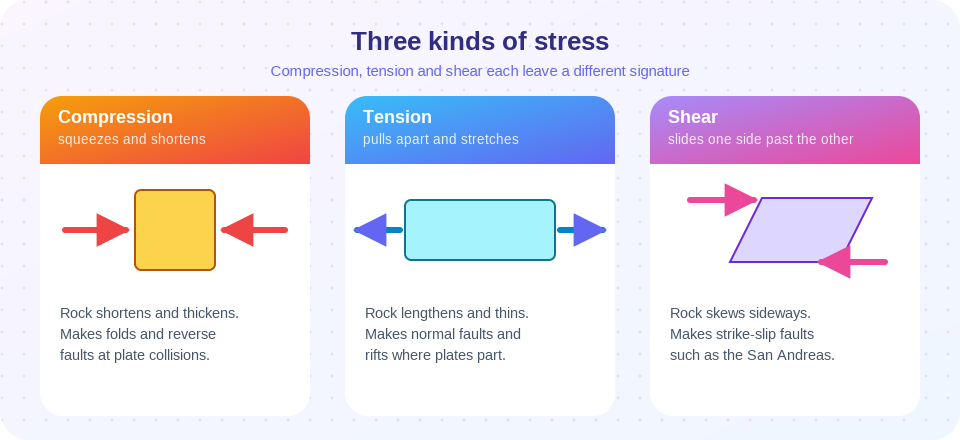
- Compression squeezes. It shortens rock along the push and thickens it at right angles. It builds folds, reverse faults and mountain belts where plates collide.
- Tension pulls apart. It lengthens and thins the rock and produces normal faults and rift valleys.
- Shear pushes two sides in opposite directions, like sliding the top of a deck of cards. It produces strike-slip faults and skewed shapes.
Strain: how rock responds
Strain compares a body before and after. If a 100 m long layer is shortened to 80 m, its strain is ε = ΔL / L0 = (80 − 100) / 100 = −0.20, or 20 percent shortening. Strain can be a change in length, a change in angle (shear strain) or a change in volume.
Rock responds in three ways.
- Elastic strain disappears when the stress is removed. Seismic waves travel by elastic strain. Within the elastic range, stress is proportional to strain:
σ = E ε. The constantEis Young's modulus, in the tens of gigapascals for most rocks. - Ductile (plastic) strain is permanent and smooth. Rock folds or flows without breaking, like warm wax. Folds are ductile or semi-ductile structures.
- Brittle strain is permanent and abrupt. The rock fractures. Faults and joints are brittle structures.
What decides between them?
| Factor | Pushes rock toward ductile | Pushes rock toward brittle |
|---|---|---|
| Temperature | Higher | Lower |
| Confining pressure | Higher (hard to open cracks) | Lower |
| Strain rate | Slow | Fast |
| Rock type | Salt, shale, marble | Quartzite, granite at shallow depth |
| Fluids | Dry rock | Water raises pore pressure and weakens it |
Because both temperature and pressure rise with depth, shallow crust breaks and deep crust flows. In quartz-rich continental crust the brittle-ductile transition lies at roughly 10 to 15 km, near 300 °C. That is why most earthquakes start in the upper crust and why folds in deep metamorphic rock look like toothpaste.
Stress on a plane and the angle of faults
Suppose σ1 and σ3 act in a flat cross-section. Take a plane whose normal makes an angle θ with the σ1 direction. The stresses on that plane are:
σn = (σ1 + σ3)/2 + (σ1 − σ3)/2 · cos 2θ
τ  =               (σ1 − σ3)/2 · sin 2θ
Check the extremes. When θ = 0°, the plane faces σ1 head-on, so σn = σ1 and τ = 0. When θ = 45°, shear stress is at its maximum, (σ1 − σ3)/2.
You might expect rock to fail along the plane of maximum shear stress, at 45° to σ1. It does not, because friction resists sliding more strongly on planes with more normal stress. The Coulomb criterion says a plane fails when
τ = c + μ σn
where c is cohesion (the rock's own strength) and μ = tan φ is the coefficient of internal friction, typically between 0.6 and 0.85 (Byerlee's law for many rocks). The first plane to meet this condition is the one with θ = 45° + φ/2. The fault therefore forms at 45° − φ/2 to σ1. With μ = 0.6, φ ≈ 31° and the angle between σ1 and the fault is about 30°.
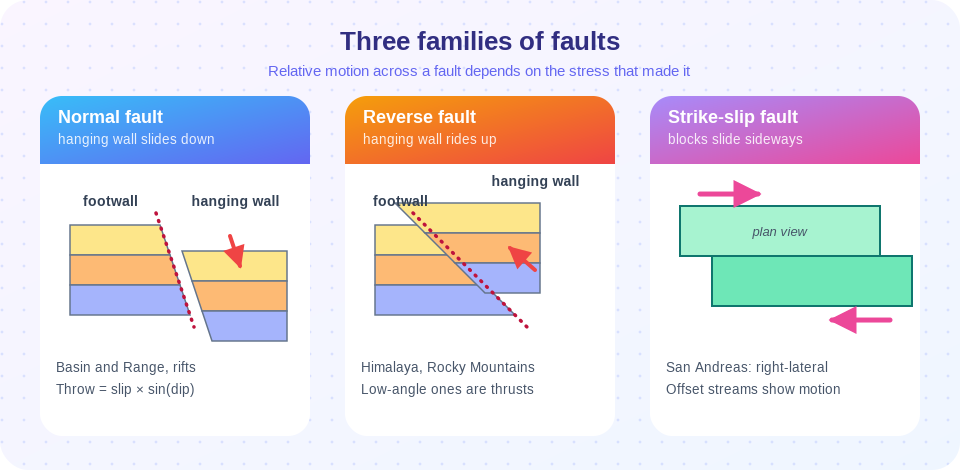
This is how Anderson (1905, 1942) explained why faults tend to have characteristic dips. If σ1 is vertical (gravity dominates, tension sideways), faults dip about 60°: normal faults. If σ3 is vertical (a horizontal squeeze), faults dip about 30°: reverse faults and thrusts. If σ2 is vertical, vertical faults slip sideways: strike-slip.
Common misconceptions
"Rock is too hard to deform without breaking." Given enough heat, pressure and time, solid rock flows. The mantle moves several centimeters a year without ever melting.
"Faults form on the plane of maximum shear stress." Friction resists sliding more on planes with more normal stress, so the first plane to fail is one closer to σ1 than 45°, typically about 30°.
"Pressure and stress are the same." Pressure is equal in all directions. Differential stress is what deforms rock.
Try it
Press Run (or Ctrl + Enter) to see the result here.
Program input · what you'd type while the program runs
Type the answers before you press Run, one per line. Each time the program reads a line (with input()), it gets the next line from this box.
Press Run (or Ctrl + Enter) to see the result here.
Program input · what you'd type while the program runs
Type the answers before you press Run, one per line. Each time the program reads a line (with input()), it gets the next line from this box.
Check your understanding
Quick check · 5 questions
of 5 answered You scored / 5 · perfect!
-
1. A 50 m wide layer is squeezed to 40 m. What is its strain?
Strain is the change in length over the original length: (40 − 50) / 50 = −0.20, which is 20 percent shortening. -
2. Which pairing of stress and structure is correct?
Shear stress slides blocks sideways, which produces strike-slip faults. Tension makes normal faults and rifts; compression makes folds and reverse faults. -
3. Which conditions make rock more likely to deform in a ductile way?
Heat and slow strain rates let crystals deform by creep instead of cracking. -
4. With a coefficient of friction of 0.6, a new fault plane forms at about what angle to σ1?
The fault plane forms at 45° − φ/2 from σ1. With φ ≈ 31° that is about 30°. -
5. What is lithostatic pressure?
Lithostatic pressure is isotropic. Differential stress is the directional part that causes deformation.
Summary
- Stress is force per area (Pa); strain is the dimensionless change in shape or size.
- Compression shortens, tension lengthens and shear skews.
- Rock is elastic first, then ductile or brittle depending on temperature, pressure, strain rate and rock type.
- On a plane at angle
θtoσ1,σn = (σ1+σ3)/2 + (σ1−σ3)/2 cos 2θandτ = (σ1−σ3)/2 sin 2θ. - Faults form about 30° from
σ1for typical friction, which explains why normal, reverse and strike-slip faults have their usual dips.
Next: Folds
Följ dina framsteg
Skapa ett gratis konto för att bocka av lektioner och fortsätta där du slutade, på vilken enhet som helst.