
























Урок 46 · Projects and Practice
Practice Set: Chapters 5 to 8
Fourteen worked practice problems on kinetics, quantum chemistry, spectroscopy and statistical thermodynamics, with answers, a Python solution checker and an interactive answer tester.
The best way to learn physical chemistry is to solve problems with pencil and paper first, then check with code. This set has fourteen problems across the last four chapters. Try each before you open the answers section, write down units with every number, and compare. A map of which equation fits which kind of problem is below.
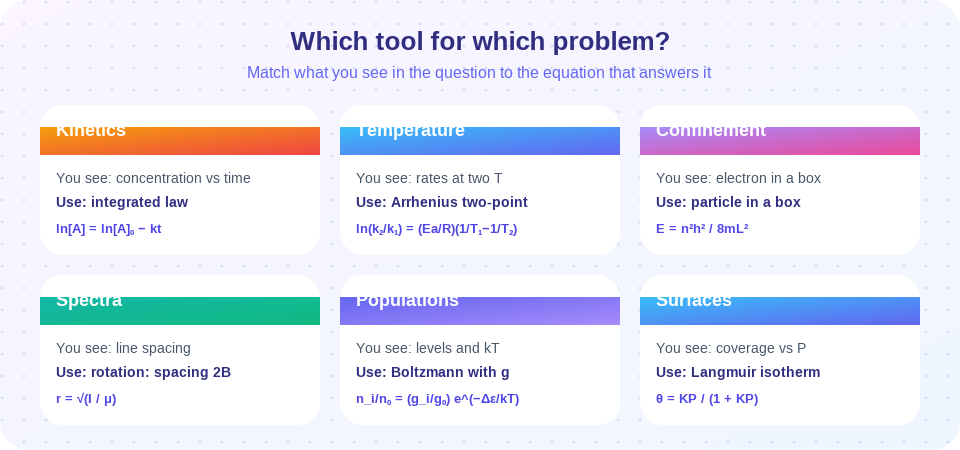
What you will learn
- Recognize which equation a problem calls for
- Practice unit handling and order-of-magnitude checks
- Verify hand calculations with a short script
How to work through the set
- Read the whole problem and underline the given data and the requested quantity.
- Write the governing equation in symbols before inserting numbers.
- Convert to SI units (or consistent spectroscopic units) first.
- Estimate the answer roughly before computing.
- Check units and sign of the result.
Constants you may need: R = 8.314 J K⁻¹ mol⁻¹, h = 6.626 × 10⁻³⁴ J s, k = 1.381 × 10⁻²³ J K⁻¹, hc = 1239.84 eV nm, kT/hc = 207.2 cm⁻¹ at 298 K.
Chemical kinetics
P1. For A + B → P the initial rate is 3.0 × 10⁻³ M s⁻¹ at [A] = 0.20 M, [B] = 0.10 M; 1.2 × 10⁻² M s⁻¹ at [A] = 0.40 M, [B] = 0.10 M; and 3.6 × 10⁻² M s⁻¹ at [A] = 0.40 M, [B] = 0.30 M. Find the orders and k.
P2. A first-order reaction has a half-life of 45 min. How long does it take to reach 90 % conversion?
P3. The rate constant is 2.0 × 10⁻⁴ s⁻¹ at 300 K and 6.4 × 10⁻³ s⁻¹ at 330 K. Find the activation energy.
P4. An enzyme has V_max = 50 µM s⁻¹ and K_M = 20 µM. What is the rate at [S] = 60 µM?
Quantum chemistry
P5. An electron is confined to a box 2.0 nm long. Find E₁ in eV and the wavelength of light for the n = 2 → 3 transition.
P6. For He⁺ (Z = 2), Eₙ = −13.6 Z²/n² eV. Find the ionization energy from n = 1 and the wavelength of the n = 2 → 1 line.
P7. Using the MO order for N₂, CO and NO (π₂ₚ below σ₂ₚ), fill the valence orbitals of NO (11 valence electrons). Give the bond order and the number of unpaired electrons.
Spectroscopy
P8. CO has B = 1.931 cm⁻¹. Give the first three rotational absorption lines in cm⁻¹ and the J = 0 → 1 frequency in GHz.
P9. A dye solution in a 1.00 cm cell has A = 0.85 at its peak, where ε = 2.4 × 10⁴ M⁻¹ cm⁻¹. Find the concentration and the transmittance.
P10. In a 500 MHz spectrometer, a CH₂ quartet has lines 7.0 Hz apart. What is J in ppm, and how wide (in ppm) is the whole quartet from the first to the last line?
Statistical thermodynamics and surfaces
P11. Estimate the rotational partition function of N₂ at 500 K (θ_rot = 2.88 K, σ = 2).
P12. What is the population of a nondegenerate level 600 cm⁻¹ above the ground state, relative to the ground state, at 298 K?
P13. In the Langmuir model with K = 0.04 kPa⁻¹, what pressure gives 90 % coverage?
P14. Water (γ = 0.072 N m⁻¹, ρ = 997 kg m⁻³, contact angle 0°) rises in a glass capillary of radius 0.25 mm. How high does it climb?
Answers and worked solutions
P1. Experiments 1 → 2: [A] doubles, rate ×4, so order in A is 2. Experiments 2 → 3: [B] triples, rate ×3, so order in B is 1. rate = k[A]²[B], k = 3.0×10⁻³ / (0.20² × 0.10) = 0.75 M⁻² s⁻¹.
P2. k = ln 2/45 = 0.0154 min⁻¹. Ninety percent conversion leaves 10 %: t = ln 10 / k = 2.303/0.0154 = 149 min, which is 3.32 half-lives.
P3. Ea = R ln(k₂/k₁) / (1/T₁ − 1/T₂) = 8.314 × ln 32 / (3.03 × 10⁻⁴) = 9.5 × 10⁴ J mol⁻¹ = 95 kJ mol⁻¹.
P4. v = 50 × 60 / (20 + 60) = 37.5 µM s⁻¹.
P5. E₁ = h²/(8mL²) = 0.376 eV × (1 nm / 2 nm)² = 0.094 eV. E₃ − E₂ = 5E₁ = 0.470 eV, so λ = 1239.84 / 0.470 = 2.64 × 10³ nm, in the near infrared.
P6. E₁ = −13.6 × 4 = −54.4 eV, so the ionization energy is 54.4 eV. For n = 2 → 1: ΔE = 54.4 × (1 − ¼) = 40.8 eV, so λ = 1239.84/40.8 = 30.4 nm, in the extreme ultraviolet.
P7. Configuration: σ₂ₛ² σ*₂ₛ² π₂ₚ⁴ σ₂ₚ² π*₂ₚ¹. Bonding electrons 8, antibonding 3: bond order (8 − 3)/2 = 2.5, with one unpaired electron (NO is paramagnetic).
P8. Lines at 2B(J + 1): 3.862, 7.724 and 11.586 cm⁻¹. For J = 0 → 1, ν = 3.862 cm⁻¹ × 29.979 GHz/cm⁻¹ = 115.8 GHz.
P9. c = A/(εl) = 0.85/(2.4×10⁴ × 1.00) = 3.5 × 10⁻⁵ M. T = 10^(−0.85) = 0.141, or 14 %.
P10. J = 7.0 Hz / 500 MHz = 0.014 ppm. Four lines span three spacings: 3 × 7.0 = 21 Hz = 0.042 ppm.
P11. q_rot = T/(σθ_rot) = 500/(2 × 2.88) = 87, so about 87 rotational states are thermally accessible.
P12. e^(−600/207.2) = e^(−2.896) = 0.055, about 5.5 %.
P13. θ = KP/(1 + KP) = 0.90 gives KP = 9, so P = 9 / 0.04 = 225 kPa.
P14. h = 2γ/(ρgr) = 0.144 / (997 × 9.81 × 2.5 × 10⁻⁴) = 0.0589 m ≈ 5.9 cm.
Try it
First, a script that recomputes every numerical answer, so you can check your arithmetic (and the answers above).
Press Run (or Ctrl + Enter) to see the result here.
Program input · what you'd type while the program runs
Type the answers before you press Run, one per line. Each time the program reads a line (with input()), it gets the next line from this box.
Second, an answer tester. Type your numerical answer to a problem and see whether it falls within tolerance. It only checks numbers; it cannot check your method.
Check your understanding
Quick check · 3 questions
of 3 answered You scored / 3 · perfect!
-
1. A doubling of [A] quadruples the rate and doubling [B] doubles it. The overall order is
2 + 1 = 3. -
2. Which first step is best when you meet a new numerical problem?
Symbols first and SI units prevent most errors. -
3. A quantity computed as 6.5 × 10³ eV for a photon of visible light is almost certainly
Sanity checks against known orders of magnitude catch unit slips.
Summary
- Match each problem to its tool, write the equation in symbols, convert units, estimate, then compute.
- Verify numerically, but always understand the method behind the number.
Next: Glossary and symbols
Отслеживайте прогресс
Создайте бесплатный аккаунт, чтобы отмечать пройденные уроки и продолжать с того места, где остановились, на любом устройстве.