
























Урок 3 · Getting Started
Greetings and first phrases
Learn the Japanese greetings you need on day one: good morning, hello, thank you, sorry, introductions and mealtime phrases, with romaji, meanings and manners.
Greetings are the quickest win in any language. You can use them on your first day, they make a strong first impression and they teach you the sound of Japanese before any grammar does. In Japan, greetings are also more than politeness: many of them are fixed expressions that people say in the same situations every day, such as before a meal, when leaving home and when coming back. A person who says them at the right moment sounds natural, even with a small vocabulary.
In this lesson you will learn about twenty of these phrases. Do not worry about reading the kana yet. Each phrase is written in native script followed by romaji, and the point today is to say them aloud. Where a phrase has a casual version for friends and family, the polite version is the one to use with everyone else.
What you will learn
- greetings for morning, daytime, evening and bedtime
- thank you, you are welcome, excuse me and sorry, and when to use each
- how to introduce yourself with はじめまして and よろしくおねがいします
- the set phrases for meals and for leaving and arriving home
- the basics of bowing and why a greeting is more than words
Key terms
あいさつ (aisatsu) means "greeting", and in Japanese culture it refers to a whole set of ritual phrases.
ていねい (teinei) means "polite", the level used with strangers and in public.
おじぎ (ojigi) is a bow, a gesture that accompanies many greetings.
ございます (gozaimasu) is a polite addition that turns a plain greeting into a formal one.
Greetings through the day
The first greetings follow the clock. Three of them are used again and again, and the fourth is for the end of the day.
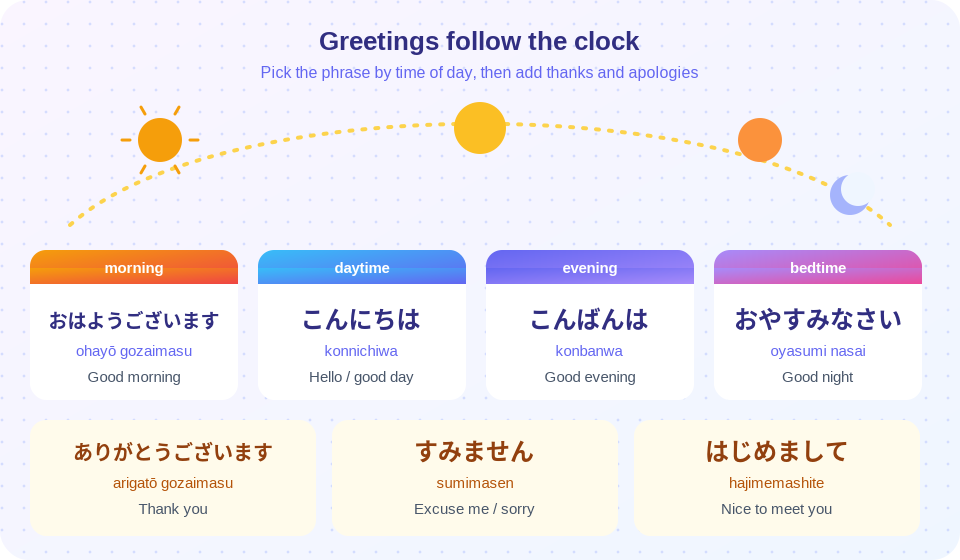
- おはようございます (ohayō gozaimasu), "good morning". Use it until about late morning. Between friends it shortens to おはよう (ohayō). Many workplaces use おはようございます even in the afternoon for the first meeting of the day, a quirk that you will notice in film and television.
- こんにちは (konnichiwa), "hello" or "good afternoon". It is the general daytime greeting and works until early evening. The last syllable is written with the character は, but it is pronounced wa in this word.
- こんばんは (konbanwa), "good evening". You say it from the evening onward, and the last character is again は, pronounced wa.
- おやすみなさい (oyasumi nasai), "good night". Unlike the other greetings it is only said when you or the other person is going to sleep or leaving for the night. Friends say おやすみ (oyasumi).
Note that Japanese greetings are sensitive to context rather than to exact hours. There is no formal rule such as "こんにちは starts at 12:00". Native speakers adjust by sunlight, by the situation and by whether they are speaking face to face or by message. In the console exercise below you can experiment with a simple rule of thumb.
Thank you, excuse me, sorry
Three more phrases cover most polite exchanges.
- ありがとうございます (arigatō gozaimasu), "thank you". Friends and family can say ありがとう (arigatō). For something that happened earlier, such as thanking a friend after a gift, Japanese uses the past form ありがとうございました (arigatō gozaimashita), which you will meet in chapter 6.
- どういたしまして (dō itashimashite), "you are welcome". It sounds a bit formal, and many people simply smile or say いいえ (iie, "no, no") to wave thanks away.
- すみません (sumimasen) is the most useful word of all. It means "excuse me" (to get a waiter's attention), "sorry" (when you bump into someone) and often "thank you" (when someone has gone out of their way for you).
- ごめんなさい (gomen nasai), "I am sorry". It is more personal than すみません and is usually said to friends, family and children, or for a small, specific mistake. Its casual shortening is ごめん (gomen).
The difference between すみません and ごめんなさい surprises many learners: with strangers and in public places, use すみません; with people you know, ごめんなさい (or ごめん) is natural for an apology.
Meeting someone
The meeting phrase is so important that it has two parts.
- はじめまして (hajimemashite), "How do you do?" or "Nice to meet you". It literally marks "the beginning" and is only said at a first meeting.
- After you give your name, add どうぞ よろしく おねがいします (dōzo yoroshiku onegai shimasu). It has no direct English translation. It is a request that the relationship go well: "Please treat me kindly" or "I look forward to working with you". It is used at the end of almost every self-introduction.
A name is introduced with です (desu), "is": リサです (Risa desu), "I am Lisa". Here is a full first-meeting dialogue between Lisa and Tanaka.
たなか: はじめまして。たなかです。どうぞ よろしく おねがいします。 Hajimemashite. Tanaka desu. Dōzo yoroshiku onegai shimasu. "How do you do? I am Tanaka. Pleased to meet you."
リサ: はじめまして。リサです。こちらこそ、よろしく おねがいします。 Hajimemashite. Risa desu. Kochira koso, yoroshiku onegai shimasu. "How do you do? I am Lisa. The pleasure is mine."
The phrase こちらこそ (kochira koso) means "likewise, me too" and is a quick way of returning someone else's politeness. After the introductions you might ask how the other person is: おげんきですか (o-genki desu ka, "How are you?") and answer はい、げんきです (hai, genki desu, "Yes, I am well") or まあまあです (māmā desu, "so-so"). Japanese people say "How are you?" less often than English speakers do, and usually only to someone they have not seen for a while.
Home and mealtime phrases
Japanese has fixed phrases for moments when English says nothing at all. They are part of daily life in every home.
| Situation | Phrase | Romaji | Meaning |
|---|---|---|---|
| Leaving home | いってきます | itte kimasu | "I am going and coming back" |
| Answering the person leaving | いってらっしゃい | itte rasshai | "Go and come back safe" |
| Arriving home | ただいま | tadaima | "I am back" |
| Welcoming someone home | おかえりなさい | okaeri nasai | "Welcome back" |
| Before eating | いただきます | itadakimasu | "I humbly receive (this food)" |
| After eating | ごちそうさまでした | gochisōsama deshita | "Thank you for the meal" |
いただきます and ごちそうさまでした are said even when you eat alone, and they are said by everyone in a family, not just guests. They give thanks to the cook and for the food. In a restaurant, say ごちそうさまでした to the staff when you leave.
If you hear さようなら (sayōnara), it means "goodbye", but it carries a feeling of a longer farewell (for example, when someone moves away or at the end of a school year). In daily life people more often say じゃあ、また (jā, mata, "well, see you again"), またね (mata ne, "see you" for friends), しつれいします (shitsurei shimasu, "excuse me, I am leaving", polite at work or school) and おつかれさまです (otsukaresama desu, "thank you for your hard work", which colleagues say all day).
Bowing and body language
Greetings in Japan often travel with a bow (おじぎ). A light nod of about 15 degrees is common for everyday hellos and thanks. A deeper bow of about 30 degrees is for formal situations, apologies and meeting someone senior. When you shake hands (which is more common with foreigners than with Japanese people), a small bow while shaking is polite. Do not worry about getting the angle perfect: a friendly attempt is always welcome.
Business cards (めいし, meishi) are exchanged with both hands and a slight bow. If someone hands you a card, take a moment to read it before putting it away carefully, not into a back pocket.
Common misconceptions
"さようなら is the normal way to say goodbye." It is correct but formal and a little final. In everyday life people prefer じゃあ、また, またね or しつれいします depending on who they are talking to.
"すみません only means sorry." It also means "excuse me" and "thank you for the trouble". Context decides.
"The last は in こんにちは is ha." It is the old topic particle, and it is pronounced wa in こんにちは and こんばんは.
Try it
First, practice with flashcards. Press Show to reveal the meaning and Next for a new phrase. Say the phrase aloud before you press Show.
The second exercise is a console experiment. It picks a greeting by the hour of the day. It is only a rule of thumb: real speakers decide by the situation.
Press Run (or Ctrl + Enter) to see the console output here.
No output.
Check your understanding
Quick check · 5 questions
of 5 answered You scored / 5 · perfect!
-
1. Which greeting is the general daytime "hello"?
こんにちは (konnichiwa) is the daytime hello. こんばんは is for the evening and おやすみなさい for bedtime. -
2. You bump into a stranger on a train. What do you say?
すみません is the polite all-purpose phrase for "excuse me" and "sorry". いただきます is for meals, ただいま for coming home. -
3. When do you say いただきます?
いただきます comes before the meal; ごちそうさまでした comes after it. -
4. What does どうぞ よろしく おねがいします express?
It is a set phrase that closes a self-introduction: roughly "please treat me well". -
5. How is the last character of こんにちは pronounced?
The character は is the old topic particle and is read wa in こんにちは and こんばんは.
Summary
- Pick a daytime greeting by time: おはようございます, こんにちは, こんばんは, then おやすみなさい at bedtime.
- ありがとうございます is thanks; すみません is "excuse me", "sorry" and sometimes "thanks".
- Introduce yourself with はじめまして, your name plus です, and どうぞ よろしく おねがいします.
- Home and meal phrases (いってきます, ただいま, いただきます, ごちそうさまでした) are used every day.
- A light bow and a friendly voice matter as much as the words.
Next: Chapter 1 review
Отслеживайте прогресс
Создайте бесплатный аккаунт, чтобы отмечать пройденные уроки и продолжать с того места, где остановились, на любом устройстве.