
























Lecția 34 · Projects and Practice
Practice Habits That Build Skill
Improve with focused exercises, limits that spark ideas, self-review questions, a simple practice journal, and a four-week plan you can adjust.
Reading helps, but skill grows when you shoot, look carefully, and try again. A short, focused practice session can teach more than a long day of random snapshots.
This chapter turns your knowledge into habits and projects. You can use any camera, including a phone.
What you will learn
- How to practice one skill at a time
- How creative limits help
- How to review your own pictures
- How to keep a practice journal and plan four weeks
One skill at a time
When you practice everything at once, it is hard to tell what improved. Pick one focus for each session:
- Shutter speed and motion
- Window light direction
- Eye focus for portraits
- Cleaner backgrounds
- White balance
Change one thing and keep the other things the same. Then compare the pictures side by side.
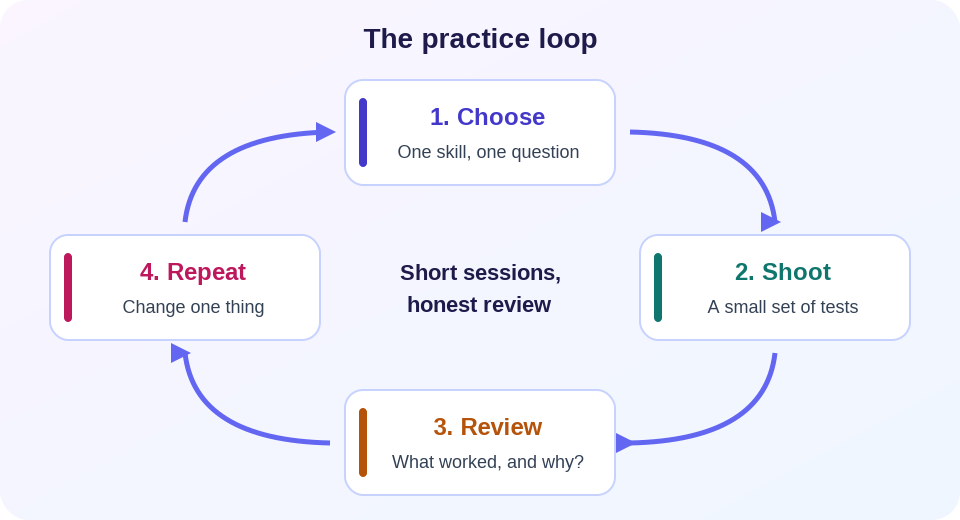
The practice loop
- Choose one skill and one question, such as "How does side light change texture?"
- Shoot a small set of tests.
- Review them soon, while you remember the scene.
- Repeat with one change based on what you saw.
Creative limits
Limits push you to look harder. Try one:
- One focal length for a whole day
- Only 24 pictures per walk
- Only one color as your theme
- Only things within 20 steps of your door
- Ten different pictures of the same chair
- Only black and white
In the chair challenge, the first ideas often come quickly. Later ones may need you to change height, light, distance, or story. That is where learning happens.
Exercises
Motion ladder
Photograph the same steady movement, such as water running from a tap, at several shutter speeds. For example: 1/1000, 1/250, 1/60, 1/15, and 1/4 second. Keep the brightness similar by changing aperture or ISO. If your range of settings is too small, skip the speeds you cannot reach. Compare the blur. Keep your gear dry.
Aperture ladder
Place three objects at different distances. Focus on the middle one. Shoot at your widest aperture, then at higher f-numbers. Compare how sharp the front and back objects look.
Light walk
Spend twenty minutes looking for five kinds of light: hard, soft, side, back, and reflected.
Look before you shoot
Walk and compose in your viewfinder or on your screen without pressing the button. Ask yourself why each frame works or does not work. Then take only the strongest ones. Stop walking while you look through the camera.
Review with good questions
After a session, choose your best five. For each one, ask:
- What did I want to show?
- Where does the eye go first?
- Is the important part sharp enough?
- Does the light help the idea?
- What at the edges distracts?
- What would I change next time?
Also look at one weak picture. Find the exact reason it fails. "Bad photo" teaches nothing. "The bright bin pulls the eye away from the person" teaches a lot.
Learn from others without copying
Visit exhibitions and libraries, and look at photo books. When a picture holds your attention, describe its light, composition, timing, and mood. Use these lessons in your own scenes. Do not copy another person's work and present it as your own idea.
A practice journal
Write a few lines after each session:
Date:
Focus skill:
What I tried:
What worked:
What did not work:
Next time:
Add a note about settings when it helps. Your camera usually stores settings in the metadata, so your notes can focus on decisions and ideas.
A four-week sample plan
| Week | Focus | Goal |
|---|---|---|
| 1 | Exposure and motion | Make a motion ladder and one low-light test |
| 2 | Focus and lenses | Make an aperture ladder and practice eye focus |
| 3 | Composition | Use one focal length and 24 pictures per walk |
| 4 | Light | Do a light walk, plus one window portrait or still life |
Adjust it to your time. Several short sessions a week work well for many people, but even one is useful.
Stay motivated
- Compare your new pictures with your own older ones.
- Keep a small "favorites" folder and look through it every few months.
- Expect many ordinary pictures. This is normal at every level.
- Take a break when you feel stuck.
- Join a local or online group that gives kind, useful feedback.
Stay safe during every challenge. Do not take risks for a picture, and follow permission and privacy rules.
When you have very little time
Ten minutes is still useful. Pick one object near you and one question. Make a few pictures, compare two of them, and write one sentence about the difference. Small sessions are easier to repeat, and repetition is what builds the habit.
A worked example: improving backgrounds
- Your question: "How can I make my subject stand out?"
- Photograph a plant at its own height in front of a messy shelf.
- Move left, right, and lower. Compare.
- Increase the distance between the plant and the shelf. Compare again.
- Try a wider aperture.
- Write down which change helped most.
Common mistakes
- Buying new gear instead of practicing with what you have.
- Changing many things at once, then guessing which one mattered.
- Never reviewing pictures after shooting.
- Judging your first attempts against the best work of someone with many years of experience.
Try it
Draw a random practice challenge and time your session.
Check your understanding
Quick check · 4 questions
of 4 answered You scored / 4 · perfect!
-
1. Why focus on one skill per session?
Changing one thing makes results easier to understand. -
2. Which review note is most useful?
A specific reason shows what to change. -
3. How can a limit such as one focal length help?
Limits encourage you to explore more options. -
4. In the motion ladder, which setting do you test on purpose?
Shutter speed is the variable you are testing.
Summary
- Practice one skill with a clear question.
- Use creative limits and short exercises.
- Review with specific questions and keep a journal.
- A simple plan builds habits over time.
Urmărește-ți progresul
Creează un cont gratuit ca să bifezi lecțiile și să reiei de unde ai rămas, pe orice dispozitiv.