
























Lecția 5 · Exposure
Exposure Basics: Light and Stops
Understand exposure, what one stop of light means, and how aperture, shutter speed and ISO work together to make a photo brighter, darker or different.
Exposure decides how bright your photo looks and how much detail it keeps in light and dark areas. Three settings control it in most cameras: aperture, shutter speed and ISO.
You will meet each one in its own lesson. First you need the idea that connects them: the stop.
What you will learn
- What exposure means
- What a stop is and how to count stops
- How to trade one setting for another without changing brightness
- What each setting changes besides brightness
What exposure means
In a strict sense, exposure is the amount of light that reaches each part of the sensor. It depends on three things: how bright the scene is, the aperture, and the shutter time.
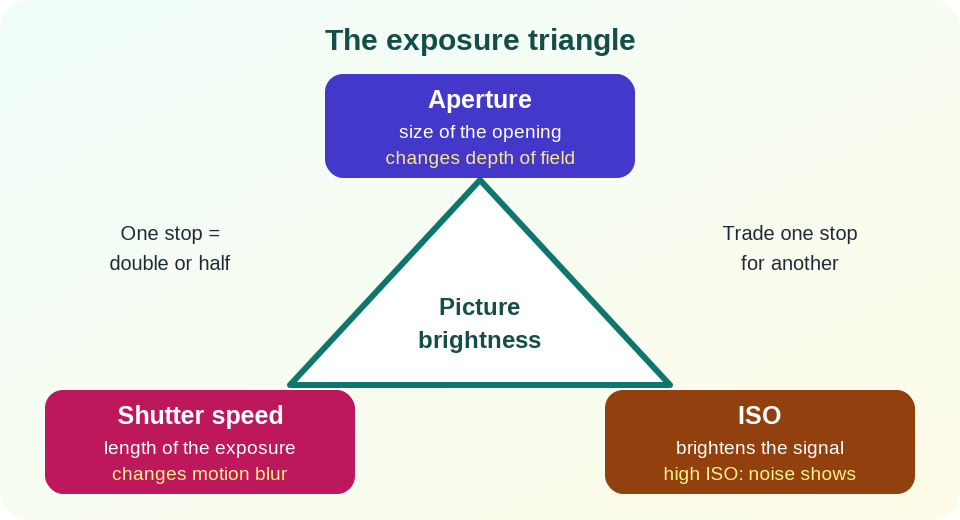
ISO does not change how much light arrives. It changes how the camera turns the captured signal into brightness. In everyday speech, people include ISO because all three change how bright the photo looks. That is why they are often drawn as the exposure triangle.
One stop
A stop is a doubling or a halving of light.
- +1 stop: twice as much light
- −1 stop: half as much light
- +2 stops: four times as much
- −3 stops: one eighth as much
Each extra stop doubles again. So 3 stops is 2 × 2 × 2 = 8 times.
Why use stops? Your eyes respond to light in a way that is closer to ratios than to simple differences. Counting in doublings also makes the three settings easy to compare.
Stops in each setting
| Setting | One stop brighter | One stop darker |
|---|---|---|
| Shutter time | 1/250 s to 1/125 s | 1/250 s to 1/500 s |
| ISO | ISO 200 to ISO 400 | ISO 200 to ISO 100 |
| Aperture | f/4 to f/2.8 | f/4 to f/5.6 |
Shutter time and ISO are easy: doubling the number gives one stop brighter. Aperture numbers work differently, and a smaller f-number means a wider opening. The full-stop aperture series is:
f/1, f/1.4, f/2, f/2.8, f/4, f/5.6, f/8, f/11, f/16, f/22
Each step to the right lets in about half the light. The numbers are rounded. You will see why in the aperture lesson.
Many cameras move in thirds of a stop, so you may also see values such as 1/160 s, ISO 250 or f/3.5.
Equivalent exposures
If you make one setting brighter by one stop and another darker by one stop, the photo brightness stays about the same. These are often called equivalent exposures.
Worked example: trading aperture and shutter
You start at f/4, 1/250 s, ISO 400 and the brightness is good.
| Settings | Change | Result |
|---|---|---|
| f/2.8, 1/500 s, ISO 400 | +1 aperture, −1 shutter | Same brightness |
| f/5.6, 1/125 s, ISO 400 | −1 aperture, +1 shutter | Same brightness |
| f/2, 1/1000 s, ISO 400 | +2 aperture, −2 shutter | Same brightness |
The brightness is the same, but the pictures differ. A wider aperture gives less depth of field. A shorter shutter time freezes motion better.
Worked example: using ISO
You are indoors at f/2.8, 1/60 s, ISO 800. A child starts to jump, and you want 1/250 s. That is 2 stops less light.
- The aperture is already as wide as your lens allows.
- So you raise ISO by 2 stops: 800 → 1600 → 3200.
New settings: f/2.8, 1/250 s, ISO 3200. The brightness matches. The price is that noise may be more visible, because the sensor now collects a quarter of the light.
Phones with fixed apertures use only shutter time and ISO (plus software) to control brightness.
Each setting has a side effect
| Setting | Brightness | Side effect |
|---|---|---|
| Aperture | Wider is brighter | Wider gives less depth of field |
| Shutter time | Longer is brighter | Longer shows more motion blur |
| ISO | Higher is brighter | Higher is usually used with less light, so noise shows more |
Good exposure is a choice between these side effects. First decide what matters most in the picture. Then set that control first.
- Sharp action? Choose a short shutter time first.
- Soft background? Choose a wide aperture first.
- Deep landscape sharpness? Choose a medium or small aperture first.
Is there one correct exposure?
Not always. A technically useful exposure keeps the detail you care about. A creative choice may make a scene darker for mood or brighter for a light, airy feel.
One limit matters a lot. If a bright area gets too bright for the sensor, it becomes pure white and its detail is lost. This is called highlight clipping. You will check for it with the histogram.
Common mistakes
Thinking a bigger f-number means a bigger opening. f/16 is a much smaller opening than f/2.
Forgetting the side effects. Changing shutter time to fix brightness may add blur.
Avoiding high ISO at all costs. A sharp photo with some noise is often more useful than a blurred one at low ISO.
Mixing up stops and numbers. Going from ISO 800 to ISO 1000 is much less than one stop. One stop would be 1600.
Try it
Change the three settings and see how many stops you moved from the start. Try to get back to zero with different settings.
Check your understanding
Quick check · 4 questions
of 4 answered You scored / 4 · perfect!
-
1. What does +2 stops mean?
Each stop doubles. Two stops are 2 times 2, which is 4. -
2. Which change is one stop brighter?
Doubling the shutter time doubles the light. -
3. You start at f/4 and 1/250 s. Which has the same brightness at the same ISO?
Opening one stop and shortening the time by one stop cancel out. -
4. Which setting does not change how much light reaches the sensor?
ISO changes how the captured signal becomes brightness.
Summary
- Exposure is about light reaching the sensor. ISO changes how bright the result is made.
- One stop is a doubling or halving.
- Shutter time and ISO double for one stop. Aperture follows the f-number series.
- Equivalent exposures keep brightness but change the look.
- Decide which side effect matters most, then set that control first.
Next: Aperture and F-Numbers
Urmărește-ți progresul
Creează un cont gratuit ca să bifezi lecțiile și să reiei de unde ai rămas, pe orice dispozitiv.