
























Lecția 17 · Casting and Molding
Chapter 3 Review: Casting and Molding
Review Chapter 3: sand casting, gating, Chvorinov's rule, risers, die and investment casting, injection molding cooling and clamp force, with a ten-question quiz.
Chapter 3 followed liquid material into a mold and out as a part. You learned the steps and parts of a sand mold, used Bernoulli's equation to size a gating system, predicted solidification time with Chvorinov's rule, sized risers, compared permanent-mold, die and investment casting, and estimated cooling time and clamp force for plastic injection molding. The same physical ideas recur: heat leaves through the mold, shrinkage must be fed, and pressure must be held back by the clamp.
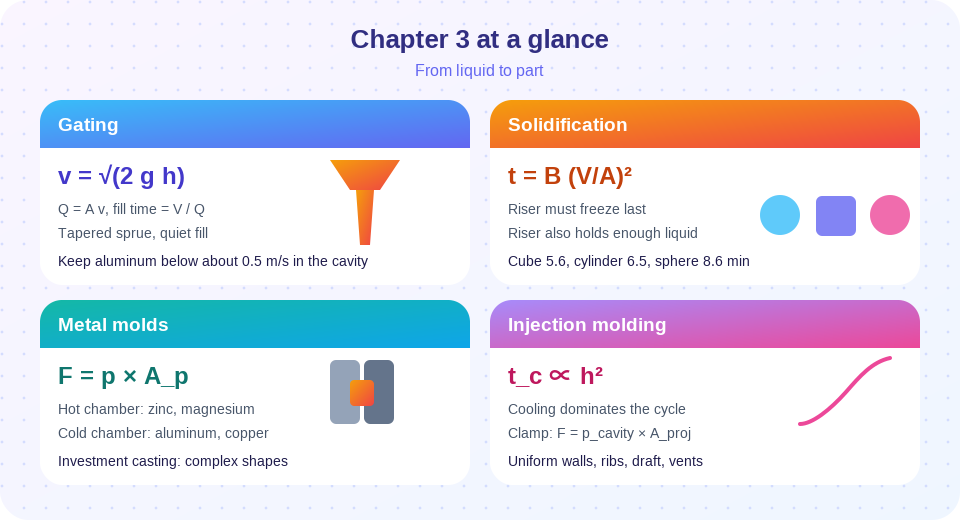
The chapter in one table
| Lesson | Key idea | Key formula |
|---|---|---|
| Overview | Pattern, mold, pour, solidify, finish; expendable versus permanent molds | Q = m [c_s ΔT + H_f + c_l ΔT_superheat] |
| Sand casting and gating | Allowances, gating, solidification time | v = √(2 g h), Q = A v, t = B (V/A)² |
| Shrinkage and risers | Three shrinkage stages; riser freezes last | Riser (V/A) about √1.25 times the casting's; feed volume check |
| Die, permanent mold, investment | Reusable metal molds or ceramic shells | F = p × A_p |
| Injection molding | Cooling dominates the cycle | t_c = h² / (π² α) × ln[...], F = p_cavity × A_proj |
Patterns that repeat
- Heat flow decides everything. Chvorinov's
(V/A)²and the moldingh²law both express that heat has to leave through a surface. - Volume change must be fed. Metal shrinks at freezing and plastic shrinks as it cools; risers and packing pressure supply extra material.
- Pressure needs a clamp. Any process that fills under pressure needs force equal to pressure times projected area.
- Tooling cost sets the volume. Sand is cheap and slow; dies and molds are costly and fast.
Common mistakes to avoid
- Quoting the ideal fill speed as the real one.
v = √(2 g h)ignores friction and bends; real velocities are lower, and turbulence control may force you to slow the stream much further. - Sizing a riser by time alone. A riser that freezes late but holds too little metal still leaves a cavity; check the feeding volume as well as the modulus.
- Forgetting that a die needs a metal that suits it. Zinc and magnesium go in hot-chamber machines, aluminum in cold-chamber machines, and steel is not die cast at all.
- Using total part area for clamp force. The relevant area is the projected area in the direction the mold opens, including the runners.
- Thickening a plastic wall for strength. Cooling time grows with thickness squared, so a thick wall costs cycle time and invites sink marks and warpage; ribs give stiffness more cheaply.
Check each of these against the quiz questions that follow.
Try it
This calculator reviews the chapter's core estimates: gate speed, solidification time, clamp force and cooling time.
Press Run (or Ctrl + Enter) to see the console output here.
No output.
Check your understanding
Quick check · 10 questions
of 10 answered You scored / 10 · perfect!
-
1. Liquid falls 0.2 m in a sprue. The ideal speed is about:
v = √(2 × 9.81 × 0.2) = 1.98 m/s. -
2. Casting A has V/A = 1.0 cm and casting B has V/A = 2.0 cm (same B, n = 2). B takes how many times longer to solidify?
Time scales with (V/A)², so (2/1)² = 4. -
3. Which shape of equal volume solidifies slowest?
The sphere has the smallest surface area for its volume, so the largest V/A. -
4. Which shrinkage stage does the riser mainly feed?
The riser supplies liquid to fill the volume lost when liquid becomes solid. -
5. Why is zinc typically die cast in a hot-chamber machine?
Low melting point and mild attack on steel allow the injection parts to sit in the melt. -
6. Pressure 60 MPa on 8,000 mm² projected area. The separating force is:
60 × 8,000 = 480,000 N = 480 kN. -
7. What defines investment casting?
Wax patterns are coated with ceramic, then melted out to leave the mold. -
8. A molded wall is made 3 mm thick instead of 1.5 mm. Cooling time changes by about:
Cooling time ∝ h², so doubling thickness gives four times the cooling time. -
9. A thin fin of plastic along the parting line indicates:
Flash means melt escaped at the parting line. -
10. Which process would you choose for ten thousand identical thin-walled aluminum housings?
Medium to high volume and thin walls in aluminum suit die casting.
Summary
- Casting and molding turn liquid into near-net shapes; mold type and volume decide the economics.
- Gating controls fill, Chvorinov controls solidification order, risers feed shrinkage.
- Die casting and injection molding add pressure, which needs clamp force
p × A. - Cooling dominates molding time and scales with wall thickness squared.
- Chapter 4 now turns to forming and forging, where solid metal is squeezed into shape.
Urmărește-ți progresul
Creează un cont gratuit ca să bifezi lecțiile și să reiei de unde ai rămas, pe orice dispozitiv.