
























Lecția 10 · Reading
IELTS Reading: Format, Skimming, Scanning
Learn the IELTS Reading format for Academic and General Training, then practice skimming, scanning, close reading and spotting paraphrases.
The Reading test gives you 60 minutes for 40 questions. For many learners the problem is not one hard sentence. It is running out of time after reading everything slowly. You need different reading speeds for different jobs.
What you will learn
- How Academic and General Training Reading differ
- How to skim, scan and read closely
- Why paraphrase matters
- The main question types
The format
Both versions have three sections, 40 questions and 60 minutes. Each correct answer earns one mark. There is no extra time added for transferring answers, so enter them as you go.
Academic has three long passages from sources such as books, journals, magazines and newspapers. They are written for readers without specialist knowledge. At least one has a detailed logical argument. The official site gives a total of 2,150 to 2,750 words.
General Training uses texts such as advertisements, handbooks and official documents. Section 1 has short everyday texts, Section 2 has work-related texts, and Section 3 has one longer text of general interest.
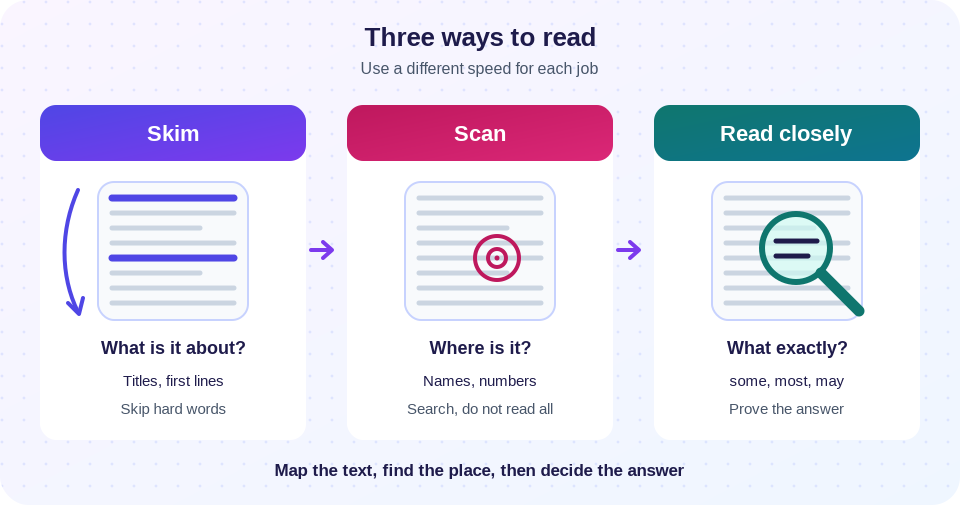
Skim
What is each part about?
Scan
Where is the answer?
Read closely
Which answer is right?
Three ways to read
Skimming means reading quickly for the general idea. Look at the title, the first sentences of paragraphs and repeated ideas. Do not stop for unknown words.
Scanning means searching for something specific, such as a year, a name or a technical term. Your eyes move until they reach it.
Close reading means reading a few sentences carefully. Notice words that limit a claim, such as some, most, only, may, usually and since.
Worked example
Read this short original text.
Many city gardens began as empty lots. Residents cleared them and shared the work. Today some gardens supply vegetables to local kitchens, although most produce only small amounts.
- Skim: it is about community gardens and what they produce.
- Scan: if a question mentions kitchens, find that word.
- Close read: some supply kitchens. Most produce only small amounts. A claim that "city gardens feed the local kitchens" would be much too strong.
Paraphrase
A paraphrase says the same idea in different words. Questions often paraphrase the text.
| In the question | In the text |
|---|---|
| a rise in the number of visitors | visitor figures climbed |
| it is not yet known why | the cause remains unclear |
| was prevented | was stopped from happening |
| the majority of staff | most employees |
Train yourself to match ideas, not only identical words.
The main question types
Academic Reading may include multiple choice; True, False, Not Given; Yes, No, Not Given; matching information, headings, features or sentence endings; sentence, summary, note, table and flow chart completion; diagram labels; and short answers. General Training uses a similar range.
See True, False, Not Given, matching headings and completion tasks.
A basic routine
- Skim the passage in a short, fixed time.
- Read the instructions for the first question group.
- Choose key words and think of paraphrases.
- Scan to the place, then read closely.
- Answer and move on. Mark hard ones to revisit.
You can also read the questions before skimming. Test both orders in practice and keep what works for you.
When you meet an unknown word, use the sentence around it. You can often tell whether it is positive or negative, or a kind of person, object or action. Often you do not need to know it at all.
A worked first minute
You open a passage titled "Why Some Bridges Hum". In the first minute, you read the title and the first sentence of each paragraph. Suppose they suggest this map:
| Paragraph | Your short note |
|---|---|
| A | the strange sound people report |
| B | wind and vibration |
| C | an early test that failed |
| D | design changes |
Now, when a question asks about "an unsuccessful trial", you know to look near paragraph C. You saved time because you did not need to search the whole text.
Handling unknown words
Look at this sentence: "The old mill had become derelict, with broken windows and a collapsed roof." You may not know derelict, but the broken windows and collapsed roof show that the building was abandoned and in very poor condition. Use this kind of clue first. If a word still blocks an answer, move on and return later.
Build speed in daily reading
Choose a short article. Give yourself one minute to find its main idea, then check by reading it carefully. Next, set a question such as Which year is mentioned? and scan for it. Over time, you will feel more confident switching between speeds. Read topics outside your comfort zone too, such as science, history and the environment.
Choosing practice texts
For Academic preparation, read articles that explain research, history or social questions to general readers. For General Training, read notices, job information, service rules and instructions, as well as longer magazine-style texts. In both cases, finish each practice session by writing two or three sentences that give the main idea. If you cannot, skim again and look at the first sentences. This small habit checks that you understood the whole, not only a few words.
Common mistakes
Do not try to understand every word on first reading. It uses time that you need for the questions. Build a quick map of the text first.
Try it
Check your understanding
Quick check · 4 questions
of 4 answered You scored / 4 · perfect!
-
1. How long is the Reading test?
You have 60 minutes for 40 questions. -
2. What is skimming?
Skimming gives you a map of the text. -
3. Which is the closest paraphrase of "the cause remains unclear"?
"Unclear" means we do not know yet. -
4. The text says "some gardens supply kitchens". Which claim goes too far?
"Some" is not "all".
Summary
- Both versions have three sections, 40 questions and 60 minutes.
- Skim for the gist, scan for details and read closely to decide.
- Questions often paraphrase the text.
- Watch words that limit a claim.
Urmărește-ți progresul
Creează un cont gratuit ca să bifezi lecțiile și să reiei de unde ai rămas, pe orice dispozitiv.