
























Lecția 5 · Listening
IELTS Listening: The Four Parts
Get to know the IELTS Listening test: four parts, 40 questions, one hearing only, the main question types and a method for staying on track.
In the Listening test you hear each recording once only. You cannot ask the speaker to repeat. That sounds hard, but the test has a clear shape, and you can train for it.
The structure below was checked on ielts.org in November 2026. Listening is the same for Academic and General Training.
What you will learn
- What happens in each of the four parts
- Which question types you may meet
- The rules that can cost you marks
- A routine for before, during and after each recording
The four parts
| Part | Speakers | Setting |
|---|---|---|
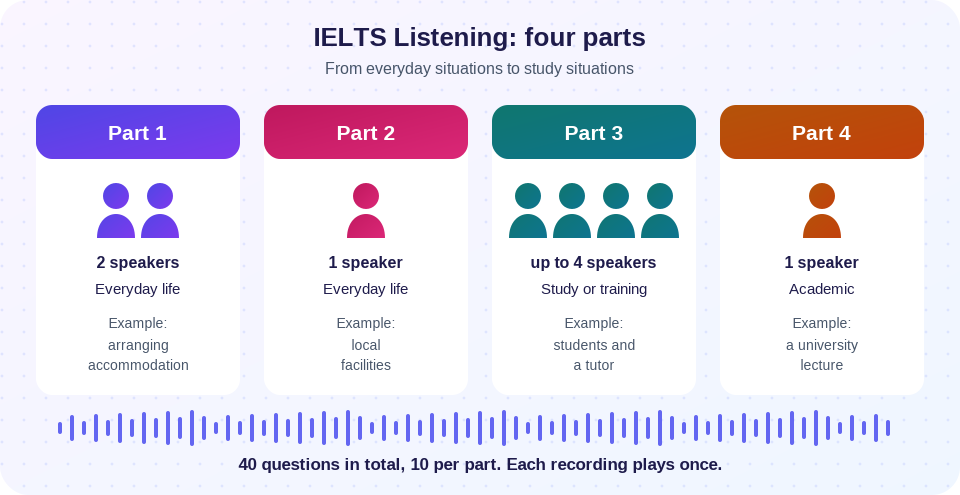
| 1 | A conversation between two people | Everyday social life, such as arranging accommodation |
| 2 | One speaker | Everyday social life, such as a talk about local facilities |
| 3 | A discussion between up to four people | Education or training, such as students and a tutor |
| 4 | One speaker | An academic talk |
There are 40 questions, with 10 in each part, and each correct answer earns one mark. Questions follow the order of the information in the recording. You can expect a range of accents, including British, Australian, New Zealand and North American. The test takes about 30 minutes.
Question types
- Multiple choice
- Matching
- Plan, map or diagram labeling
- Form, note, table or flow chart completion
- Sentence completion
- Short-answer questions
Later lessons cover form and note completion, multiple choice and matching and maps, plans and diagrams.
Before the audio
While you listen
In any checking time
Rules that cost marks
- Word limits. An instruction such as "NO MORE THAN TWO WORDS AND/OR A NUMBER" is strict. A longer answer loses the mark.
- Hyphens. A hyphenated word such as "check-in" counts as one word.
- Spelling. A misspelled answer can be marked wrong. Practice common names of places, days, months and facilities.
- Position. Make sure each answer is in the box for the right question.
How you get time to check your answers depends on how you take the test. Older paper advice gives extra time to copy answers to a sheet. For a computer test, follow the instructions given on screen and in the official familiarization material.
A routine that works
- Use the reading time. Read the next set of questions. Underline or note the important words.
- Predict the answer type. Is it a name, a number, a place, a noun or a verb?
- Listen for meaning. The recording often says the same idea in different words.
- Keep an eye one question ahead. If you hear information for question 7 while waiting for question 6, leave question 6.
- Move on after a miss. One lost mark must not become five.
Worked example: predicting
Question: The library is closed on ______.
Before you listen, you can predict that the answer is probably a day, perhaps with a "s" ending. Now suppose the speaker says: "We open every day except Monday." The words "closed on" never appear. "Every day except Monday" carries the same meaning, so the answer is Monday or Mondays. If the key allows only one form, follow what you hear and what fits the sentence.
Signpost words
Speakers guide you with signposts, which are phrases that show where the talk is going.
| Signpost | What may come next |
|---|---|
| "Moving on to..." | A new topic, perhaps the next question |
| "However," or "Having said that," | A contrast or correction |
| "The main reason is..." | A cause |
| "Actually, let me check." | A change to earlier information |
Reading the instructions closely
Instructions are short, and every word matters. Compare these.
| Instruction | What you may write |
|---|---|
| ONE WORD ONLY | A single word, not a number phrase of two parts |
| ONE WORD AND/OR A NUMBER | "bus", "42" or "gate 4" |
| NO MORE THAN TWO WORDS | One or two words |
| Choose TWO letters | Exactly two letters |
If you see a new instruction, take a moment to read it before the audio starts.
Worked example: staying with the order
Questions 5, 6 and 7 ask about a museum's opening day, ticket price and meeting point. You miss the opening day because you were still thinking about question 4. Then you hear "Tickets cost eight pounds". This is clearly about question 6. Write it, leave question 5 and be ready for the meeting point. At the end, make a sensible guess for question 5, perhaps a day you remember hearing.
Build up your stamina
The recordings get harder to follow if your attention drifts. Start your training with one part at a time. Later, do all four parts without stopping. If you notice that you lose focus in a particular part, practice that type more often and use the reading time to prepare your mind for the topic.
What to practice first
If you are new to the test, start with form completion, because the audio is often more predictable. Then add map labeling and multiple choice. Part 4 needs longer attention, so build toward it gradually.
A note on accents
You may meet speakers from several English-speaking countries. You do not need to copy any accent. You need to recognize common words in different forms. For example, some speakers do not pronounce the "r" at the end of "car", while others do. The word "schedule" also starts differently for many British and American speakers. Mix your listening sources so that a new voice does not surprise you.
Common mistakes
Do not stop listening while you perfect one answer. Write it quickly and return your attention to the recording. Fix spelling later if you have checking time.
Try it
Read the question before you play or read the script. Hear or read it once only.
Check your understanding
Quick check · 4 questions
of 4 answered You scored / 4 · perfect!
-
1. How many times do you hear each recording?
The recordings are played once only. -
2. Which part is usually an academic talk by one speaker?
Part 4 is a monologue on an academic subject. -
3. You miss the answer to question 12 and hear information for question 13. What should you do?
Staying behind puts later marks at risk. -
4. The limit is two words and/or a number. Which answer breaks it?
"The main entrance" is three words. "Check-in desk" is two because the hyphenated word counts as one.
Summary
- Listening has four parts and 40 questions, and each recording plays once.
- Answers come in the order of the recording.
- Word limits and spelling matter.
- Read ahead, predict, listen for meaning and move on after a miss.
Urmărește-ți progresul
Creează un cont gratuit ca să bifezi lecțiile și să reiei de unde ai rămas, pe orice dispozitiv.