
























Lekcja 20 · Forming and Forging
Rolling, Extrusion and Drawing
Calculate draft, contact length, rolling force and power; extrusion ratio and pressure; and wire-drawing stress, using the flow curve and the constant-volume rule.
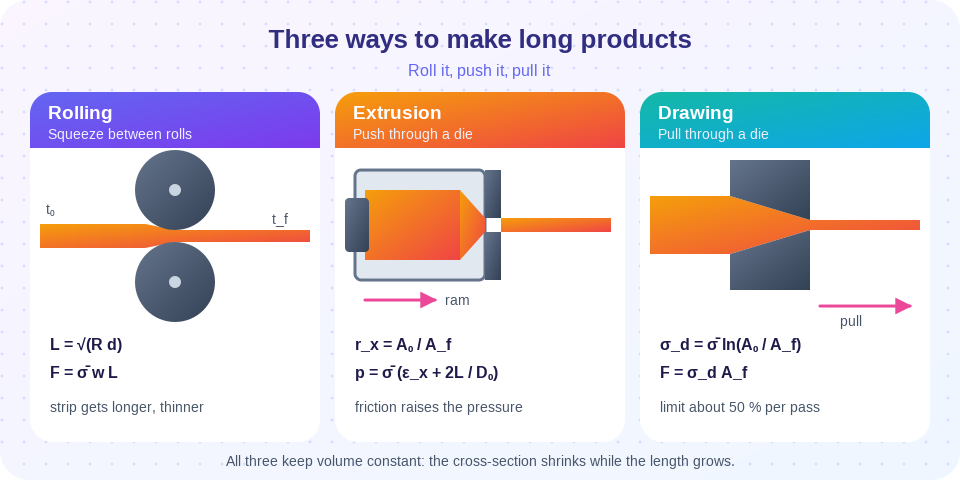
Forging squeezes a piece once. Three other bulk processes squeeze metal continuously, turning a short billet into a very long product. Rolling passes metal between rotating cylinders and makes most of the world's steel plate, sheet, rails and beams. Extrusion pushes metal through a shaped hole like toothpaste, making aluminum window frames and hollow tubes. Drawing pulls metal through a die and makes wire, rod and tube. All three rely on the same physics: the metal is compressed (or squeezed) so that its cross-section shrinks, its length grows, and its volume stays constant. This lesson gives the formulas to estimate how hard each process pushes back.
What you will learn
- Compute draft, contact length, rolling force, torque and power for flat rolling.
- Explain why there is a maximum draft that depends on friction.
- Calculate extrusion ratio and estimate extrusion pressure and force.
- Estimate wire-drawing stress and force, and understand the reduction limit.
Key terms
Draft: the reduction in thickness in one rolling pass, d = t₀ - t_f.
Contact length (L): the length of the arc where the roll touches the strip.
Extrusion ratio: the starting cross-section area divided by the final area, r_x = A₀ / A_f.
Drawing stress: the pulling stress applied to the exit of the die in drawing.
Reduction: r = (A₀ - A_f) / A₀, the fractional decrease in area.
Flat rolling
A strip of thickness t₀ enters two rolls of radius R, and leaves with thickness t_f. The strip's width w barely changes, so the length increases by the ratio t₀ / t_f. Key quantities:
- Draft:
d = t₀ - t_f. - True strain:
ε = ln(t₀ / t_f). - Contact length (projected):
L = √(R d). - Maximum draft:
d_max = μ² R. The rolls can only pull the strip in if friction is high enough; ifdexceeds this, the strip slips and will not enter. A rough hot-rolled surface gives high μ (0.4 or more) and lets mills take big reductions, whereas lubricated cold rolling uses μ about 0.05 to 0.15. - Rolling force:
F = σ̄_f × w × L, where the average flow stress isσ̄_f = K ε^n / (1 + n). - Power:
P = 2π N F Lfor two driven rolls, where N is rotation speed in revolutions per second and L is in meters.
Worked example
Cold rolling low-carbon steel (K = 530 MPa, n = 0.26) from t₀ = 3.0 mm to t_f = 2.4 mm, strip width w = 500 mm, roll radius R = 250 mm, μ = 0.1, roll speed 100 rpm.
d = 0.6 mm. Limit:d_max = 0.1² × 250 = 2.5 mm, so the pass is feasible.L = √(250 × 0.6) = 12.2 mm.ε = ln(3.0 / 2.4) = 0.223,σ̄_f = 530 × 0.223^0.26 / 1.26 = 285 MPa.F = 285 × 500 × 12.2 = 1.74 × 10⁶ N = 1.74 MN.N = 100 / 60 = 1.667 rev/s,P = 2π × 1.667 × 1.74 × 10⁶ N × 0.0122 m = 2.2 × 10⁵ W = 224 kW.
The force per unit width is a useful number for choosing a mill. To reduce force, mills use work rolls of smaller diameter (smaller R, smaller L), but small rolls bend, so they are backed up by larger rolls in a four-high or cluster mill. Another trick is tension applied to the strip entering and leaving, which lowers the needed rolling force. Hot rolling reduces flow stress dramatically, which is why slabs are hot rolled first and the thin sheet is cold rolled later for surface quality and strength.
Extrusion
In direct extrusion a hydraulic ram pushes a heated billet through a die with the opening of the desired cross-section. The extrusion ratio is r_x = A₀ / A_f. The ideal true strain is ε_x = ln r_x. Real extrusion needs more work because metal must be sheared at the die entrance (redundant work) and friction acts at the die and, in direct extrusion, along the container wall. Johnson's empirical relation adds both:
ε_x = a + b ln r_x, with a ≈ 0.8 and b ≈ 1.2 to 1.5.
The ram pressure at the start of the stroke is about:
p = σ̄_f (ε_x + 2L / D₀)
where L is the billet length remaining and D₀ is the billet diameter. The last term is the friction in the container, which falls to zero as the billet shortens, so the force falls during the stroke in direct extrusion. Indirect extrusion moves the die toward a stationary billet, removing container friction.
Worked example
Extrude a 150 mm diameter, 500 mm long aluminum billet hot into a 30 mm diameter rod. Assume σ̄_f = 60 MPa at the working temperature (an assumed value; real values depend on temperature and speed).
r_x = (150 / 30)² = 25,ln r_x = 3.219.ε_x = 0.8 + 1.5 × 3.219 = 5.63(using b = 1.5).2L / D₀ = 2 × 500 / 150 = 6.67at the start.p = 60 × (5.63 + 6.67) = 738 MPa; billet areaA₀ = π × 150² / 4 = 17,671 mm², soF = 738 × 17,671 = 13.0 MN, about 1,330 tonnes-force.
Compare the ideal case, p = 60 × 3.219 = 193 MPa. Friction and redundant work make the real pressure almost four times larger. That is why extrusion presses are enormous, and why hollow shapes (made with a mandrel and bridge die) are limited in complexity.
Extruded products include aluminum structural profiles, copper tubes, plastic pipes (the polymer version of the same idea), and, in impact extrusion, cans and tubes made in one punch stroke.
Drawing
In wire drawing a rod is pulled through a conical die whose exit is smaller than the entrance. The metal is pulled, not pushed, so the wire carries tension at the exit. The ideal drawing stress (no friction, no redundant work) is:
σ_d = σ̄_f × ln(A₀ / A_f)
The drawing force is F = σ_d × A_f. There is a built-in limit: the exit wire is itself under stress σ_d, and it must not yield (neck) there. For a perfectly plastic metal the limit is reached when ln(A₀/A_f) = 1, a reduction of 1 - 1/e = 63 percent. Friction and die geometry lower the practical limit to about 50 percent per pass, so a thin wire is made through many dies in sequence, often with annealing between stages.
Worked example
Draw annealed copper wire (K = 315 MPa, n = 0.54, classroom values) from 2.0 mm to 1.6 mm.
A₀ / A_f = (2.0 / 1.6)² = 1.5625,ε = ln 1.5625 = 0.446.σ̄_f = 315 × 0.446^0.54 / 1.54 = 132 MPa.σ_d = 132 × 0.446 = 59 MPa, andA_f = π × 1.6² / 4 = 2.01 mm², soF = 59 × 2.01 = 119 N.
Real drawing forces are higher by a factor of 1.2 to 1.5 because of friction and redundant work, so use the ideal value as a lower bound. Die half-angles are typically a few degrees up to about 12 degrees, a balance between friction in a long die and redundant deformation in a steep one.
Tube drawing and rod drawing use the same idea, often with a mandrel or plug to control the inner diameter. Cold drawn products have excellent finish, accuracy and strength because of strain hardening.
Common misconceptions
"Rolling force depends only on the reduction." It also depends on roll radius (through contact length), width, material strength and friction.
"Extrusion pressure is just flow stress times ln r_x." Friction in the container and redundant work can multiply the pressure several times.
"A wire can be drawn to any size in one pass." The drawing stress cannot exceed the strength of the emerging wire, so a pass has a limit and thin wire needs many dies.
Try it
Set the rolling conditions and see the force and power. The calculator also reminds you when the draft exceeds the friction limit.
The second example runs the three worked examples and plots the effect of friction on extrusion pressure through the billet stroke.
Press Run (or Ctrl + Enter) to see the result here.
Program input · what you'd type while the program runs
Type the answers before you press Run, one per line. Each time the program reads a line (with input()), it gets the next line from this box.
Check your understanding
Quick check · 5 questions
of 5 answered You scored / 5 · perfect!
-
1. A strip is rolled from 10 mm to 8 mm with rolls of radius 200 mm. The contact length is:
L = √(R d) = √(200 × 2) = √400 = 20 mm. -
2. The friction coefficient is 0.2 and the roll radius 300 mm. What is the maximum draft?
d_max = μ² R = 0.04 × 300 = 12 mm. -
3. A billet of 100 mm diameter is extruded to a 25 mm diameter rod. The extrusion ratio is:
r_x = (100/25)² = 16. -
4. Why does direct extrusion pressure fall during the stroke?
The 2L/D₀ friction term shrinks as the remaining billet length L decreases. -
5. What limits the reduction in one wire-drawing pass?
The drawing stress is carried by the exit wire, so it cannot exceed that wire's strength.
Summary
- Rolling:
d = t₀ - t_f,L = √(R d),F = σ̄_f w L,d_max = μ² R,P = 2π N F L. - Extrusion:
r_x = A₀ / A_f; real pressure far exceedsσ̄_f ln r_xbecause of friction and redundant work. - Drawing:
σ_d = σ̄_f ln(A₀ / A_f); one pass is limited to about 50 percent reduction in practice. - All three keep volume constant; cross-section shrinks as length grows.
Next: Sheet-Metal Forming
Śledź swoje postępy
Załóż darmowe konto, aby odhaczać lekcje i wracać do miejsca, w którym skończyłeś, na dowolnym urządzeniu.