
























Lekcja 42 · Projects and Practice
Glossary of differential geometry
A glossary of the key terms of differential geometry, from arc length and Frenet frames to geodesics, Gauss-Bonnet and Riemann curvature, with a searchable lookup and flashcards.
Differential geometry has a large vocabulary, and the words matter: two terms that sound alike (normal curvature and geodesic curvature, extrinsic and intrinsic) mean different things. This glossary collects the terms of the whole course in one place, grouped by theme. Use it as a reference while you work through problems, and as a checklist before an exam.
What you will learn
- The precise meaning of the course's technical terms.
- How terms group into curves, surfaces, curvature, geodesics, topology and manifolds.
- How to test yourself with flashcards.
Curves and surfaces
| Term | Meaning |
|---|---|
| Arc length | The length ∫ ‖α′(t)‖ dt of a curve; reparametrizing by arc length gives unit speed. |
| Curvature of a curve (κ) | The rate at which the unit tangent turns per unit length: κ = ‖T′‖. |
| Torsion (τ) | The rate at which a space curve leaves its osculating plane. |
| Frenet frame | The moving orthonormal frame T, N, B (tangent, normal, binormal) along a space curve. |
| Regular curve or surface | One whose velocity (or whose partial derivatives xᵤ, xᵥ) never vanish or become dependent. |
| Parametrization | A smooth map x(u, v) describing a patch of a surface. |
| Tangent plane | The plane spanned by xᵤ and xᵥ at a point. |
| Unit normal (N) | The unit vector xᵤ × xᵥ / ‖xᵤ × xᵥ‖, perpendicular to the tangent plane. |
| Orientable surface | One that admits a continuous choice of unit normal. |
The fundamental forms
| Term | Meaning |
|---|---|
| First fundamental form | I = E du² + 2F du dv + G dv²: the inner product on tangent vectors, so lengths, angles and areas. |
| Area element | dA = √(EG − F²) du dv. |
| Second fundamental form | II = e du² + 2f du dv + g dv² with e = ⟨xᵤᵤ, N⟩ and so on: how the surface bends away from its tangent plane. |
| Shape operator (S) | The linear map S = −dN on the tangent plane; II(v, w) = ⟨S v, w⟩. |
| Isometry | A map that preserves the first fundamental form, hence lengths, angles and areas. |
| Intrinsic / extrinsic | Intrinsic quantities depend only on E, F, G; extrinsic ones also need the surrounding space. |
Curvature of surfaces
| Term | Meaning |
|---|---|
| Normal curvature (κₙ) | The signed curvature of the normal section in a given direction: II(v, v)/I(v, v). |
| Principal curvatures (κ₁, κ₂) | The extreme values of κₙ; the eigenvalues of S. |
| Principal directions | The perpendicular directions where κ₁ and κ₂ occur. |
| Euler's formula | κₙ(θ) = κ₁cos²θ + κ₂sin²θ. |
| Gaussian curvature (K) | κ₁κ₂ = (eg − f²)/(EG − F²); intrinsic (Theorema Egregium). |
| Mean curvature (H) | (κ₁ + κ₂)/2; extrinsic, changes sign with the normal. |
| Umbilic point | A point with κ₁ = κ₂, such as every point of a sphere. |
| Elliptic, hyperbolic, parabolic, planar | Points with K > 0, K < 0, K = 0 (not flat) and S = 0. |
| Minimal surface | A surface with H = 0 everywhere, such as a soap film (catenoid, helicoid). |
| Gauss map | The map sending each point to its unit normal on the unit sphere. |
| Theorema Egregium | Gauss's theorem that K depends only on the first fundamental form. |
Geodesics and transport
| Term | Meaning |
|---|---|
| Geodesic | A curve with no tangential acceleration: α″ ∥ N; locally shortest; constant speed. |
| Geodesic curvature (κ_g) | ⟨α″, N × T⟩: the bending of a curve within the surface; zero exactly for geodesics. |
| Christoffel symbols (Γᵏᵢⱼ) | Coefficients computed from E, F, G that appear in the geodesic and transport equations. |
| Clairaut's relation | On a surface of revolution r sin ψ is constant along a geodesic. |
| Covariant derivative | The tangential part of the ordinary derivative of a vector field along a curve. |
| Parallel transport | Carrying a vector along a curve with zero covariant derivative. |
| Holonomy | The rotation of a vector transported around a closed loop; ≡ ∬K dA (mod 2π). |
Gauss–Bonnet and topology
| Term | Meaning |
|---|---|
| Exterior angle | The turning angle at a corner of a boundary curve. |
| Local Gauss–Bonnet | ∮κ_g ds + ∬K dA + Σθᵢ = 2π for a disk region. |
| Euler characteristic (χ) | V − E + F of any triangulation; 2 − 2g for a closed orientable surface of genus g. |
| Genus | The number of holes of a closed orientable surface. |
| Global Gauss–Bonnet | ∬K dA = 2πχ for a closed surface. |
| Angle defect | 2π minus the sum of the face angles at a polyhedron's vertex; curvature concentrated at a point. |
Manifolds
| Term | Meaning |
|---|---|
| Chart, atlas | A coordinate map on an open set; a collection of charts covering the space. |
| Transition map | The coordinate change between two overlapping charts; smooth for a smooth manifold. |
| Tangent space | T_p M, the vector space of velocities of curves through p. |
| Differential | The linear map df_p induced by a smooth map; the Jacobian in charts. |
| Riemannian metric | A smooth inner product g on every tangent space. |
| Levi-Civita connection | The torsion-free, metric-compatible way to differentiate vector fields. |
| Riemann curvature tensor | The tensor measuring failure of parallel transport around infinitesimal loops. |
| Ricci tensor, scalar curvature | Traces of the Riemann tensor; for surfaces Ricci = K g and R = 2K. |
| Sectional curvature | The Gaussian curvature of the surface swept by geodesics in a given tangent 2-plane. |
| Space form | A manifold of constant sectional curvature: sphere, Euclidean space, hyperbolic space. |
Try it
First, a searchable lookup. Type any fragment of a word in the call at the bottom and the console prints the matching definitions.
Press Run (or Ctrl + Enter) to see the console output here.
No output.
Edit the three calls at the bottom to search for other words. Second, flashcards: the page shows a term, you try to recall the definition, then reveal it.
The flashcards pick a random next card; press Show definition only after you have tried to answer.
Common misconceptions
Confusing normal curvature and geodesic curvature. Normal curvature is the part of a curve's bending forced by the surface; geodesic curvature is the part inside the surface. A great circle has κₙ = 1/R and κ_g = 0.
Confusing intrinsic and extrinsic. K and geodesics are intrinsic; H, principal curvatures and the normal are extrinsic.
Assuming a name means one thing. "Curvature" alone can mean the curvature of a curve, normal curvature, Gaussian curvature or sectional curvature. Always say which.
Check your understanding
Quick check · 5 questions
of 5 answered You scored / 5 · perfect!
-
1. Which of these is an intrinsic quantity?
By the Theorema Egregium K is determined by E, F, G. -
2. The geodesic curvature of a geodesic is
κ_g = 0 characterizes geodesics. -
3. The Euler characteristic of the torus is
χ = 2 − 2g with g = 1. -
4. A transition map is
It converts coordinates on the overlap of two charts. -
5. Holonomy of a loop equals, mod 2π,
That is the relation between parallel transport and Gaussian curvature.
Summary
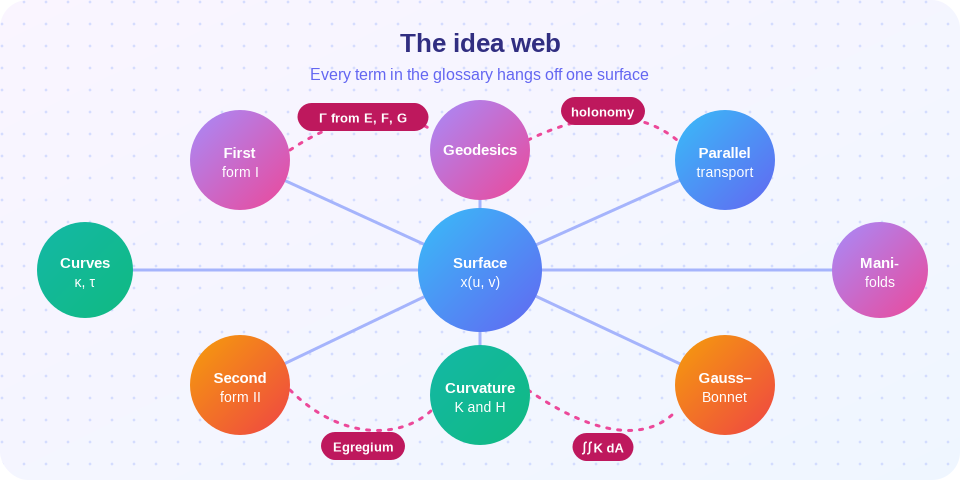
- Intrinsic terms (E, F, G, K, geodesics, Γ, holonomy, Riemann tensor) need no ambient space; extrinsic terms (N, S, κ₁, κ₂, H) do.
- The big links: Theorema Egregium (K from E, F, G), Gauss–Bonnet (K and topology), holonomy (K and transport).
- Manifolds generalize charts and the metric to any dimension.
Next: Cheat sheet
Śledź swoje postępy
Załóż darmowe konto, aby odhaczać lekcje i wracać do miejsca, w którym skończyłeś, na dowolnym urządzeniu.