
























Les 1 · Foundations
Time Management Course Map
Start your time management course here: see all nine chapters, learn how to study them, and set a simple starting point you can measure your progress against.
This course helps you decide what to do, when to do it, and how to protect the time you need. It is for students, workers, parents, freelancers, and anyone who ends the day wondering where it went.
You will not find a magic system here. You will find small, practical skills that work together. You can try each one with a pen and paper, a free calendar, or whatever tools you already use.
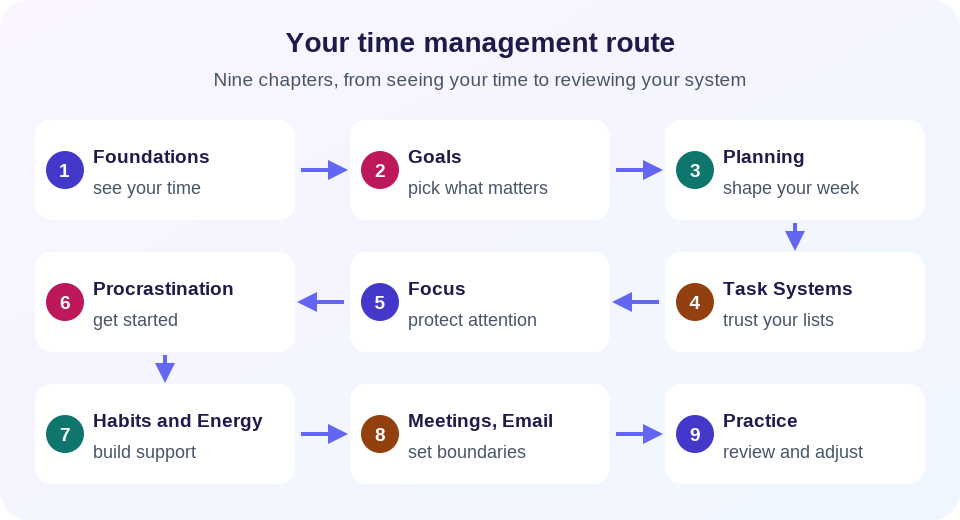
What you will learn
- How the nine chapters fit together
- How to study the course so the ideas turn into habits
- How to record a simple starting point
- What this course can and cannot do for you
The nine chapters
Each chapter answers one everyday question.
- Foundations: What is time management, and where does your time go now?
- Goals and Priorities: What matters most, and what can wait?
- Planning Your Time: How do you turn priorities into a realistic week?
- Task Systems: How do you stop keeping everything in your head?
- Focus and Distraction: How do you protect your attention?
- Procrastination: Why do you delay, and how can you start?
- Habits and Energy: How can routines and rest support your work?
- Meetings, Email and Boundaries: How do you handle other people's demands?
- Practice and Review: How do you keep your system working?
The first four chapters build the base. You learn to see your time, choose your goals, plan your week, and keep your tasks in one trusted place. The later chapters help you carry out your plans in real life.
How to study this course
Reading about time management feels useful, but reading alone changes very little. Use this simple cycle for each lesson:
- Read the lesson once without taking many notes.
- Try one idea within two days. Choose the smallest version.
- Notice what happened. Did it help? What got in the way?
- Keep, change, or drop the idea.
You do not need to adopt every method. Some methods suit a student with a fixed timetable. Others suit a manager whose day changes every hour. Your job is to test them and keep what fits your life.
A good pace is two or three lessons per week. A slower pace gives you time to practice. If you rush through the whole course in one weekend, you will probably remember the names of methods but not use them.
A worked example
Imagine Mina, who studies in the morning and works part-time in the evening. She reads a lesson about tracking time. Instead of tracking every minute for two weeks, she writes down her main activity every hour for three days. She notices that her "short break" after lunch often lasts 90 minutes. She does not blame herself. She simply moves one study session to before lunch and checks the result the next week.
This is the whole method in small form: observe, make one change, and check.
Record your starting point
Before you change anything, write down how things feel today. You will compare your answers at the end of the course. Rate each statement from 1 (rarely true) to 5 (almost always true).
- I know what my most important tasks are this week.
- I usually finish my important tasks before their deadlines.
- I have time for rest and people I care about.
- I rarely forget a promise or a task.
- I can focus on one thing when I need to.
Low scores are not a failure. They show where the course may help you most. If your lowest score is about forgetting tasks, you will probably enjoy the Task Systems chapter. If it is about focus, look forward to chapter five.
This course teaches general skills. It cannot fix an impossible workload on its own. If your tasks need more hours than you have, you may need to negotiate, delegate, or drop some of them. Long-lasting stress, sleep problems, or trouble concentrating that affects daily life are good reasons to talk to a doctor or another qualified professional.
What good time management looks like
It does not mean filling every minute. A well-managed week usually has:
- A few clear priorities
- A plan with some empty space
- A reliable place for tasks and dates
- Regular time for rest
- A short habit of looking back and adjusting
You can be busy and badly organized. You can also have a calm day and still do your most important work. The aim is not to look productive. The aim is to spend your limited time on things that matter to you.
Common mistakes
- Trying every method at once. Change one thing at a time so you know what helps.
- Starting by buying a new app or planner. Learn the idea first, then choose a tool.
- Judging yourself harshly for your starting scores. They are information, not a grade.
- Expecting a perfect week. Plans change, and a good system helps you recover.
Try it
Rate your starting point. The tool shows your lowest area and suggests where to pay close attention.
Check your understanding
Quick check · 4 questions
of 4 answered You scored / 4 · perfect!
-
1. What is the main aim of good time management?
The aim is to use limited time on what matters, including rest. -
2. You read about a new planning method. What is a good next step?
A small, quick test shows whether the idea fits your life. -
3. Why record a starting point?
It shows your weak areas and gives you something to compare with later. -
4. Your tasks need more hours than you have. What may you need to do?
No planning method creates extra hours.
Summary
- The course has nine chapters, from understanding your time to reviewing your system.
- Read, try, notice, then keep, change, or drop each idea.
- Record a starting point so you can see your progress.
- Good time management includes priorities, empty space, rest, and review.
- No method can fix an impossible workload by itself.
Volg je voortgang
Maak een gratis account om lessen af te vinken en op elk apparaat verder te gaan waar je gebleven was.