
























Les 19 · Focus and Distraction
How Attention Works
Learn why focus is limited, what task switching really costs you, and how to spot the internal and external distractions that break your concentration.
Planning tells you what to do and when. Focus decides whether the work actually happens. You can have a perfect calendar and still lose a whole morning to small interruptions.
This chapter is about protecting your attention. First, you need a simple picture of how it behaves. Then the later lessons give you tools for your phone, your work blocks and the people around you.
What you will learn
- Why demanding work gets worse when you split your attention
- What happens each time you switch tasks
- The difference between external and internal distractions
- How to notice your own distraction pattern
One demanding task at a time
You can combine some activities easily. You can walk and talk. You can fold laundry while listening to music. This works because at least one of the activities is so familiar that it needs little thought.
Two demanding tasks are different. Writing a message while following a discussion is a good example. Both need language and decisions. Usually you cannot give both your full thought at the same time. You jump back and forth. Each task gets only part of you, and you may miss things without noticing.
So when people say they are multitasking on serious work, they are often task switching. It can feel busy and productive. The result often has more mistakes and takes longer.
The cost of switching
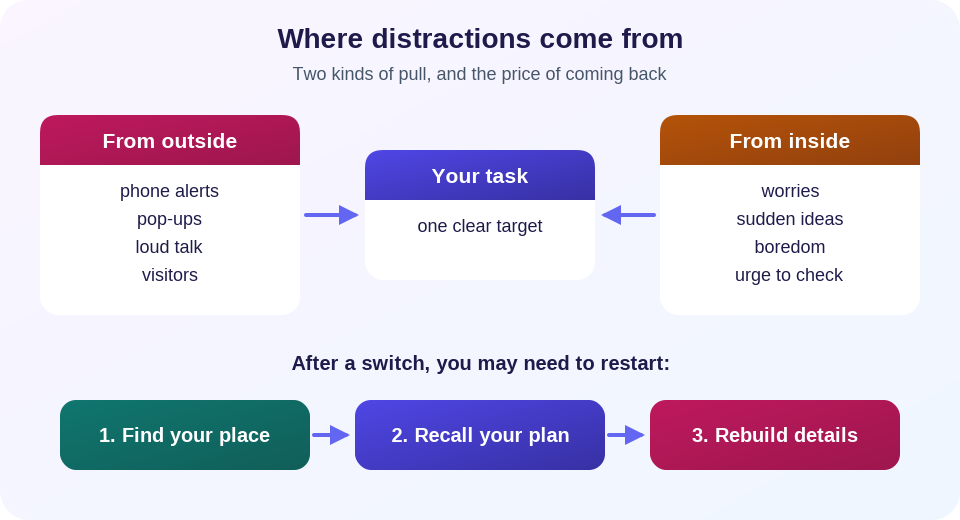
Every switch can have a restart cost. When you return to a task, you must answer questions again:
- Where was I?
- What was I about to do?
- Which details did I need to keep in mind?
For simple tasks, the answers come quickly. For complex tasks, such as solving a math problem or fixing a plan with many parts, rebuilding that picture can take real effort.
Part of your mind may also stay on the thing you just left. The researcher Sophie Leroy used the term attention residue for this. You glance at a worrying message, go back to your essay, and keep writing a reply in your head. The glance was short. Its effect can last longer.
Example: two mornings
Amara has to write a short proposal. On the first morning, her chat window stays open. She writes two sentences, answers a question, writes one more, checks a notification and rereads her first paragraph. By lunch she has half a page, and she feels tired.
On the second morning, she closes the chat, writes down the one question the proposal must answer, and works for 40 minutes. Then she opens the chat and replies to everyone together. Her colleagues waited less than an hour. She had one clear stretch for the hard part.
Not every job allows this. If you answer customers or care for a child, being interruptible is part of the task. The aim is to protect focus where you can, not to ignore your responsibilities.
External and internal distractions
An external distraction comes from your surroundings: a ringing phone, a pop-up, a loud conversation, a person at your desk.
An internal distraction starts inside you: a sudden idea, a worry, hunger, boredom, or the urge to check something. No one asked for your attention. It moved by itself, or you moved it.
This difference matters because the fixes are often different. Turning off alerts helps with the phone. It does little for a worry about tomorrow. For internal distractions, try a capture note. Keep paper beside you. When a thought appears, write a few words, such as "pay the electricity bill," and return to your task. You are not ignoring the thought. You are giving it a safe place until later.
Some internal signals deserve action now. If you are hungry, thirsty, in pain or need the bathroom, take care of that. A capture note is for things that can wait.
Look for the moment just before
Many switches happen at predictable points. You reach a hard sentence. A page loads slowly. You finish a small step and have not chosen the next one. In these gaps, your hand moves to something easier.
For one or two work sessions, make a small mark each time you leave your task. Next to it, write the reason in one or two words. Do not try to change anything yet. At the end, look for the two most common reasons. Those are your best starting points.
For example, your notes might show "phone" three times and "stuck" six times. Blocking apps would solve only a small part of that. A better first step might be to write down the exact thing that confuses you, or to choose a smaller next action.
Before a short pause, leave yourself a restart line, such as "Next: add the cost example." It lowers the effort of coming back.
When focus is hard for other reasons
Attention changes with sleep, stress, illness, noise and interest in the task. A bad focus day does not mean you are lazy. If concentration problems are strong, long-lasting or affect daily life, it is sensible to talk to a qualified health professional. This course gives general study and work skills, not a diagnosis.
Common mistakes
- Believing that a quick glance is free. Even short checks can break your train of thought.
- Blaming only your phone while ignoring worries, unclear tasks and tiredness.
- Expecting perfect focus all day. Plan some focused stretches and some open time.
- Cutting yourself off without telling people who depend on you.
Try it
Sort each example. Ask yourself where the pull on your attention starts.
Check your understanding
Quick check · 4 questions
of 4 answered You scored / 4 · perfect!
-
1. What often happens when you try to do two demanding tasks together?
Demanding tasks compete for attention, so you tend to jump between them. -
2. What does the term attention residue describe?
You may keep thinking about what you left, even while looking at the new task. -
3. A thought about a bill interrupts your reading. It can wait. Which tool fits best?
This is an internal distraction. A capture note stores the thought for later. -
4. What is a useful first step for understanding your own distractions?
A short, honest record shows your most common triggers.
Summary
- Demanding tasks usually work best one at a time.
- A switch can have a restart cost, and your mind may stay partly on the last task.
- Distractions can be external or internal, and they often need different fixes.
- A capture note and a restart line make returning easier.
- Your own distraction record is a useful guide.
Volg je voortgang
Maak een gratis account om lessen af te vinken en op elk apparaat verder te gaan waar je gebleven was.