
























Les 14 · Clear Writing at Work
Writing With a Clear Purpose
Plan clear workplace writing: know your purpose and reader, put the main point first, and use headings and lists so busy people can read quickly and act.
At work and in study, people often read your message between other tasks. Many skim first and read closely only if they need to. If your point is hidden, it may be missed.
Clear writing begins before the first sentence. You decide why you are writing, who will read it and what should happen next.
What you will learn
- How to define your purpose and reader
- How to put the main point first
- How to organize a message so it is easy to scan
- A quick check before you send
Two planning questions
1. What do I want to happen? Pick the main purpose.
- Inform: the reader should know something.
- Request: the reader should do something.
- Decide: the reader should choose.
- Record: people should be able to check this later.
2. Who will read it? Think about what they already know, what they care about, how much time they have and whether others may see it too.
Write a one-sentence plan: "I want the volunteer team to confirm their Saturday shifts by Wednesday." That sentence often becomes your opening.
Put the main point first
A common weak order is history, details, then the request. A stronger order is point, key details, then background if needed.
Weak: "As you know, we've had a few problems with the room, and last week the booking system changed, so after some thought I wondered..."
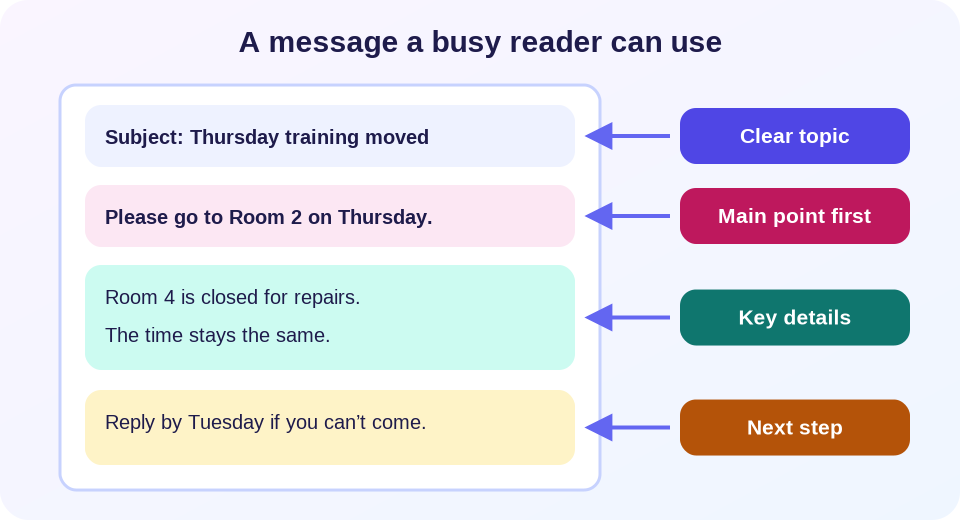
Strong: "Please move Thursday's training to Room 2. The usual room is closed for repairs. The time stays the same."
Some readers and cultures expect a greeting or a brief friendly opening before the point. Keep it short, then get to the purpose.
Organize for scanning
- A clear title or subject line says what the message is about.
- Short paragraphs hold one idea each.
- Headings help in longer documents.
- Bulleted lists suit items with no order.
- Numbered lists suit steps that happen in order.
- Tables help compare items across the same features.
Formatting helps only when it matches the content. Too much bold or too many bullet points make nothing stand out. Some apps show formatting differently, and some readers use screen readers, so keep the structure simple and use real headings and lists where your tool offers them.
Make the action visible
If you need something, say so plainly: who should act, what they should do and by when.
| Unclear | Clear |
|---|---|
| "It would be good to look at this." | "Sara, please check page 2 by Tuesday." |
| "Let me know your thoughts." | "Please tell me which layout you prefer, A or B." |
| "ASAP, please." | "Please send it by 3 p.m. Monday, your time." |
If no action is needed, say that too: "No reply needed. This is for your information." For teams in different time zones, name the time zone.
Length
Short is not always clear. A two-line message that leaves out the date can cause ten follow-ups. Include what the reader needs to understand and act, then cut the rest. For long material, add a short summary at the top and place detail below or in an attachment or link, if your workplace allows that.
When you finish, read only the title and the first two sentences. Would a busy reader know what this is about and what they should do? If not, move that information up.
A five-point check
- Is the purpose clear early?
- Does the reader have the information they need?
- Is each action tied to a person and a time?
- Is anything private or unnecessary?
- Does it still make sense if forwarded to someone else?
Worked example
Draft: "Hi all, lots going on lately. The survey, as discussed, plus the new form. Some people haven't done it yet. Thanks."
Revised: "Hi all, please complete the 5-question volunteer survey by Friday at 5 p.m. It takes about two minutes and helps us plan next month's shifts. The link is on the team page. If you already filled it in, thank you; no action is needed."
The revision names the action, deadline, reason and what to do if it is already done. The "two minutes" should only be included if it is true.
Plan longer documents
For a longer document, such as a proposal or a guide, outline before you write. List your headings, and put one sentence under each saying what it will cover. Then check the order. Does each section answer a question the reader will have at that point?
This takes a few minutes and can save a rewrite. If a heading has nothing to say, remove it. If one heading holds two topics, split it. You can also share the outline early with the person who asked for the document, so that they can correct your direction before you write a lot of text.
Reread after a break
If the message matters, leave it for a few minutes and read it again with fresh eyes. You will often spot a missing date or a sentence that only makes sense to you.
Common mistakes
- Writing before you know what you want to happen.
- Putting the request at the end of a long story.
- Using "someone" when you mean a specific person.
- Writing "soon" when you mean a date.
- Formatting everything as important.
Try it
Check your understanding
Quick check · 4 questions
of 4 answered You scored / 4 · perfect!
-
1. What should you decide before writing a work message?
Purpose and reader guide everything else. -
2. Where does a request usually work best?
Busy readers can find it quickly. -
3. Which list fits steps that must be done in order?
Numbers show sequence. -
4. Which request is clearest?
It names who, what and when.
Summary
- Know your purpose and reader before you write.
- Put the main point early.
- Use headings and lists when they match the content.
- State who should act, what and by when.
- Read the top of your message as a busy reader would.
Volg je voortgang
Maak een gratis account om lessen af te vinken en op elk apparaat verder te gaan waar je gebleven was.