
























Les 22 · Feedback
Feedback: Purpose and Types
Understand what feedback is for, the difference between appreciation, coaching and evaluation, and how to choose the right moment, place and amount of detail.
Feedback is information about someone's work or behavior that can help them. It can tell them what to keep doing, what to change and how their actions affect others. Without it, people have to guess how they are doing.
Many people feel nervous about feedback because they expect criticism. Good feedback is much wider than that. It includes thanks and recognition, practical coaching and honest judgments about quality. This lesson helps you pick the right kind. The next lessons show how to give and receive it.
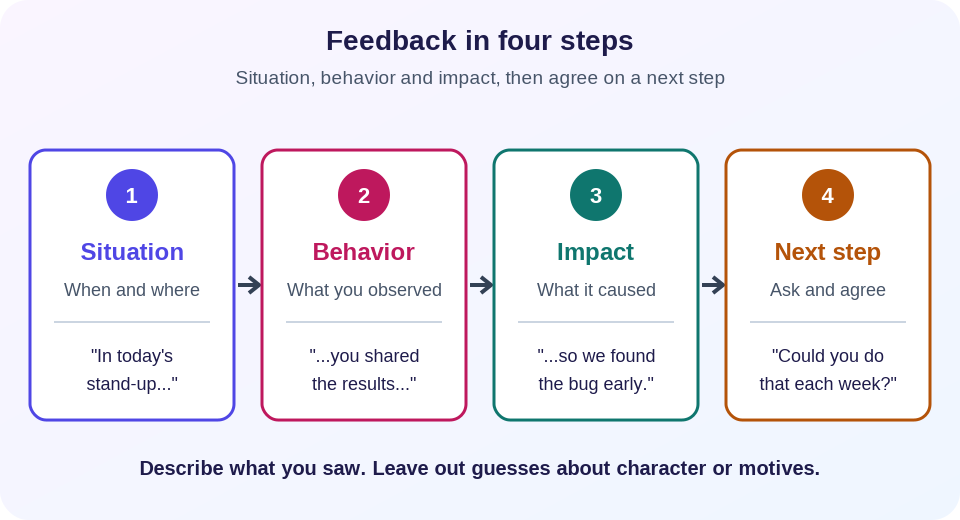
What you will learn
- Three common kinds of feedback
- What makes feedback useful
- When and where to give it
- How to ask for the kind you need
Three kinds of feedback
A helpful way to sort feedback, used by many coaches and writers, is by its purpose.
| Kind | Purpose | Example |
|---|---|---|
| Appreciation | Show that you noticed and value something | "Thank you for staying calm with that caller." |
| Coaching | Help someone get better | "Next time, try opening with the main number." |
| Evaluation | Say how work compares with a standard | "This draft does not yet meet the safety checklist." |
Problems often start when the two people expect different kinds. Imagine a friend shows you a first short story and hopes for encouragement. You reply with a list of grammar errors. Your points may be correct, but they answer a question your friend did not ask.
Mixing kinds can also blur the message. If you give coaching and evaluation at once, the listener may hear only the judgment and miss the advice. When both are needed, label them: "First, where this stands against the requirements. Then some ideas to improve it."
What makes feedback useful
Useful feedback is usually:
- Specific. "Your summary on page one listed the three risks" is better than "Good job."
- About behavior and results, not about personality. "The message went out without the date" is better than "You are careless."
- Timely. Details are fresher soon after the event.
- Actionable. It points to something the person can do.
- Balanced and honest. Praise should be real, and problems should be clear.
Compare these two comments.
- "Your presentation was confusing."
- "On slides four to six, there were three charts with different time ranges, and I lost track of the trend. Using the same range on all three would help."
The second comment tells the speaker where the problem was, what effect it had and what to try.
Choose the moment and the place
Ask yourself these questions before you speak.
- Is the person able to listen now? Right after a stressful event may be a poor time, unless something urgent must change.
- Is this private enough? Sensitive points are usually better one to one. Praise can be public, but some people dislike public attention, so learn their preference.
- Which channel fits? A quick positive note works well in writing. Serious or sensitive concerns usually go better in a live conversation.
- How much is useful? One or two key points are easier to act on than ten.
Safety problems, harassment and serious rule breaking are not ordinary feedback topics. Act promptly and follow your organization's reporting process. Rules and laws differ by country and employer.
Ask permission and ask for what you need
A short invitation helps the other person get ready.
- "Would you like some thoughts on the draft?"
- "I noticed something in the meeting. Is now a good time to talk about it?"
A manager sometimes must give feedback even if the timing is not perfect. Even then, you can offer a choice of time: "We need to talk about the deadline today. Would after lunch work?"
When you are the one asking, say which kind you want.
- Appreciation: "I worked hard on this and I'd like to know what is working."
- Coaching: "How could I make the opening stronger?"
- Evaluation: "Is this ready to send to the client? If not, what is missing?"
Clear requests get more useful answers than "What do you think?"
Feedback and trust
People hear feedback through the relationship they have with you. If the only time you speak is to point out problems, even fair comments may feel like attacks. Notice good work often, and mean it. This is not a trick to soften bad news. It is accurate information that people need too.
There is no need to force a fixed ratio of positive to negative comments. Aim to be truthful, specific and respectful each time.
A worked example
Priya asks a colleague, Tom, to look at her email to a customer.
- Her request: "Could you coach me on the tone? I'm not asking you to check the facts yet."
- Tom's reply: "The first line thanks them clearly, which works well. The third sentence, 'As I already told you,' may sound annoyed. You could write, 'To recap,' instead."
Tom stays inside the request. He names one strength and one change, and he gives a replacement phrase.
Common mistakes
- Giving a detailed critique when the person needs encouragement first
- Praising with empty words such as "nice" and nothing else
- Saving up many months of comments for one long meeting
- Judging character instead of describing behavior
- Giving sensitive criticism in front of a group
Try it
Sort each comment into appreciation, coaching or evaluation.
Check your understanding
Quick check · 4 questions
of 4 answered You scored / 4 · perfect!
-
1. Which comment is coaching?
It suggests a way to improve. -
2. Which feedback is most useful?
It is specific and describes behavior and its result. -
3. What should you do before giving thoughts on a friend's first draft?
Matching the purpose avoids answering a question the person did not ask. -
4. What is the best way to handle a serious safety problem?
Serious risks need quick action through the proper process.
Summary
- Feedback can be appreciation, coaching or evaluation.
- Make it specific, behavior-based, timely and actionable.
- Choose a suitable time, place and amount.
- When you ask, say which kind you need.
Volg je voortgang
Maak een gratis account om lessen af te vinken en op elk apparaat verder te gaan waar je gebleven was.