
























Les 29 · Compressible and Supersonic Flow
Shock waves and expansion fans
Learn normal and oblique shock relations, the theta-beta-Mach chart, Prandtl-Meyer expansion fans, and compute lift and wave drag with shock-expansion theory.
If a smooth supersonic flow meets an obstacle, it cannot gently adjust: the air upstream has no way of knowing the obstacle is there. Instead the flow changes almost instantly across a surface only a few molecular mean free paths thick, a shock wave. Pressure, density and temperature jump up and the flow slows. When a supersonic flow turns away from itself (round a convex corner) it expands smoothly through a fan of Mach waves instead. Together these two phenomena let you calculate forces on supersonic bodies exactly in many cases.
What you will learn
- The normal shock relations and what they imply about entropy and stagnation pressure.
- How an oblique shock turns a supersonic stream, and how the θ-β-M relation limits it.
- How a Prandtl-Meyer expansion fan accelerates flow around a convex corner.
- How to combine shocks and expansions to compute lift and wave drag on a flat plate.
Key terms
Normal shock: a shock perpendicular to the flow; the flow behind it is always subsonic.
Oblique shock: a shock inclined at angle β to the flow; it turns the flow by θ.
Expansion fan: a set of Mach waves through which flow turns around a convex corner and accelerates.
Prandtl-Meyer function ν(M): the angle through which a sonic flow must expand to reach Mach number M.
The normal shock
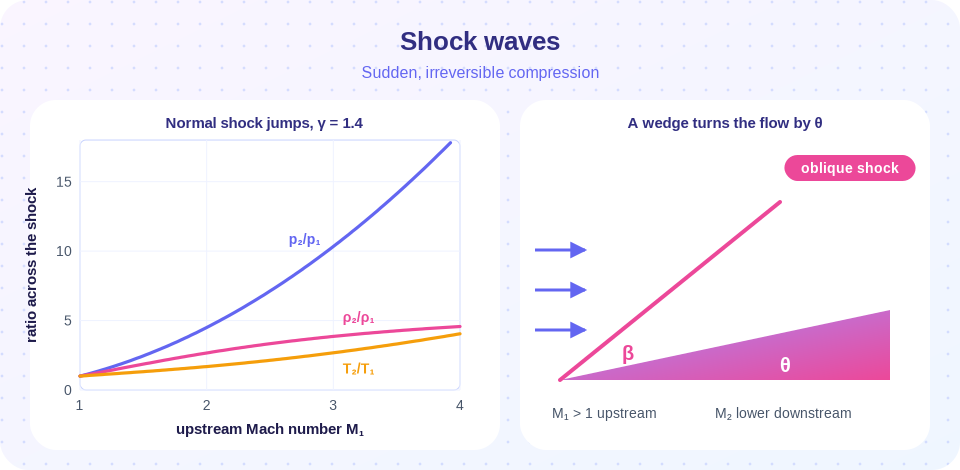
Conservation of mass, momentum and energy across a shock fixes everything behind it from the upstream Mach number M₁. For air (γ = 1.4):
M₂² = (1 + 0.2 M₁²) / (1.4 M₁² − 0.2)
p₂/p₁ = 1 + (2γ/(γ+1)) (M₁² − 1)  = 1 + 1.1667 (M₁² − 1)
ρ₂/ρ₁ = (γ+1) M₁² / ((γ−1) M₁² + 2)
T₂/T₁ = (p₂/p₁) / (ρ₂/ρ₁)
For M₁ = 2: M₂ = 0.577, p₂/p₁ = 4.50, ρ₂/ρ₁ = 2.67, T₂/T₁ = 1.69. For M₁ = 3: M₂ = 0.475, p₂/p₁ = 10.33, ρ₂/ρ₁ = 3.86. Notice two things. First, M₂ is always below 1: a normal shock turns supersonic flow subsonic. Second, the density ratio cannot exceed (γ+1)/(γ−1) = 6 however strong the shock is.
Total temperature stays the same across the shock (no heat is added), but stagnation pressure falls, because the process is irreversible and entropy rises. At M₁ = 2 the stagnation pressure behind the shock is only about 72% of the value ahead of it; at M₁ = 3, about 33%. This loss of stagnation pressure is the heart of wave drag and why shocks in an engine inlet cost thrust. A "shock" that goes the other way, from subsonic to supersonic, would reduce entropy and is impossible.
Oblique shocks
Most shocks on aircraft are not normal. A wedge in a supersonic stream forces the flow to turn by the wedge angle θ. The flow responds with a shock inclined at angle β to the upstream direction. A neat trick: the flow component tangential to the shock is unchanged, and the component normal to it follows the normal-shock relations with Mach number Mₙ₁ = M₁ sin β. Then:
tan θ = 2 cot β · (M₁² sin²β − 1) / ( M₁² (γ + cos 2β) + 2 )
M₂ = Mₙ₂ / sin(β − θ)
For each θ (below a maximum) there are two solutions for β: a weak shock (small β, flow stays supersonic) and a strong shock (large β, flow becomes subsonic). Nature normally picks the weak one. If θ exceeds the maximum for that Mach number, no attached solution exists, and a curved detached bow shock stands ahead of the body. This is why blunt noses of re-entry capsules have detached shocks while sharp wedges at moderate angles have attached ones.
Example: M₁ = 2, θ = 10° gives a weak shock at β ≈ 39.3°, with M₂ ≈ 1.64 and p₂/p₁ ≈ 1.71. The normal component is only 2 · sin 39.3° = 1.27, so the shock is weak and the losses small. That is why supersonic inlets use a sequence of weak oblique shocks followed by a weak normal shock rather than one strong normal shock.
Expansion fans
Now turn the flow the other way: around a convex corner of angle θ. There is no shock; instead a fan of Mach waves, each at the local Mach angle μ, spreads from the corner. Pressure, density and temperature all fall and the Mach number rises. The flow is isentropic, and the turning angle is just a difference of the Prandtl-Meyer function:
ν(M) = √((γ+1)/(γ−1)) · arctan √( (γ−1)/(γ+1) · (M² − 1) ) − arctan √(M² − 1)
θ = ν(M₂) − ν(M₁)
At M = 1 ν = 0; at M = 2, ν = 26.38°. Expanding M₁ = 2 through 10° needs ν₂ = 36.38°, which gives M₂ ≈ 2.38. Pressure then follows from the isentropic relation using constant p₀.
Shock-expansion theory
For a flat plate at a small angle of attack α in supersonic flow, the lower surface turns the flow into itself by α: an oblique shock, high pressure. The upper surface turns away by α: an expansion fan, low pressure. With the pressures p₂ (lower) and p₃ (upper), the normal force coefficient is cₙ = (p₂ − p₃)/q∞ with q∞ = ½γ p∞ M². Then c_l = cₙ cos α and wave drag c_d = cₙ sin α. You will compute this in the second example below and compare it with the simple formula c_l = 4α/√(M² − 1) of the next lesson.
Common misconceptions
"A shock is a barrier the aircraft punches through." It is a thin zone of compression carried with the aircraft; the "sound barrier" was a historical engineering problem, not a wall.
"Shocks heat the air by friction." They raise temperature by irreversible compression and conversion of kinetic energy; viscosity inside the thin shock zone is what makes the process irreversible, but the heating is not "surface friction".
"Flow behind any shock is subsonic." Only behind normal and strong oblique shocks. Weak oblique shocks leave the flow supersonic.
Try it
First, the θ-β-M chart for four Mach numbers. The peak of each curve is the largest turn that an attached shock can achieve.
Press Run (or Ctrl + Enter) to see the result here.
Program input · what you'd type while the program runs
Type the answers before you press Run, one per line. Each time the program reads a line (with input()), it gets the next line from this box.
Second, a complete shock-expansion calculation for a flat plate, compared with the linear formula.
Press Run (or Ctrl + Enter) to see the result here.
Program input · what you'd type while the program runs
Type the answers before you press Run, one per line. Each time the program reads a line (with input()), it gets the next line from this box.
Check your understanding
Quick check · 5 questions
of 5 answered You scored / 5 · perfect!
-
1. What happens to the Mach number across a normal shock?
Behind a normal shock the flow is always subsonic. -
2. What is the maximum possible density ratio across a normal shock in air (γ = 1.4)?
ρ₂/ρ₁ → (γ+1)/(γ−1) = 6 as M₁ → ∞. -
3. Which quantity falls across a normal shock?
Static pressure and temperature rise; stagnation pressure falls because the process is irreversible. -
4. A supersonic stream turns round a convex corner. What happens to the pressure?
Convex corner means expansion: pressure falls, Mach number rises. -
5. For a given Mach number and a wedge angle below the maximum, how many attached oblique-shock solutions exist?
The θ-β-M relation has a weak and a strong solution; nature usually picks the weak one.
Summary
- A normal shock slows supersonic flow to subsonic, raises
p,ρ,Tand loses stagnation pressure. - Oblique shocks turn the flow by
θ; use the normal componentM₁ sin βwith the normal-shock formulas. - Beyond the maximum turn angle, the shock detaches from the body.
- Expansion fans are isentropic:
θ = ν(M₂) − ν(M₁). - Shock-expansion theory gives exact forces on a flat plate or diamond airfoil.
Volg je voortgang
Maak een gratis account om lessen af te vinken en op elk apparaat verder te gaan waar je gebleven was.