
























레슨 28 · Antenna Fundamentals
Impedance, Efficiency and Polarization
Understand radiation resistance, reflection coefficient, VSWR and mismatch loss, antenna bandwidth and efficiency, and how polarization mismatch costs decibels.
An antenna with a perfect pattern is useless if the transmitter cannot push power into it, or if the wave it sends arrives in a polarization the receiving antenna ignores. These are the two ways power is wasted before the pattern even matters. This lesson gives each of them a number: the reflection coefficient and its mismatch loss, and the polarization loss factor.
What you will learn
- How to model an antenna as a circuit and what radiation resistance means.
- How to compute reflection coefficient, VSWR and mismatch loss.
- How bandwidth relates to the antenna's Q.
- How to compute polarization loss for linear and circular cases.
Key terms
Radiation resistance Rr: the resistance that would dissipate the same power as the antenna radiates, for the same current.
Reflection coefficient Γ: (Za - Z0) / (Za + Z0) at the antenna terminals.
VSWR: (1 + |Γ|) / (1 - |Γ|).
Mismatch loss: -10 log10(1 - |Γ|²) dB, the power not accepted.
Polarization loss factor (PLF): fraction of the incoming power usable by the receiver given the polarization angle.
The antenna as a load
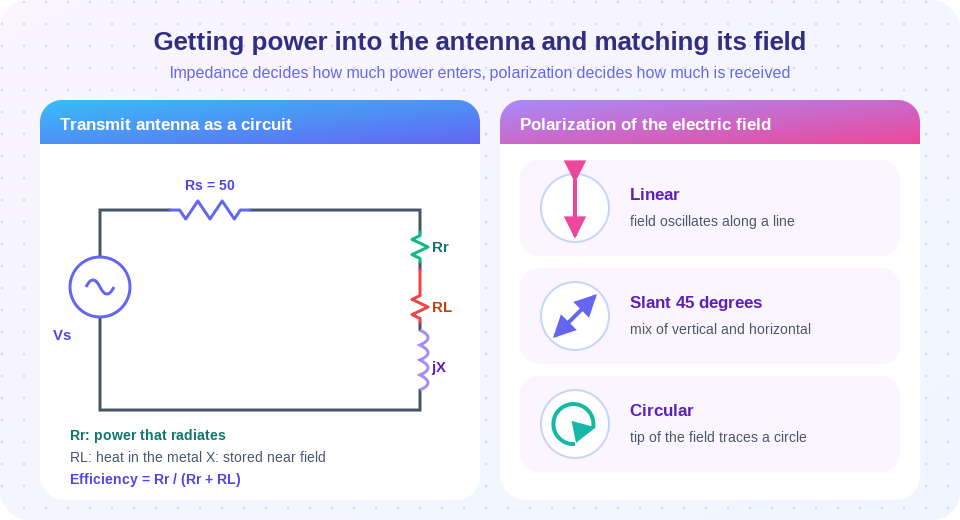
Seen from its terminals, a transmit antenna is an impedance Za = Rr + RL + jX. The power radiated is (1/2)|I|² Rr, the power wasted as heat in the conductor and dielectric is (1/2)|I|² RL, and the reactance X stores energy in the near field. The efficiency is
e = Rr / (Rr + RL)
Typical values: a resonant half-wave dipole in free space has Za ≈ 73 + j42.5 Ω at its nominal length and a purely resistive 73 Ω when shortened by a few percent. A quarter-wave monopole over a perfect ground has half of that, about 36.5 Ω. A tiny loop or short dipole has very small Rr, so even a little loss resistance ruins the efficiency, which is why electrically small antennas are poor radiators.
Mismatch
The feed line has characteristic impedance Z0, usually 50 Ω. A mismatch reflects part of the wave:
Γ = (Za - Z0) / (Za + Z0), VSWR = (1 + |Γ|) / (1 - |Γ|), RL (dB) = -20 log10 |Γ|
The fraction of power reflected is |Γ|² and the power accepted is 1 - |Γ|². A VSWR of 2:1 means |Γ| = 1/3, return loss 9.54 dB, and 11 percent of the power reflected, which is a mismatch loss of 0.51 dB. A VSWR of 1.5:1 gives |Γ| = 0.2, return loss 14 dB and mismatch loss 0.18 dB. Many data sheets define "the bandwidth" as the frequency range where VSWR stays under 2:1.
A dipole of 73 Ω on a 50 Ω line: Γ = (73 - 50)/(73 + 50) = 0.187, VSWR = 1.46, mismatch loss 0.15 dB. That is negligible, which is why dipoles are used directly on 50 Ω or 75 Ω cables.
Bandwidth and Q
Near resonance an antenna behaves like a series RLC circuit. Its quality factor Q = ω0 L / R sets how fast the reactance grows away from resonance. For a given VSWR limit the fractional bandwidth is roughly proportional to 1/Q. A thick dipole has low Q and wide bandwidth; a tiny antenna has high Q and narrow bandwidth. The Chu-Harrington limit sets a minimum Q for any antenna of given electrical size: shrinking the antenna necessarily narrows its bandwidth.
Polarization
Polarization is the shape traced by the tip of the electric field vector as the wave goes by. A linear field oscillates along a line; a circular one rotates at the carrier frequency, either right-handed or left-handed. The axial ratio (AR) measures the ellipse: AR = 1 (0 dB) is perfect circular, infinite is linear.
A receiving antenna responds to the component of the incoming field along its own polarization. For two linear antennas misaligned by angle ψ the polarization loss factor is
PLF = cos² ψ
- Aligned (ψ = 0): PLF = 1, no loss.
- ψ = 45°: PLF = 0.5, a 3 dB loss.
- ψ = 90°: PLF = 0, theoretically infinite loss. Practical cross-polar isolation of 20 to 30 dB is typical, which is why systems reuse a frequency on two orthogonal polarizations.
- A circular wave into a linear antenna, or the reverse: a constant 3 dB loss at any rotation angle, which is why GPS handsets with linear antennas can tolerate any orientation at the cost of 3 dB.
- Right-hand circular into left-hand circular: ideally no reception at all.
A reflection reverses the sense of circular polarization, which is used to reject bounced signals.
Common misconceptions
"VSWR 1:1 means the antenna works well." It means power gets in. A perfectly matched lossy antenna still wastes power as heat.
"A bad VSWR always means a bad antenna." A VSWR of 3:1 only loses about 1.25 dB. Matching networks can improve it, but a wrongly matched efficient antenna beats a matched poor one.
"Rotating a linear antenna by 90 degrees just costs a bit." Cross-polarization can drop the signal by 20 dB or more.
Try it
Press Run (or Ctrl + Enter) to see the result here.
Program input · what you'd type while the program runs
Type the answers before you press Run, one per line. Each time the program reads a line (with input()), it gets the next line from this box.
Press Run (or Ctrl + Enter) to see the result here.
Program input · what you'd type while the program runs
Type the answers before you press Run, one per line. Each time the program reads a line (with input()), it gets the next line from this box.
Press Run (or Ctrl + Enter) to see the console output here.
No output.
Check your understanding
Quick check · 5 questions
of 5 answered You scored / 5 · perfect!
-
1. A 100 ohm antenna on a 50 ohm line has |Gamma| =
(100 - 50)/(100 + 50) = 1/3. -
2. What fraction of power is reflected at VSWR = 2?
|Gamma| = 1/3 so |Gamma|^2 = 1/9, about 11 percent. -
3. An antenna has Rr = 20 ohm and RL = 5 ohm. Its efficiency is
e = 20/(20 + 5) = 0.8. -
4. Two linear antennas are misaligned by 60 degrees. The polarization loss is
cos^2 60 = 0.25, which is -6 dB. -
5. Which antenna has the widest bandwidth for similar size and frequency?
Bandwidth is roughly proportional to 1/Q.
Summary
Za = Rr + RL + jX; efficiencye = Rr/(Rr + RL).Γ = (Za - Z0)/(Za + Z0); VSWR 2:1 means 0.51 dB mismatch loss and return loss 9.54 dB.- Bandwidth scales roughly as
1/Q. PLF = cos² ψfor linear antennas; circular to linear costs 3 dB.