
























레슨 12 · Electrical Signaling
Resting membrane potential: ions, gradients and the Nernst equation
Learn why neurons rest near -70 mV: ion gradients, selective channels, the sodium-potassium pump, and how to compute potentials with Nernst and GHK equations.
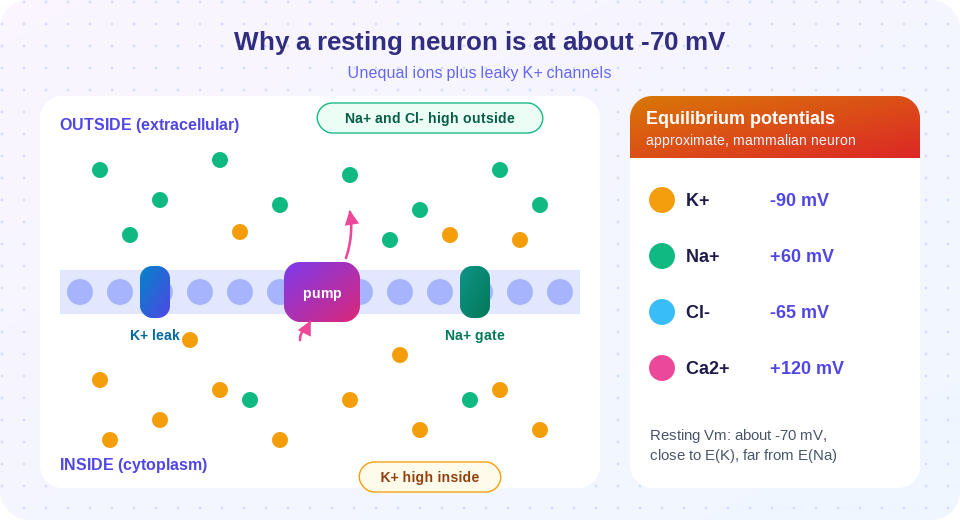
Why is the inside of a resting neuron about 70 millivolts (mV) more negative than the outside? The answer needs only two ingredients: ions that are unequally distributed across the membrane, and a membrane that is far more permeable to one of them, potassium, than to the others. Once you see why, a lot of neuroscience follows: spikes, synaptic potentials and the effects of drugs and diseases.
What you will learn
- Typical ion concentrations inside and outside a neuron.
- How a concentration gradient and an electrical gradient balance (the Nernst equation).
- How several ions combine to set the resting potential (the Goldman equation).
- What the sodium-potassium pump does, and does not do.
Key terms
- Equilibrium potential (E): the voltage at which an ion has no net movement across the membrane.
- Nernst equation: the formula for E of one ion.
- Permeability (P): how easily an ion crosses the membrane.
- Leak channel: a channel that is open at rest.
- Na⁺/K⁺-ATPase: the pump that moves 3 Na⁺ out and 2 K⁺ in per ATP.
Unequal ions
Typical concentrations for a mammalian neuron (millimolar, mM; roughly):
| Ion | Outside | Inside |
|---|---|---|
| Na⁺ | 145 | 15 |
| K⁺ | 5 | 140 |
| Cl⁻ | 110 | 10 |
| Ca²⁺ | 2 | 0.0002 (200 nM) |
Large organic anions (proteins, nucleic acids) are trapped inside the cell and carry negative charge. Two things keep these gradients alive. The sodium-potassium pump uses ATP to push 3 Na⁺ out and 2 K⁺ in. Other transporters keep Cl⁻ and Ca²⁺ in check. The brain spends a large part of its energy budget keeping these gradients up.
Two forces on every ion
Each ion feels two pushes. Diffusion pushes it down its concentration gradient: K⁺ tends to leave the cell because there is more inside. But when K⁺ leaves, each ion that goes takes a positive charge with it and makes the inside more negative, and that electrical force pulls K⁺ back. At some voltage the two forces cancel exactly. That voltage is the equilibrium potential, given by the Nernst equation:
E = (R·T / (z·F)) · ln([ion]out / [ion]in)
Here R is the gas constant, T the temperature in kelvin, z the ion's charge and F the Faraday constant. At body temperature (37 °C, 310 K), R·T/F is about 26.7 mV, and converting to base-10 logarithms gives the handy form:
E ≈ (61.5 mV / z) · log10([ion]out / [ion]in)
Work through potassium: E_K = 61.5 × log10(5/140) = 61.5 × (-1.447) ≈ -89 mV. Sodium: E_Na = 61.5 × log10(145/15) = 61.5 × 0.985 ≈ +61 mV. Chloride has z = -1, so E_Cl = -61.5 × log10(110/10) ≈ -64 mV. Calcium (z = +2): E_Ca = 30.8 × log10(2/0.0002) ≈ +123 mV.
An equilibrium potential tells you the direction of ion flow. If Vm is more positive than E_K, K⁺ flows out; if more negative, K⁺ flows in. The difference Vm - E is the driving force.
Several ions at once: the Goldman equation
A real membrane is permeable to several ions, so the resting potential is a weighted compromise. The Goldman-Hodgkin-Katz (GHK) equation gives the potential when each ion's permeability is known:
Vm = 61.5 · log10( (P_K·[K]out + P_Na·[Na]out + P_Cl·[Cl]in) / (P_K·[K]in + P_Na·[Na]in + P_Cl·[Cl]out) )
(Chloride appears with inside and outside swapped because it is negative.) At rest, a neuron's membrane is much more permeable to K⁺ than to Na⁺, with typical relative permeabilities of roughly P_K : P_Na : P_Cl = 1 : 0.05 : 0.4 in this model. Because potassium dominates, Vm sits near E_K, but is pulled up a little by the small Na⁺ leak, so real neurons rest at about -65 to -70 mV rather than -89 mV.
An analogy helps. Imagine tug-of-war between ions, each pulling Vm toward its own equilibrium potential, with strength proportional to how permeable the membrane is. At rest, K⁺ is the strongest team. During a spike, Na⁺ becomes the strongest team for about a millisecond.
What does the pump do?
The pump is often said to "create" the resting potential, but that is only partly right. In the short term, the potential comes from K⁺ leaving through leak channels. Over longer times, the pump maintains the gradients that make this possible. Because it moves 3 positive charges out for every 2 in, it also adds a small direct hyperpolarizing current (a few millivolts). If the pump stops, say through lack of oxygen during a stroke, the gradients decay and neurons lose their ability to signal.
How many ions move to set a voltage?
Surprisingly few. A membrane acts as a capacitor with about 1 µF per cm². For a spherical neuron of radius 10 µm, the amount of charge needed to build 70 mV is tiny compared with the ions inside the cell. The worked example below calculates it: about 5 million ions have to be moved, out of roughly 350 billion K⁺ ions inside the cell, which is about 0.002%. This is why the gradient hardly changes during one spike: a few spikes consume a minute fraction of the stored gradient, and the pump restores it over time.
Common misconceptions
"The resting potential is the equilibrium potential of potassium." It is close to E_K, but not equal. Sodium and chloride permeabilities pull it away, which is exactly what the GHK equation shows.
"Ions are charged particles in the way electrons are in a wire." They move by diffusion and electrical drift through channels, and much more slowly. The signal is a change in the voltage, not the movement of one ion all the way along the axon.
"Chloride is always inhibitory." E_Cl is close to the resting potential in many neurons, so opening Cl⁻ channels mostly stabilizes Vm. In some immature neurons E_Cl is higher and GABA can depolarize.
Try it
Press Run (or Ctrl + Enter) to see the result here.
Program input · what you'd type while the program runs
Type the answers before you press Run, one per line. Each time the program reads a line (with input()), it gets the next line from this box.
Check your understanding
Quick check · 5 questions
of 5 answered You scored / 5 · perfect!
-
1. Which ion is more concentrated inside a resting neuron than outside?
K+ is about 140 mM inside and 5 mM outside. -
2. If Vm is more positive than E_K, which way does K+ move through open channels?
When Vm is above E_K, the net driving force pushes K+ out. -
3. E_Na is about +61 mV. What happens to Vm when sodium permeability increases?
The ion with the highest permeability pulls Vm toward its own equilibrium potential. -
4. The sodium-potassium pump moves...
Three sodium ions go out and two potassium ions go in per ATP. -
5. The resting potential is not exactly E_K mainly because...
The GHK equation weights all permeant ions, so small Na+ leak pulls Vm above E_K.
Summary
- Na⁺, Cl⁻ and Ca²⁺ are high outside, K⁺ is high inside; the Na⁺/K⁺ pump maintains the gradients.
- The Nernst equation gives each ion's equilibrium potential: about -89 mV (K⁺), +61 mV (Na⁺), -64 mV (Cl⁻), +123 mV (Ca²⁺).
- The Goldman equation combines ions by permeability; K⁺ dominates at rest, so Vm is about -65 to -70 mV.
- Only a tiny fraction of the ions need to move to set the voltage.
Next: The action potential