
























레슨 35 · Stochastic Models and Simulation
Chapter 7 review: stochastic models and simulation
Review Monte Carlo simulation, random walks, Markov chains and queues with a one-picture summary, a formula table, a quick experiment and a ten-question quiz.
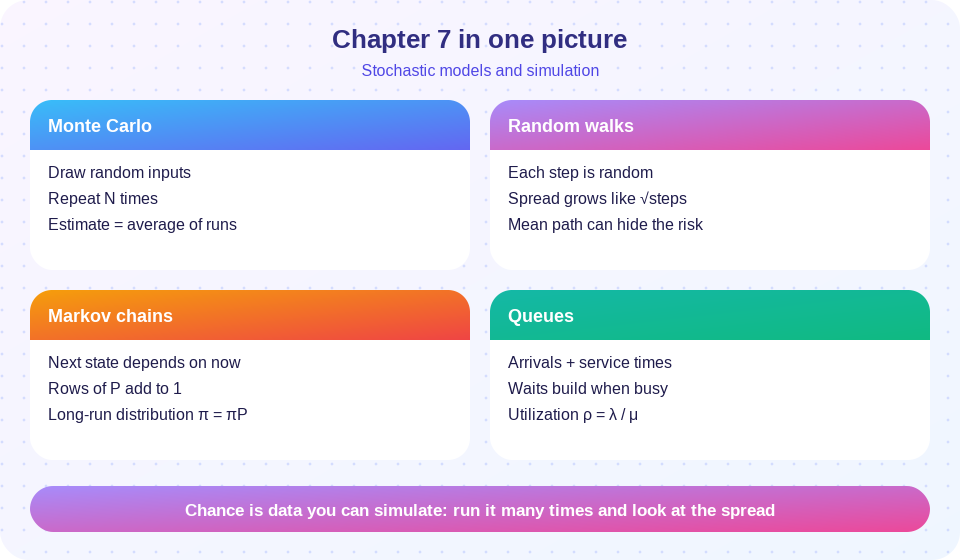
This chapter taught you to let chance into your models and to read the answer as a distribution. Here is the whole chapter on one page: a poster, a table of formulas, a short experiment on the law of large numbers, and a ten-question quiz.
Recap table
| Tool | Key idea | Formula or rule |
|---|---|---|
| Monte Carlo | average many random runs | error ≈ σ/√N |
| Random walk | sum of independent steps | spread √n, mean 0 |
| Gambler's ruin | reach N before 0 |
fair game: k/N |
| Markov chain | next state depends on now | π·P = π, rows sum to 1 |
| M/M/1 queue | random arrivals and service | ρ = λ/μ, W_q = ρ/(μ − λ) |
| Little's law | links queue size and time | L = λ·W |
Habits of a good simulation
- Seed it so a colleague can reproduce your run, and try other seeds to see the noise.
- Run enough replications to make the standard error small relative to the effect you care about.
- Report a distribution: mean, a percentile and the chance of a bad outcome, not just one number.
- Validate with a case where an exact answer exists (the birthday formula, M/M/1).
- Question the inputs. The outputs can be no better than the distributions you fed in.
Try it
This experiment shows the law of large numbers: the running average of die rolls settles toward 3.5, with fluctuations shrinking like 1/√n.
Press Run (or Ctrl + Enter) to see the result here.
Program input · what you'd type while the program runs
Type the answers before you press Run, one per line. Each time the program reads a line (with input()), it gets the next line from this box.
A second check: what the load does to a queue. The table gives the M/M/1 average wait for several loads with a service time of 1 minute, so you can see where waits become unreasonable.
Press Run (or Ctrl + Enter) to see the result here.
Program input · what you'd type while the program runs
Type the answers before you press Run, one per line. Each time the program reads a line (with input()), it gets the next line from this box.
Check your understanding
Quick check · 10 questions
of 10 answered You scored / 10 · perfect!
-
1. A Monte Carlo estimate has an error of 0.10 with 1,000 samples. Roughly how many samples give an error of 0.01?
A tenfold error reduction needs about 100 times more samples. -
2. A symmetric random walk of 2,500 steps has a typical distance from the start of about:
sqrt(2500) = 50. -
3. In a fair gambler's ruin game starting with 2 coins and aiming for 8, the chance of success is:
k / N = 2 / 8 = 0.25. -
4. The stationary distribution pi of a Markov chain satisfies:
A stationary distribution is unchanged by one more step of the chain. -
5. Each row of a transition matrix sums to:
From any state the chain must go somewhere, so the probabilities add to 1. -
6. For M/M/1 with lambda = 0.9 and mu = 1 per minute, the average time in the system W is:
W = 1 / (mu - lambda) = 1 / 0.1 = 10 minutes. -
7. Why do queues form even when average capacity exceeds average demand?
Variability creates waits even at loads below 1. -
8. Which does a larger number of simulation runs improve?
More runs reduce sampling noise only. -
9. Which statement about the Markov property is correct?
That is the definition of the Markov property. -
10. Which is a good way to validate a simulation?
Matching known results builds trust that the code is right.
Summary
- Stochastic models produce distributions; report spread and tail risk, not only means.
- Monte Carlo error falls like
1/√N; random walks spread like√n. - Markov chains settle to
π = πP; M/M/1 queues blow up asρ → 1. - Validate with an exact special case and treat the inputs with suspicion.
Next: Chapter 8 overview: model validation and communication