
























레슨 29 · Daily Life and Questions
Chapter 5 review: daily life and questions
Review chapter 5: numbers, counters, clock times, dates and question words in Japanese, with a recap table, a practice dialogue and a ten-question quiz.
You now have the three tools that carry most everyday Japanese: counting, time and questions. This review pulls them onto one page, checks the irregular items that cause most mistakes, and then lets you test yourself with ten mixed questions. Read it slowly the first time and aloud the second time.
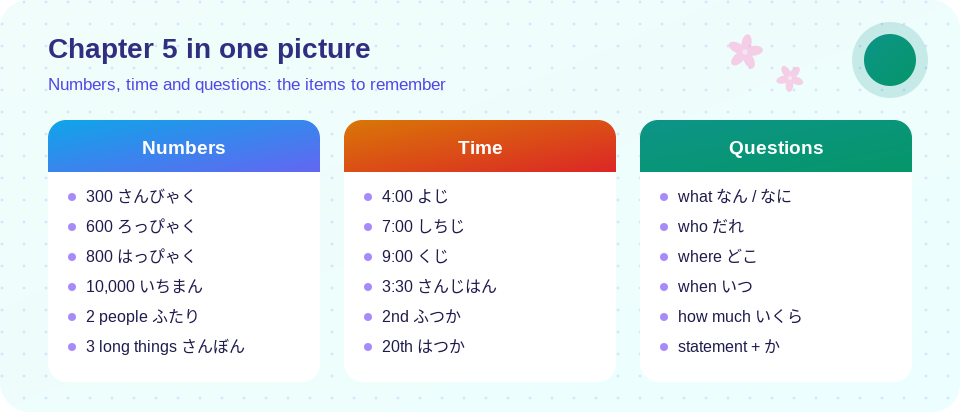
The chapter in one table
| Topic | Rule | Example |
|---|---|---|
| Numbers 1-10 | いち, に, さん, よん, ご, ろく, なな, はち, きゅう, じゅう | ichi, ni, san, yon, go, roku, nana, hachi, kyuu, juu |
| Hundreds | change after 3, 6, 8 | さんびゃく (300), ろっぴゃく (600), はっぴゃく (800) |
| Thousands | change after 3, 8 | さんぜん (3,000), はっせん (8,000) |
| Ten thousand | needs いち | いちまん (10,000) |
| Native counting | ひとつ ... とお | みっつ (3 things) |
| Counters | by shape | ひとり, にほん, さんびき, ごまい, ろっこ, じゅっさつ |
| Hours | 4, 7, 9 are special | よじ, しちじ, くじ |
| Minutes | ふん or ぷん | ごふん, ろっぷん, じゅっぷん, はん (half) |
| Dates | 1-10, 14, 20, 24 special | ついたち, ふつか, みっか, はつか |
| Particle に | with clock times, dates, weekdays | しちじに, にちようびに |
| Questions | add か; swap in a question word | なんですか, どこですか, いくらですか |
| なん/なに | なん before です and counters | なんじ, なんにん; but なにを |
Common errors to avoid
The five most frequent mistakes in this chapter are worth knowing by heart. Saying yonji for four o'clock instead of よじ is the first one. The second is reading 600 as ろくひゃく instead of ろっぴゃく. The third is adding に after あした or きょう (relative words never take に). The fourth is using ひとり for more than one person (it means exactly one; two is ふたり, and three and more are number + にん). The fifth is the order of a counted phrase: the object comes first and the number follows it, as in ねこが にひき います (neko ga nihiki imasu).
A mixed practice dialogue
Read this out loud, and then try rebuilding it from the English alone.
A: すみません、これは いくらですか。 (Sumimasen, kore wa ikura desu ka.) Excuse me, how much is this? B: ごひゃくえんです。 (Gohyaku en desu.) It is 500 yen. A: では、みっつ ください。 (Dewa, mittsu kudasai.) Then three, please. B: せんごひゃくえんです。 (Sen gohyaku en desu.) That will be 1,500 yen. A: ありがとう。 このみせは なんじまでですか。 (Arigatou. Kono mise wa nanji made desu ka.) Thank you. Until what time is this shop open? B: ごご くじまでです。 (Gogo kuji made desu.) Until nine p.m.
Check: 3 × 500 = 1,500, which reads せんごひゃく (sen gohyaku). There is no sound change because 5 is regular.
Try it
The program below drills a mix of what you learned. It picks random prices and hours and prints each one together with its reading. Cover the right-hand side with your hand, say the answer aloud, then check. Run it several times.
Press Run (or Ctrl + Enter) to see the result here.
Program input · what you'd type while the program runs
Type the answers before you press Run, one per line. Each time the program reads a line (with input()), it gets the next line from this box.
Now, in a second tool, use a quick random checklist: say the answer first, then press the button.
Check your understanding
Quick check · 10 questions
of 10 answered You scored / 10 · perfect!
-
1. How do you read 800?
Eight shortens to はっ and the h turns to p: はっぴゃく (happyaku). -
2. What is 'one million' in Japanese?
One million is 100 × 10,000, so ひゃくまん (hyakuman). いちおく is 100 million. -
3. Which counter and reading is right for 'six pens'?
Six shortens and ほん becomes ぽん after it: ろっぽん (roppon). -
4. How do you say '9:00'?
Nine o'clock is くじ (kuji): the special hours are よじ, しちじ and くじ. -
5. How do you say 'half past three'?
半 (はん) follows the hour: さんじはん (sanji han). -
6. What is the 4th day of the month?
Days 1-10 use special words: よっか (yokka) is the 4th. -
7. Which sentence is correct?
あした is a relative time word and does not take に. -
8. Which question word means 'which one' out of three or more things?
どれ (dore) means which one. どこ is where, だれ is who and いつ is when. -
9. In 'なんじですか', why is it なん and not なに?
Before counters and before です, the word for what is なん. -
10. How do you say 'two people'?
ふたり (futari) is the irregular word for two people.
Summary
- Numbers are built by multiplying and adding; remember the changes in 300, 600, 800, 3,000 and 8,000, and that 10,000 needs いち.
- Counters follow the noun; 人 is irregular for 1 and 2; 本 and 匹 change after 1, 3, 6, 8, 10.
- Hours よじ, しちじ and くじ are special; minutes use ふん or ぷん; 半 means half past.
- Days of the month 1-10, 14, 20 and 24 are special words; use に with clock times and dates, not with あした or きょう.
- Questions are statements plus か, with a question word where the answer goes.