
























레슨 40 · Mission Design
Chapter 8 Review: Mission Design on One Page
One-page recap of mission design: lifecycle phases, delta-v budgets, launch windows and gravity assists, with a planet-transfer planner and a ten-question quiz.
Mission design is where physics meets planning. The lifecycle tells you when decisions must be made, the Δv budget tells you what it costs, the launch window tells you when you can go, and the gravity assist tells you how to cheat. This review ties them together with a planner that works for any planet and a longer quiz.
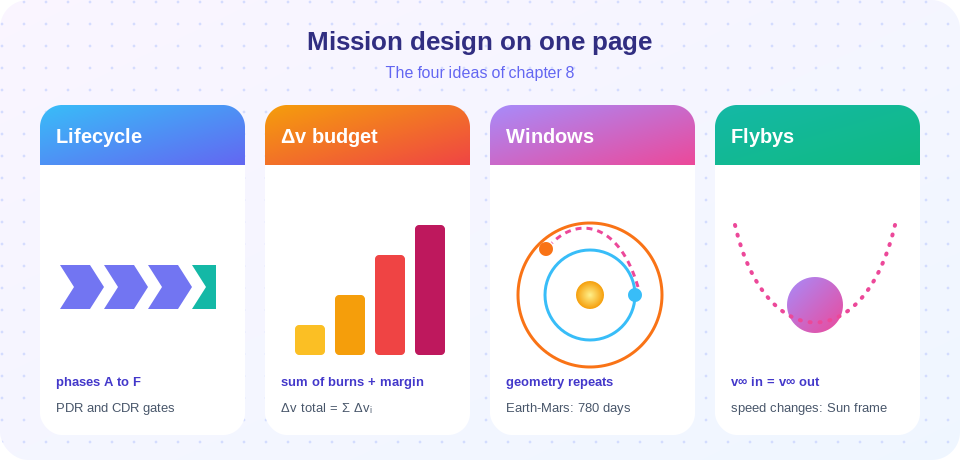
The chapter in a table
| Idea | Key relation | Remember |
|---|---|---|
| Lifecycle | Phases A to F, PDR at the end of B and CDR at the end of C | the cost of change rises each phase |
| Requirements | testable "shall" statements | trade studies justify choices |
| Δv budget | Σ Δvᵢ plus margin; work backward with m₀ = m_f e^(Δv/vₑ) |
surface to LEO about 9.4 km/s |
| Synodic period | 1/S = abs(1/T₁ − 1/T₂) |
Earth-Mars about 780 days |
| Phase angle | φ = 180° − n₂ · t_transfer |
Mars: about 44° |
| Hohmann interplanetary | `v∞ = | v_transfer − v_planet |
| Flyby | e = 1 + r_p v∞²/μ, δ = 2 arcsin(1/e), v_out = V + v∞,out |
speed changes in the Sun frame only |
Putting it together
A mission to a new planet follows a chain. Decide the target and the date from the synodic period; compute the Hohmann transfer (or a faster or lower-energy variant) for v∞; convert it to a departure burn from the parking orbit; sum with arrival and margins; use the rocket equation to get a spacecraft mass; check whether a launcher can lift it. If not, look for a gravity assist or a lower-energy path, accept a longer flight, or reduce the payload. Throughout, requirements and reviews keep the whole chain consistent.
Common misconceptions
"A mission is only as good as its trajectory." Operations, power, thermal, communications and cost shape the mission just as much.
"Gravity assists are free." They cost planning flexibility, flight time and navigation accuracy.
"Hohmann is the only option for interplanetary transfers." It minimizes impulsive Δv between circular coplanar orbits, but faster transfers cost more Δv and slower low-thrust spirals use less propellant.
Try it
Press Run (or Ctrl + Enter) to see the result here.
Program input · what you'd type while the program runs
Type the answers before you press Run, one per line. Each time the program reads a line (with input()), it gets the next line from this box.
Press Run (or Ctrl + Enter) to see the result here.
Program input · what you'd type while the program runs
Type the answers before you press Run, one per line. Each time the program reads a line (with input()), it gets the next line from this box.
Check your understanding
Quick check · 10 questions
of 10 answered You scored / 10 · perfect!
-
1. Which review follows Phase B and approves the architecture?
PDR closes the preliminary design phase; CDR closes the final design phase. -
2. A mission needs burns of 1.0, 2.0 and 0.5 km/s. The total Δv is
Burns add: 1.0 + 2.0 + 0.5 = 3.5 km/s, before margin. -
3. Why is the mass at the start of a mission much larger than at the end?
Each burn's propellant adds to the mass the previous burn must accelerate. -
4. The Earth-Venus synodic period is about
1/S = 1/224.7 − 1/365.26 gives S ≈ 584 days. -
5. In a flyby, which quantity is unchanged in the planet's frame?
Only the direction of v∞ changes; its magnitude is preserved. -
6. A flyby has e = 1.15. What is the deflection angle approximately? (arcsin 0.8696 ≈ 60.4°)
δ = 2 arcsin(1/e) = 2 × 60.4° ≈ 121°. -
7. Which factor most sets how often Mars launch windows occur?
The relative geometry of Earth and Mars repeats every synodic period, about 26 months. -
8. A lander with dry mass 500 kg needs Δv = 2 km/s with Isp = 330 s (vₑ = 3,236 m/s). Propellant needed is about
m_prop = 500 × (e^(2000/3236) − 1) = 500 × (1.855 − 1) ≈ 428 kg. -
9. What is a main drawback of using gravity assists?
Flybys constrain the dates and add flight time, but save propellant. -
10. Why did the Ariane 5 first flight fail?
Ariane 4 software was reused without checking the larger values of Ariane 5's trajectory.
Summary
- The lifecycle (phases A to F) and its reviews exist because late changes are costly.
- Δv budgets sum burns with margin; work backward to find the starting mass.
- Launch windows follow the synodic period; the phase angle at departure follows from the transfer time.
- Gravity assists rotate
v∞and so change speed in the Sun's frame; they trade date flexibility for propellant.