
























Lezione 36 · Spectroscopy
Rotational and Vibrational Spectroscopy
Read molecular structure from microwave and infrared spectra: rotational line spacing and bond length, anharmonicity, P and R branches, normal modes and functional-group frequencies.
Take the levels from the last chapter and shine light on them. The rotational ladder, with rungs BJ(J+1), gives a microwave spectrum of evenly spaced lines. The vibrational ladder, with rungs near (v + ½)ħω, gives an infrared absorption. When a molecule does both at once, the infrared band splits into a comb of lines. Each of these patterns can be inverted: the line spacing yields a bond length, and the band position yields a force constant.
What you will learn
- Predict rotational line positions and derive bond lengths from them
- Describe anharmonic vibration and overtones
- Interpret P and R branches of a rovibrational band
- Count normal modes and decide which are infrared active
- Use group frequencies to identify functional groups
Key terms
Gross selection rule: microwave absorption needs a permanent dipole; infrared absorption needs a dipole that changes during the vibration.
Anharmonicity: departure of a real potential from a parabola; it narrows the level spacings as v rises and allows overtones.
Normal mode: an independent collective vibration with a single frequency; a molecule of N atoms has 3N − 6 (3N − 5 if linear).
Branches: the P branch (ΔJ = −1) lies below the band origin, the R branch (ΔJ = +1) above it.
Pure rotational spectroscopy
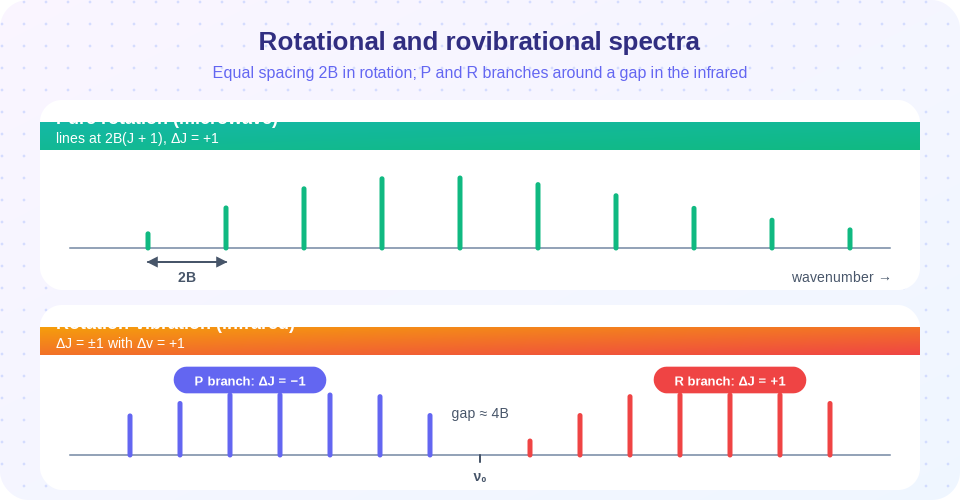
For a rigid rotor, absorption takes J → J + 1 (selection rule ΔJ = ±1, with a permanent dipole). In wavenumbers the line positions are
ν̃(J → J+1) = 2B (J + 1), J = 0, 1, 2, …
so successive lines are equally spaced by 2B. The intensity first rises with J (more degenerate states) and then falls (less population), peaking near J_max = √(kT/2hcB) − ½.
Measure the spacing, halve it, and you have B. Then
I = h / (8π² c B), r = √(I/μ)
Worked example: bond length of HBr
Suppose the lines of H⁷⁹Br in the far infrared are spaced by about 16.93 cm⁻¹. Then B = 8.465 cm⁻¹. With h/(8π²c) = 2.799 × 10⁻⁴⁶ kg m² cm⁻¹, I = 2.799×10⁻⁴⁶ / 8.465 = 3.307 × 10⁻⁴⁷ kg m². The reduced mass is μ = 0.9952 u = 1.6525 × 10⁻²⁷ kg, so
r = √(3.307×10⁻⁴⁷ / 1.6525×10⁻²⁷) = 1.415 × 10⁻¹⁰ m = 141 pm
Microwave spectroscopy measures bond lengths to a few thousandths of an angstrom. Isotopic substitution (¹²CO versus ¹³CO) changes μ but not r, so it gives independent checks and allows the bond lengths of polyatomic molecules to be found. Real molecules also stretch as they spin faster: this centrifugal distortion slightly lowers the line positions at high J: ν̃ = 2B(J+1) − 4D(J+1)³, where D is small.
Vibrational spectroscopy
If the oscillator were harmonic, Δv = ±1 would give a single line at ν̃ = (1/2πc)√(k/μ). Real bonds are anharmonic. A convenient model is
G(v) = ω̃ₑ (v + ½) − ω̃ₑxₑ (v + ½)²
The second term makes the levels converge as v rises. The fundamental (v = 0 → 1) is at ω̃ₑ − 2ω̃ₑxₑ. For HCl, ω̃ₑ = 2990.9 cm⁻¹ and ω̃ₑxₑ = 52.8 cm⁻¹, so the fundamental is at 2990.9 − 105.6 = 2885 cm⁻¹, in agreement with the observed band. The overtone (v = 0 → 2) is at 2ω̃ₑ − 6ω̃ₑxₑ = 5665 cm⁻¹. Overtones are weak, but they are allowed because of anharmonicity. A larger anharmonicity means a weaker bond; at the dissociation limit the levels merge into a continuum.
Vibration-rotation spectra
In a gas, a vibrational transition occurs together with rotational changes. With ΔJ = ±1 there are two branches:
- R branch (J → J + 1):
ν̃ = ν̃₀ + 2B(J + 1), J = 0, 1, 2, … - P branch (J → J − 1):
ν̃ = ν̃₀ − 2BJ, J = 1, 2, 3, …
The band origin ν̃₀ itself is missing: that would be ΔJ = 0 (the Q branch), which is forbidden for a diatomic molecule like HCl (but allowed for NO, whose electron has orbital angular momentum, and for the bending modes of linear polyatomics). The gap between the first P and first R lines is 4B. In practice B is slightly smaller in the upper vibrational state because the bond stretches, so R lines crowd together while P lines spread out.
Real HCl lines come as close pairs because of the ³⁵Cl and ³⁷Cl isotopes (75.8 % and 24.2 %).
Polyatomic molecules: normal modes
A molecule of N atoms has 3N − 6 vibrations (3N − 5 for linear molecules). Water, N = 3 and bent, has three modes: symmetric stretch (3657 cm⁻¹ in the gas), bend (1595) and asymmetric stretch (3756). All three change the dipole moment, so all are infrared active.
Carbon dioxide is linear, so it has 3 × 3 − 5 = 4 modes:
| Mode | Wavenumber (cm⁻¹) | IR active? |
|---|---|---|
| symmetric stretch | 1388 | no (no dipole change) |
| bend (two degenerate) | 667 | yes |
| asymmetric stretch | 2349 | yes |
Those two active modes are why CO₂ traps heat: it absorbs infrared radiation leaving the Earth. The symmetric stretch is Raman active instead.
Group frequencies
Characteristic bonds absorb in predictable ranges almost regardless of the rest of the molecule, so infrared spectra identify functional groups:
| Group | Region (cm⁻¹) | Appearance |
|---|---|---|
| O–H (alcohol, hydrogen bonded) | 3200–3600 | broad, strong |
| N–H | 3300–3500 | medium |
| C–H (sp³) | 2850–3000 | strong |
| C≡N, C≡C | 2100–2260 | sharp, medium |
| C=O (ketone, ester, acid) | 1650–1750 | very strong |
| C–O | 1000–1300 | strong |
Higher force constants and lower reduced masses push absorption to higher wavenumber: triple bonds above double bonds above single bonds, and X–H stretches above everything else.
Common misconceptions
"All vibrations absorb infrared light." Only those that change the dipole moment do; symmetric stretches of symmetric molecules are IR silent.
"The missing center of a rovibrational band is a mistake." It is the forbidden ΔJ = 0 transition.
"Rotational lines get weaker steadily with J." They first rise because of degeneracy, then fall.
Try it
First, simulate the rovibrational band of HCl. The intensities come from Boltzmann populations of the lower level. This is a simplified simulation (single isotopologue, constants quoted to ±0.1 cm⁻¹, no centrifugal distortion), so compare only the pattern.
Press Run (or Ctrl + Enter) to see the result here.
Program input · what you'd type while the program runs
Type the answers before you press Run, one per line. Each time the program reads a line (with input()), it gets the next line from this box.
Second, a bond-length calculator: enter a rotational constant and masses, get the bond length. B values are literature values to about three figures (ground-state values for the hydrogen halides, so the lengths differ from equilibrium values in the last digit).
Press Run (or Ctrl + Enter) to see the result here.
Program input · what you'd type while the program runs
Type the answers before you press Run, one per line. Each time the program reads a line (with input()), it gets the next line from this box.
Check your understanding
Quick check · 5 questions
of 5 answered You scored / 5 · perfect!
-
1. Rotational lines in a microwave spectrum are spaced by
ν̃ = 2B(J + 1), so neighbors differ by 2B. -
2. Which molecule has no pure rotational spectrum?
A homonuclear diatomic has no permanent dipole. -
3. In the rovibrational spectrum of HCl, the gap at the band origin equals
The first R line is at ν₀ + 2B and the first P line at ν₀ − 2B. -
4. How many vibrational modes does CO₂ have?
Linear: 3N − 5 = 4. -
5. A strong, sharp absorption near 1715 cm⁻¹ suggests
The carbonyl stretch sits at roughly 1650–1750 cm⁻¹.
Summary
- Pure rotation:
ν̃ = 2B(J + 1); the line spacing gives B, I and the bond length. - Anharmonicity gives overtones and the fundamental at
ω̃ₑ − 2ω̃ₑxₑ. - Rovibrational bands have P and R branches with a gap of about 4B.
- Linear molecules have 3N − 5 modes, nonlinear 3N − 6; only dipole-changing modes absorb infrared.
- Group frequencies identify functional groups.
Tieni traccia dei progressi
Crea un account gratuito per segnare le lezioni completate e riprendere da dove avevi lasciato su qualsiasi dispositivo.