
























Lezione 18 · Ideal and Potential Flow
Euler's Equation and Bernoulli's Equation
Derive Bernoulli's equation from Euler's equation, learn its assumptions and apply it to Venturi tubes, draining tanks and Pitot tubes with worked examples.
Daniel Bernoulli published Hydrodynamica in 1738, linking the speed of a flowing fluid to its pressure. The version taught today, in terms of energy per unit volume, was put in its modern form by Leonhard Euler. The equation says something simple and extremely useful: along a streamline in a smooth, frictionless flow, if the speed goes up, the pressure goes down, and if the fluid rises, the pressure drops by the weight of the extra height. It is the statement of energy conservation for flowing fluid. With it you can read a speed from a pressure difference, find how fast a tank drains and size a flow meter.
What you will learn
- How Euler's equation leads to Bernoulli's equation.
- The assumptions that must hold, and what breaks them.
- How to use it for Venturi meters, Torricelli's law and Pitot tubes.
- Why the "equal transit time" explanation of lift is wrong.
Key terms
Euler equation: Newton's law for an ideal fluid, ρ Du/Dt = −∇p + ρg.
Bernoulli's equation: p + ½ρv² + ρgz = constant along a streamline.
Dynamic pressure ½ρv²: the pressure associated with motion.
Stagnation pressure p₀ = p + ½ρv²: the pressure where the flow is brought to rest.
Head: an energy per unit weight expressed as a height, p/(ρg) + v²/(2g) + z.
Euler's equation
Remove the viscous term from Navier-Stokes and you have Euler's equation:
ρ (∂u/∂t + (u·∇)u) = −∇p + ρ g.
Now follow a streamline in a steady flow. Let s be the distance along the streamline. The component of the equation along the streamline is ρ v dv/ds = −dp/ds − ρ g dz/ds (since u·∇u = v dv/ds along a streamline, and the gravity component is −g dz/ds). For constant ρ, multiply by ds and integrate:
p + ½ ρ v² + ρ g z = constant along a streamline.
Every term has units of pressure (Pa), or energy per unit volume (J/m³). Dividing by ρ g gives the head form, p/(ρg) + v²/(2g) + z = H, every term a height in metres.
When it applies
- Steady flow (otherwise there is an extra
ρ ∫ ∂v/∂t dsterm). - Incompressible (ρ constant; for gases only if Mach is below about 0.3).
- Inviscid (no friction losses, no heat added or removed, no pumps or turbines between the two points).
- Along one streamline. If the flow is also irrotational, the constant is the same for every streamline, so the equation holds between any two points.
Friction and turbines are handled by adding a loss or work term, but that is beyond the ideal-flow model.
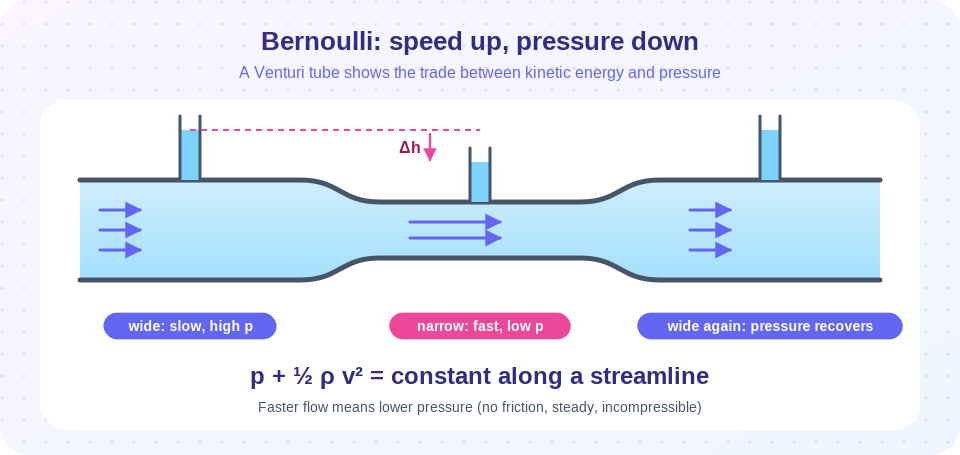
Worked example 1: a Venturi meter
Water (ρ = 998 kg/m³) flows through a pipe of diameter D₁ = 0.10 m which narrows to a throat of D₂ = 0.05 m. The speed upstream is v₁ = 1 m/s. Continuity: v₂ = v₁ (D₁/D₂)² = 4 m/s. Bernoulli (same height): p₁ − p₂ = ½ ρ (v₂² − v₁²) = 0.5 × 998 × (16 − 1) = 7.49×10³ Pa ≈ 7.5 kPa. That corresponds to a water column of Δh = Δp/(ρg) = 0.76 m. Turning this around: measuring Δp between throat and inlet, we get the flow speed v₁ = √( 2Δp / (ρ((D₁/D₂)⁴ − 1)) ). Real Venturi meters have a discharge coefficient near 0.98 to account for small losses.
Worked example 2: Torricelli's law
An open tank of water has a small hole a depth h = 2 m below the free surface. Compare the surface (point 1: p = p_atm, v ≈ 0) with the jet just outside (point 2: p = p_atm, speed v). Bernoulli: p_atm + ρ g h = p_atm + ½ρ v², so
v = √(2 g h) = √(2 × 9.81 × 2) = 6.26 m/s,
the same speed an object would reach after falling the same height. For a hole of diameter 1 cm (A = 7.85×10⁻⁵ m²), the ideal flow rate would be Q = A v = 4.9×10⁻⁴ m³/s (0.49 L/s). Real jets are narrower than the hole (the vena contracta), and the measured flow is about 60 percent of this (discharge coefficient C_d ≈ 0.6) for a sharp-edged hole.
Worked example 3: a Pitot tube
A Pitot tube measures the pressure at a point where the flow is brought to rest (a stagnation point), p₀ = p + ½ρv². Together with a static pressure measurement p, the speed is v = √(2 (p₀ − p) / ρ). For air (ρ = 1.2 kg/m³) with a measured difference of 600 Pa: v = √(2 × 600/1.2) = 31.6 m/s (about 114 km/h). Aircraft airspeed indicators work exactly this way, corrected for air density and compressibility at high speeds. A blocked Pitot tube reads a wrong airspeed, which has contributed to real aircraft accidents.
Common misconceptions
"Air over the top of a wing must meet the air below at the trailing edge, so the longer path means higher speed." This "equal transit time" idea is wrong: in real flows, the air over the top gets there well ahead of the air below. Lift arises because the wing turns the flow downward and sets up circulation; Bernoulli's equation relates the resulting pressure and speed differences but does not by itself explain why they arise.
"Bernoulli's equation applies between any two points." Only along a streamline (or anywhere in an irrotational flow), with no friction, no pump and no turbine between them.
"Pressure falls because the fluid has speed." Better: a pressure difference accelerates the fluid; where the pressure drops along the flow, the fluid speeds up. Cause and effect run from pressure gradient to acceleration.
Try it
First, compute the pressure along a duct that narrows to a throat and widens again. With the flow rate fixed, continuity gives the speed and Bernoulli gives the pressure. At the throat the pressure falls below the inlet value.
Press Run (or Ctrl + Enter) to see the result here.
Program input · what you'd type while the program runs
Type the answers before you press Run, one per line. Each time the program reads a line (with input()), it gets the next line from this box.
Second, three quick calculators in the console: the Torricelli speed, the Pitot speed and the Venturi speed from a measured pressure difference.
Press Run (or Ctrl + Enter) to see the console output here.
No output.
Check your understanding
Quick check · 5 questions
of 5 answered You scored / 5 · perfect!
-
1. Bernoulli's equation states that along a streamline (steady, incompressible, inviscid)
p + (1/2) rho v^2 + rho g z = constant. -
2. Water drains from an open tank through a hole 5 m below the surface. The ideal exit speed is about
v = sqrt(2 g h) = sqrt(2 x 9.81 x 5) = 9.9 m/s. -
3. A Pitot tube measures a stagnation-minus-static pressure of 450 Pa in air (rho = 1.2). The speed is about
v = sqrt(2 x 450 / 1.2) = sqrt(750) = 27.4 m/s. -
4. Which condition is NOT required for Bernoulli's equation?
Temperature need not be constant; the requirements are steady, incompressible, frictionless flow along a streamline. -
5. In a Venturi tube, the pressure in the throat is lower than upstream because
Continuity forces a higher speed in the throat; Bernoulli then requires a lower pressure.
Summary
- Euler's equation is Navier-Stokes without viscosity; integrated along a streamline it gives
p + ½ρv² + ρgz = const. - It needs steady, incompressible, frictionless flow along a streamline (any two points if irrotational).
- Applications: Venturi meters, Torricelli's law
v = √(2gh), Pitot tubesv = √(2Δp/ρ). - Bernoulli connects pressure and speed but is not an explanation of lift by itself.
Tieni traccia dei progressi
Crea un account gratuito per segnare le lezioni completate e riprendere da dove avevi lasciato su qualsiasi dispositivo.