
























Lezione 24 · Idioms and Expressions
How idioms work
Find out what idioms are, why they cannot be translated word for word, which parts can change, and how to learn them without sounding strange.
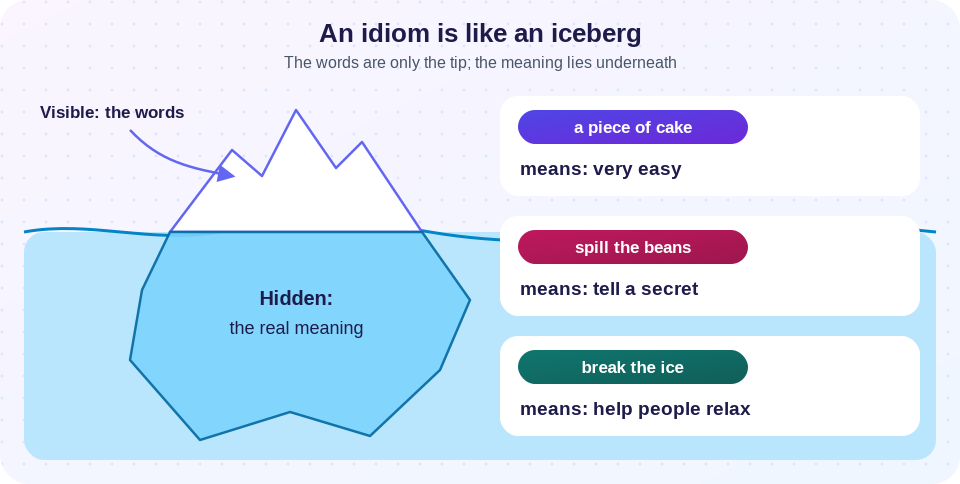
An idiom is a fixed phrase whose meaning is not the sum of its words. If someone says an exam was a piece of cake, nobody is eating. They mean it was very easy. Idioms add color to English, and you will hear them in films, songs, meetings and chats.
They can also cause confusion. A word-for-word translation may produce a strange picture. In this lesson you will learn how idioms are built, so you can work out and learn new ones with care.
What you will learn
- How an idiom differs from a literal phrase.
- Which parts of an idiom can change and which cannot.
- Strategies for guessing meaning from context.
- How to decide whether an idiom is worth learning to use.
Idiom
Learn it in three steps
Literal or figurative?
A literal meaning is the plain meaning of the words. A figurative meaning goes beyond them. The same phrase can be either.
- Literal: The glass fell and we had to pick up the pieces.
- Figurative: After the company closed, they had to pick up the pieces. (rebuild their lives)
The situation usually tells you which one is meant.
What is fixed and what can change
Most idioms have a fixed set of words. We say a piece of cake, not a slice of cake, when we mean "easy". We say kick the bucket (an informal way to say "die"), and changing it to kick the pail destroys the idiom.
Still, some parts can change.
| Part that can change | Example |
|---|---|
| tense | She broke the ice. / He is breaking the ice. |
| pronoun or possessive | I lost my temper. / He lost his temper. |
| subject | They were on cloud nine. / She was on cloud nine. |
Lose your temper means "become angry". The possessive changes to match the person, but temper stays.
Where idioms come from
Many idioms started with a literal picture. Break the ice now means "make people feel relaxed when they first meet". A possible picture is a path being opened through ice for a boat, but origin stories for idioms are often uncertain. Treat popular stories carefully. What matters for you is the modern meaning and the tone.
Guess from the context
Read the whole situation before you open a dictionary.
I was nervous before my speech, but my friend told a joke and broke the ice. After that, everyone talked freely.
The clues are nervous and talked freely. The idiom probably means "made people relax". Next, check your guess. A learner's dictionary or an idiom dictionary will give the meaning and often a label such as informal or old-fashioned.
Types you will meet
- Pure idioms such as spill the beans (tell a secret) are hard to guess.
- Easier pictures such as keep an eye on (watch carefully) are close to the literal idea.
- Similes compare with as or like: as busy as a bee, sleep like a log (sleep very deeply).
- Pairs use two words in a fixed order: safe and sound (unharmed), give and take (compromise), sooner or later.
Fixed pairs are worth noticing because the order does not change. We say safe and sound, not sound and safe.
Decide what to learn
You do not need to use every idiom you see. Sort new ones into two groups.
- Understand only. Rare, very informal or old-fashioned idioms. For example, many learners recognize raining cats and dogs (raining heavily), but it can sound old-fashioned in everyday speech.
- Understand and use. Common, clear idioms such as on the other hand, a piece of cake or keep in touch.
For each idiom in group two, write the meaning, the tone and one sentence about your own life. The next lesson, idioms about time, money and feelings, gives you many to practice. Advice about tone is in using idioms naturally.
Idioms and other fixed phrases
Not every fixed phrase is an idiom. Of course and by the way are fixed, but their meanings are easy to learn. Such phrases help your speech sound smooth, and they are covered in conversation expressions. You can also compare idioms with phrasal verbs, which have their own grammar rules.
Worked example: a note card
Suppose you hear a coworker say, Let's not beat around the bush. We are over budget. The second sentence is direct, so the first phrase probably asks people to speak directly. You check a dictionary: beat around the bush means to avoid saying the important point. Your note card could look like this.
| Field | Your note |
|---|---|
| Idiom | beat around the bush |
| Meaning | avoid saying the main point |
| Tone | everyday, fairly informal |
| Where I met it | a budget meeting |
| My sentence | Please don't beat around the bush; tell me what happened. |
The field "Where I met it" is useful. It reminds you of a real situation, which helps both memory and judgement about tone.
Common mistakes
- Translating word for word. An idiom from your own language may not exist in English.
- Changing a fixed word. Say a piece of cake, not a piece of pie for "easy".
- Using an idiom with the wrong tone. Kick the bucket is not suitable for sad or serious news.
- Trusting every origin story. Some popular stories about idioms have no good evidence.
Try it
Check your understanding
Quick check · 4 questions
of 4 answered You scored / 4 · perfect!
-
1. What makes a phrase an idiom?
You often cannot work out an idiom from the separate words. -
2. Which change keeps the idiom correct?
Possessives and tense may change, but the key noun stays. -
3. What does break the ice mean?
It describes making a first meeting comfortable. -
4. What should you check before using a new idiom?
Tone shows where the idiom fits.
Summary
- An idiom has a meaning that goes beyond its words.
- Most words are fixed, although tense and pronouns can change.
- Use context to guess, then check a dictionary.
- Learn common idioms actively and just recognize the rarer ones.
Tieni traccia dei progressi
Crea un account gratuito per segnare le lezioni completate e riprendere da dove avevi lasciato su qualsiasi dispositivo.