
























Lezione 1 · How to Learn Words
English Vocabulary: Course Map
See the whole English vocabulary course, learn how each lesson works, and make a simple weekly plan for building words you can really use.
Words are the material of every language. You can know a lot of grammar and still get stuck because one important word is missing. With the right words, people can often understand you even when your grammar is not perfect.
This course helps you do two things. First, you learn how to learn words, so your effort is not wasted. Second, you learn many useful words and patterns, grouped so that they are easier to remember and use. It is written for adults and teenagers, including learners of English, and it uses plain language.
What you will learn
- what the nine chapters cover and in what order
- how each lesson is built
- how to set up a small weekly routine
- what this course can and cannot do for you
The road through the course
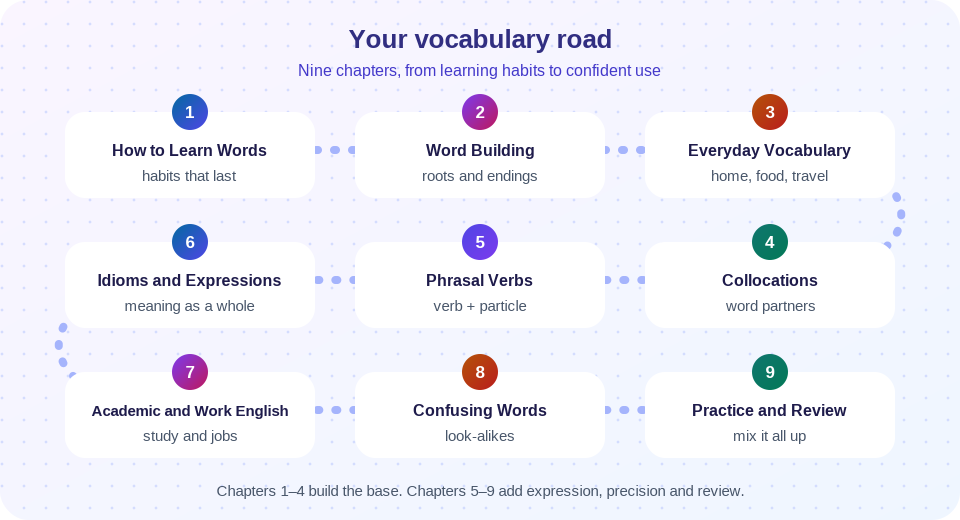
| Chapter | Topic | What you can do afterwards |
|---|---|---|
| 1 | How to Learn Words | choose, record and review words in a smart way |
| 2 | Word Building | work out many new words from their parts |
| 3 | Everyday Vocabulary | talk about home, food, people and travel |
| 4 | Collocations | put words together the natural way |
| 5 | Phrasal Verbs | understand verbs such as look after |
| 6 | Idioms and Expressions | follow figurative, informal speech |
| 7 | Academic and Work English | read and write for study and jobs |
| 8 | Confusing Words | avoid common mix-ups |
| 9 | Practice and Review | mix and test everything |
You can read the chapters in order, which is the best choice if you are not sure of your level. You can also jump to a topic you need now. Chapters 1 and 2 are worth reading early, because their methods help in every later chapter.
How a lesson works
Most lessons follow the same shape, so you know where you are:
- A short introduction explains why the topic matters.
- What you will learn lists the goals.
- The main part gives many examples. Read the example sentences, not only the lists.
- Common mistakes warns you about typical errors.
- Try it gives you small interactive exercises that check your choices on the page.
- A short quiz and a summary close the lesson.
The exercises compare your choice with a stored answer. The site cannot hear you, read your own sentences or give you a score on your English. For feedback on speaking and writing, ask a teacher, a classmate or a trusted language partner.
A weekly routine that fits real life
A small plan that you follow is better than a large plan that you drop. Here is one example. Change the numbers to suit you.
| Day | Time | Task |
|---|---|---|
| Monday | 20 min | Read a new lesson and note 6–10 words |
| Tuesday | 10 min | Review the new words |
| Wednesday | 20 min | Do the exercises, then write 5 sentences of your own |
| Friday | 10 min | Review all words from this week |
| Weekend | 15 min | Listen or read for pleasure and notice your words |
The number of words is only a suggestion. A few words that you can use are worth more than a long list that you forget. Choosing which words to learn helps you decide what deserves your time.
Active and passive vocabulary
You will meet two useful terms in this course.
- Your passive (receptive) vocabulary is the words you understand when you read or listen.
- Your active (productive) vocabulary is the words you can use yourself when you speak or write.
For most people, the passive group is bigger. For example, you may understand reluctant in a story, but still say not very happy to do it when you talk. Moving a word from the first group to the second takes practice, and the course pushes you in that direction.
Before you start: a quick self-check
Think about your last week in English. Which sentence sounds most like you?
- "I understand a lot, but I speak with simple words." You need active practice.
- "I learn many words and then lose them." You need a review system.
- "I meet too many new words to learn." You need a way to choose.
- "I know the word, but my sentence sounds strange." You may need to learn collocations.
Many learners recognize more than one of these. That is normal. Write your answer in a notebook, then look back at it after a few weeks to see whether it has changed.
How to tell that you are improving
Progress with words can be hard to feel from day to day, so look for small signs. You may need to stop less often while reading. You may catch a word in a song or a show that you learned last week. You may use a new phrase in a message without planning it. Once a month, pick ten words from your older notes. Cover the meanings, say what each word means and use three of them in sentences. The words you miss are not a failure. They simply tell you what to review next.
Common mistakes
Collecting without using. Copying hundreds of words into a list can feel like progress. If you never review or use them, many will fade. Studying only translations is another trap: one translation rarely shows how a word behaves in English. Try to keep at least one example sentence with each word.
Try it
Match each situation to the chapter that helps most.
Check your understanding
Quick check · 4 questions
of 4 answered You scored / 4 · perfect!
-
1. What is your passive vocabulary?
Passive, or receptive, vocabulary is what you understand, even if you do not use it yourself. -
2. Which routine is most likely to help you remember words?
Coming back to words several times gives you repeated chances to recall them. -
3. What can the exercises on this site do?
The exercises only check your choices. For speaking and writing feedback, ask a person. -
4. Which chapter explains verbs such as 'look after'?
A verb plus a small word, with its own meaning, is a phrasal verb.
Summary
- The course has nine chapters, from learning methods to review.
- Lessons have goals, examples, common mistakes, exercises and a quiz.
- A short routine with reviews works better than occasional long sessions.
- Passive vocabulary is what you understand; active vocabulary is what you can use.
Tieni traccia dei progressi
Crea un account gratuito per segnare le lezioni completate e riprendere da dove avevi lasciato su qualsiasi dispositivo.