
























लेसन 1 · The Nursing Profession
Nursing Fundamentals: Course Map
Start here: see the nine chapters of this nursing fundamentals tutorial, what it can and cannot teach you, and a simple way to study each lesson well.
Nursing is a profession that cares for people when they are healthy, sick, injured, recovering or near the end of life. Nurses watch for change, act on it, teach, comfort and speak up. This course introduces the core ideas that almost every nursing program starts with.
You do not need any medical background. If English is not your first language, the sentences are short and new terms are explained when they appear.
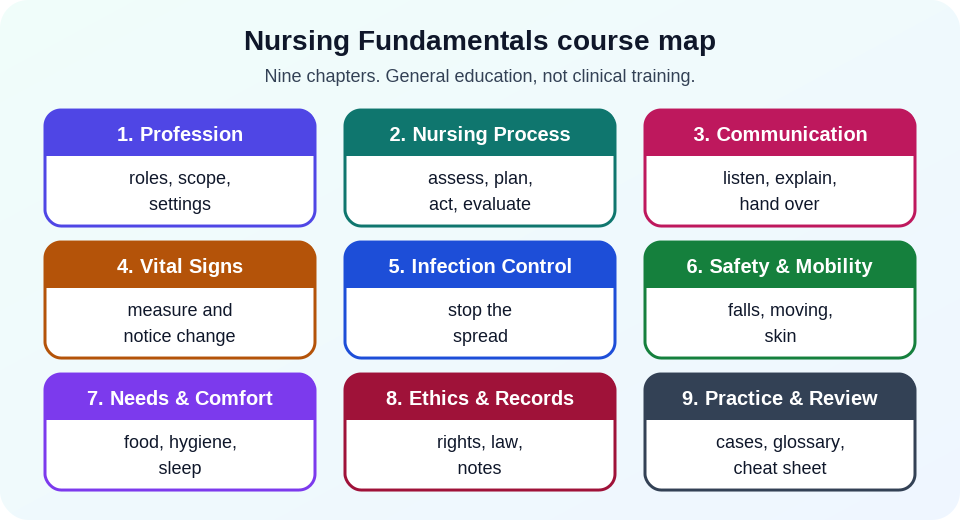
What you will learn
- What the nine chapters cover and how they connect
- What this course is, and what it is not
- A study routine that works for practical subjects
- Basic terms you will see in many lessons
Read this first: limits of the course
This course is general education. It is not clinical training and not medical advice. It does not make you safe or allowed to care for patients. Scope of practice, protocols, forms and legal duties differ by country, region and employer. Always follow your local protocols, your instructors and your supervisors. If someone may be in danger, call your local emergency number.
Real nursing skill comes from supervised practice. A text lesson can explain why a nurse checks a patient's identity. It cannot watch you do it, correct your hands or judge your decisions. You will not find real drug doses or step-by-step instructions for invasive procedures here.
The path through the course
| Chapter | Main question |
|---|---|
| The Nursing Profession | Who are nurses, and what do they do? |
| The Nursing Process | How do nurses think and plan care? |
| Communication and Patient-Centered Care | How do nurses talk, listen and respect people? |
| Vital Signs and Assessment | How do nurses notice changes in the body? |
| Infection Prevention | How is the spread of germs reduced? |
| Patient Safety and Mobility | How are falls, errors and injuries reduced? |
| Basic Needs and Comfort | How do nurses support daily needs? |
| Ethics, Law and Documentation | What are the duties, and how is care recorded? |
| Practice and Review | Can you apply it all? |
The order matters. The nursing process in chapter 2 is a thinking tool you will use in every later chapter. Communication comes early because you cannot assess a person well if you cannot talk and listen.
Words you will meet often
- Patient is a person receiving care. Some services say client, resident or service user.
- Assessment means collecting information about a person's health.
- Intervention means an action taken to help.
- Outcome is the result you hope to see, or the result you actually see.
- Scope of practice is the set of tasks a person is allowed and prepared to do in a given role and place.
- Escalate means to tell the right person quickly because something needs more help.
How to study each lesson
Use a short routine of about 25 to 40 minutes.
- Read the introduction and the learning goals. Guess what each section will say.
- Read one section. Close your eyes and explain it in your own words.
- Do the Try it exercise without looking back.
- Take the quiz. Read the explanation for every question, even the ones you got right.
- Write three lines in a notebook: one new idea, one question, one thing to check in your local rules.
A worked example of active study
Imagine you read that hand hygiene helps prevent infection. A passive reader highlights the sentence. An active reader asks, "When would a nurse need to clean their hands? Before touching a patient? After? What else?" Then the reader checks the later lesson and corrects the guess. The effort of guessing and correcting helps you remember.
Keep a "check locally" list. Whenever a lesson says that rules differ, write down the topic. Later, compare it with your school or workplace policy.
If you are thinking about a nursing career
This course can help you decide whether the work interests you. Nursing needs knowledge, calm communication, physical stamina, teamwork and honesty about what you do not know. To become a nurse, you need an approved education program and, in many places, a license or registration. Check the official nursing regulator where you plan to work.
A sample study week
You do not need long sessions. Short, regular practice usually works better than one long night before a test. Here is one possible week.
| Day | Activity |
|---|---|
| Monday | Study one new lesson and take its quiz |
| Tuesday | Explain Monday's main idea to a friend or aloud |
| Wednesday | Study a second lesson |
| Thursday | Redo both quizzes without rereading first |
| Friday | Write two questions to ask a teacher or look up in an approved source |
Change the plan to fit your life. The key is to come back to old ideas more than once.
Using fictional cases safely
Many lessons use invented people, such as Mr. Ali or Mrs. Chen. They show how an idea works. Real people are more complex, so a case answer is never a rule for real care. If you are already a student on a clinical placement, never copy real patient details into your study notes. Use made-up details instead, and follow your school's privacy rules.
How to read tables and lists
Tables here are summaries. After reading one, cover the right column and try to fill it in from memory. For lists, ask why each item is there. Knowing the reason helps when a real situation does not match the list exactly.
Common mistakes
- Treating an online lesson as permission to perform care.
- Memorizing facts without asking why they matter for a person.
- Assuming one country's rules apply everywhere.
- Skipping the quiz explanations.
Try it
Sort each statement into what this course can or cannot do.
Check your understanding
Quick check · 4 questions
of 4 answered You scored / 4 · perfect!
-
1. What does this course give you?
The course teaches ideas. It is not clinical training or medical advice. -
2. Why does the nursing process come early in the course?
Later topics such as safety and comfort all use assessment, planning and evaluation. -
3. Which step helps you remember a section best?
Explaining without looking makes you recall the idea, which strengthens memory. -
4. What should you do when your workplace policy differs from a general lesson?
Local protocols and supervisors guide real practice.
Summary
- The course has nine chapters, from the profession to practice and review.
- It is general education, not clinical training or medical advice.
- Rules and scope of practice differ by country and employer.
- Study actively: guess, explain, practice and check.
अपनी प्रगति ट्रैक करें
मुफ़्त अकाउंट बनाएँ, लेसन पूरे के रूप में चिह्नित करें और किसी भी डिवाइस पर वहीं से शुरू करें जहाँ छोड़ा था।