
























लेसन 30 · Ethics, Law and Documentation
Principles of Nursing Ethics
Understand autonomy, beneficence, non-maleficence, justice and other core ideas, and practice a calm method for thinking through ethical dilemmas.
Nurses meet people at difficult moments. Many choices are not only about facts. They are also about values: what is right, fair and respectful. Ethics is the study and practice of thinking carefully about these choices.
Professional bodies publish codes of ethics. The International Council of Nurses has a code of ethics for nurses, and many countries have their own. Read the one that applies to you.
What you will learn
- Four widely used ethical principles
- Other key professional values
- How ethics and law differ
- A simple way to think through a dilemma
Four principles
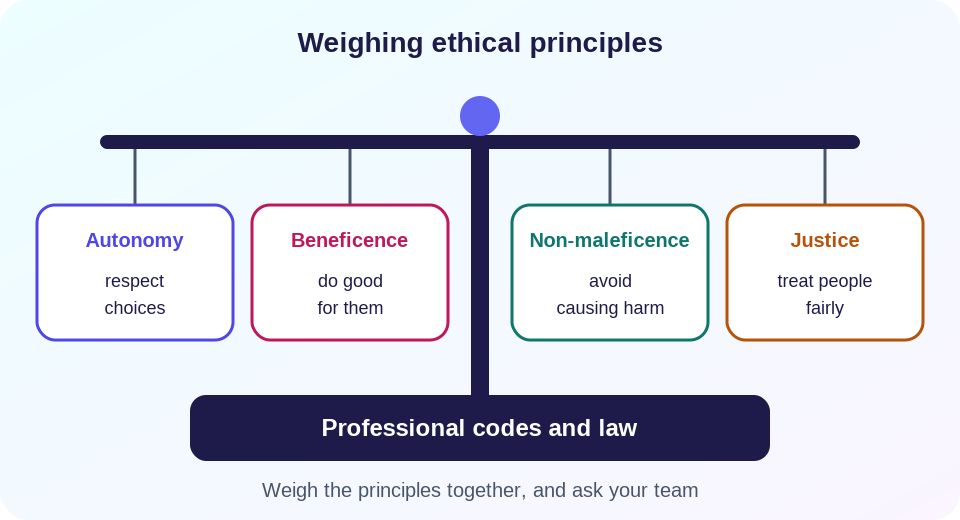
A well-known framework in health care ethics uses four principles.
Autonomy means respecting a person's right to make their own informed choices. You give clear information, listen and accept that a person may choose differently from you.
Beneficence means acting to benefit the person, such as helping someone eat comfortably.
Non-maleficence means avoiding causing harm. In practice, many treatments carry some risk, so teams weigh benefits against harms.
Justice means treating people fairly. This includes fair access to care and time, and no discrimination.
Other values
- Veracity: being truthful.
- Fidelity: keeping promises and being loyal to your professional duties.
- Confidentiality: protecting private information.
- Dignity: treating every person as having worth.
- Accountability: being responsible for your own actions.
- Advocacy: helping a person's needs and wishes be heard.
When principles pull apart
A dilemma happens when good values point in different directions. For example, a person who understands the risks wants to walk alone, while you want to prevent a fall. Autonomy and the wish to prevent harm both matter.
There is often no perfect answer. A careful process helps.
A simple thinking method
- Notice the ethical concern. What feels wrong or uncertain?
- Gather facts. What is known? What does the care plan say?
- Find the person's wishes and check how well they understand the situation.
- Identify the values and rules involved, including law and policy.
- List options and possible effects of each.
- Talk with the team. Use ethics services, supervisors or other support when available.
- Act within your role, then review what happened.
Ethics and law
Law is the set of rules a society enforces. Ethics is about what is right. They often agree but not always. Laws about consent, children, restraint, reporting abuse and end-of-life care differ greatly between countries and regions. Never assume the rule in one place applies in another.
Professional boundaries
A professional boundary keeps the relationship focused on the person's needs. Common warning signs include sharing your own personal problems, accepting valuable gifts, giving special treatment, contacting patients privately on social media, or keeping secrets from the team. Check your employer's rules.
Bias and fairness
Everyone has some unconscious bias, meaning quick judgments that can affect care. Age, weight, language, disability, ethnicity, religion, gender, sexual orientation, poverty or a past diagnosis may all trigger it. Ask yourself, "Would I act the same way if this person were different?" Listen to complaints about unfair treatment seriously.
Moral distress
Moral distress is the discomfort of knowing what you believe is right but being unable to do it, for example because of limited time or resources. It is a real experience. Talk with a trusted supervisor, mentor or support service. Raising concerns through proper channels can improve care.
A worked example
Mr. Dubois, an adult who understands his situation, wants to eat a food that does not fit the advice for his health condition. A student feels tempted to say "No." Instead, the student tells the nurse. The nurse asks what Mr. Dubois understands, explains risks and benefits in plain words, asks what matters to him and looks for options that respect his choice. The clinical team records the discussion. If there were doubt about his ability to decide, qualified staff would assess it using local law and policy.
A second example: fair use of time
A care worker has two requests at once. One person wants to chat. Another person says they feel suddenly short of breath. Justice does not mean giving each person exactly the same number of minutes. It means using fair reasons, and urgent need is a fair reason. The worker calls for urgent help for the second person. Later, the worker keeps their promise and returns to the first, which respects fidelity and dignity.
Now change the details. One person is friendly and says thank you often. Another is angry and critical. If the friendly person gets more attention without any difference in need, bias may be shaping care. Notice your reactions without feeling ashamed of them, and then decide by need and the care plan. Reflecting on a hard shift with a mentor is a useful way to learn this. When you reflect, protect patient privacy: share only what is needed, with people who are permitted to hear it.
Common mistakes
- Deciding for someone because you think you know best.
- Assuming that a choice you dislike means the person cannot decide.
- Promising to keep a safety concern secret.
- Handling a serious dilemma alone.
- Assuming the law is the same everywhere.
Try it
Check your understanding
Quick check · 4 questions
of 4 answered You scored / 4 · perfect!
-
1. What does autonomy mean?
Autonomy centers on the person's own choices. -
2. Which principle is about avoiding harm?
Non-maleficence means "do not harm". -
3. What is a sensible step in an ethical dilemma?
Facts, the person's views and team input improve decisions. -
4. Which may be a boundary problem?
Private social contact can blur professional boundaries.
Summary
- Autonomy, beneficence, non-maleficence and justice are widely used principles.
- Honesty, fidelity, dignity, accountability and advocacy matter too.
- Use a step-by-step method and involve your team.
- Law differs by place, so learn your local rules.
अपनी प्रगति ट्रैक करें
मुफ़्त अकाउंट बनाएँ, लेसन पूरे के रूप में चिह्नित करें और किसी भी डिवाइस पर वहीं से शुरू करें जहाँ छोड़ा था।