
























लेसन 34 · Past and Te-form
Chapter 6 review: past tense and te-form
Review chapter 6: the polite past for verbs, nouns and adjectives, te-form rules for every verb group, and the six key te-form patterns, with a ten-question quiz.
This chapter gave you two of the most powerful tools in beginner Japanese. With the polite past you can describe what happened; with the te-form you can request, describe ongoing actions, ask permission, forbid and tell stories. Here they are on one page, followed by a short diary text and ten questions.
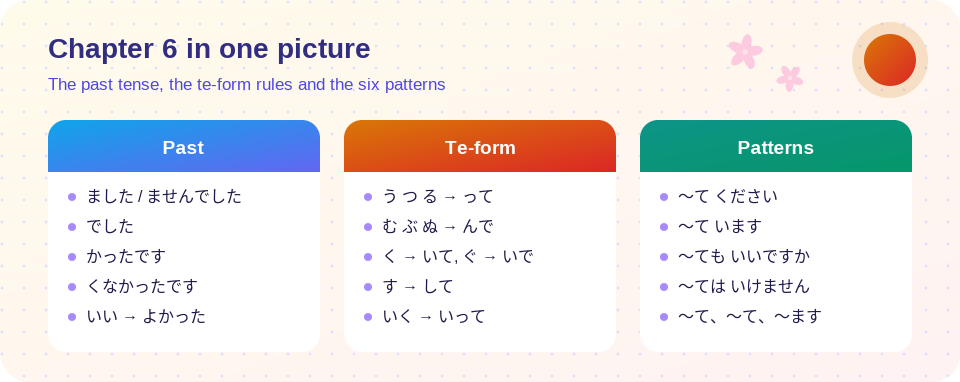
The chapter in one table
| Topic | Rule | Example |
|---|---|---|
| Verb, past | ます to ました | たべました (tabemashita) |
| Verb, negative past | ません to ませんでした | たべませんでした |
| Noun / な-adjective, past | でした | しずかでした |
| Noun / な-adjective, negative past | じゃありませんでした | しずかじゃありませんでした |
| い-adjective, past | stem + かったです | おいしかったです |
| い-adjective, negative past | stem + くなかったです | おいしくなかったです |
| いい | よ + かったです | よかったです |
| Group 1 te-form | う つ る → って; む ぶ ぬ → んで; く → いて; ぐ → いで; す → して | かって, のんで, かいて, およいで, はなして |
| Exception | いく → いって | itte |
| Group 2 te-form | drop る, add て | たべて |
| Group 3 te-form | する → して, くる → きて | shite, kite |
| Request | 〜てください | まって ください |
| In progress / state | 〜ています | よんで います, けっこんして います |
| Permission / prohibition | 〜てもいいですか / 〜てはいけません | とっても いいですか |
| Sequence | 〜て、〜て、〜ます / 〜てから | おきて、たべて、いきます |
| Joining descriptions | い-adj くて; な-adj and nouns で | ひろくて きれいです |
A decision guide
When you need to say something, ask yourself these questions in order:
- Is the event over? Use the past. Verb: ました. い-adjective: かったです. Noun or な-adjective: でした.
- Do you want a request, an ongoing action or a permission? Make the te-form of the verb and add the helper (ください, います, もいいですか).
- Are you chaining actions? Make the te-form for all but the last verb, and put tense on the last one.
- Not sure of the group? Check the dictionary form: する and くる are Group 3; ru-verbs with い or え before る are Group 2 (except かえる, はいる, はしる, しる); everything else is Group 1.
A diary text to read
きのう、わたしは しちじに おきて、あさごはんを たべました。 それから、でんしゃで がっこうへ いきました。 ひるごはんは ともだちと たべました。 ラーメンは おいしかったです。 ごごは としょかんで べんきょうしました。 よるは テレビを みて、ねました。 (Kinou, watashi wa shichiji ni okite, asagohan o tabemashita. Sorekara, densha de gakkou e ikimashita. Hirugohan wa tomodachi to tabemashita. Raamen wa oishikatta desu. Gogo wa toshokan de benkyou shimashita. Yoru wa terebi o mite, nemashita.) Yesterday I got up at seven and ate breakfast. After that I went to school by train. I ate lunch with a friend. The ramen was delicious. In the afternoon I studied at the library. In the evening I watched TV and went to bed.
Notice how the story is built: おきて chains to たべました (only the last verb carries the past), ラーメンは おいしかったです uses the い-adjective past, and しちじに uses に for a clock time.
Common slips to check
- おいしいでした: wrong. Use おいしかったです.
- いいて or いくて: wrong. いく becomes いって.
- 〜ています can describe a state: すんで います means "I live (there)" and けっこんして います means "I am married."
- Putting ました on every verb in a chain: only the last verb takes it.
- Writing かえて for かえる (return): it is a Group 1 verb: かえって.
Try it
The first tool is a drill: it picks verbs at random and shows you the te-form, so you can cover the answer and test yourself. You can also use it to check your own verbs.
Press Run (or Ctrl + Enter) to see the console output here.
No output.
The second tool turns an adjective into its polite past and negative past forms. Try your own い-adjectives.
Press Run (or Ctrl + Enter) to see the result here.
Program input · what you'd type while the program runs
Type the answers before you press Run, one per line. Each time the program reads a line (with input()), it gets the next line from this box.
Check your understanding
Quick check · 10 questions
of 10 answered You scored / 10 · perfect!
-
1. What is the polite negative past of いきます?
ます verbs use ませんでした for the negative past. -
2. What is the past of たかいです (it is expensive)?
Drop い, add かったです: たかかったです (takakatta desu). -
3. How do you say 'It was not good' (いい)?
The stem of いい is よ: よくなかったです. -
4. What is the te-form of よぶ (to call)?
ぶ verbs end in んで: よんで (yonde). -
5. What is the te-form of はなす (to speak)?
す verbs end in して: はなして (hanashite). -
6. What is the te-form of かえる (to return)?
かえる is a Group 1 verb: かえって (kaette). -
7. What does 'とうきょうに すんで います' mean?
〜ています with すむ describes a state: I live in Tokyo. -
8. Which sentence asks 'May I sit here?'
〜ても いいですか asks for permission. -
9. In 'あさ おきて、シャワーを あびて、がっこうへ いきました', what carries the past tense?
Only the last verb carries tense. -
10. How do you join 'quiet' (しずか) and 'convenient' (べんり) in one sentence?
な-adjectives join with で: しずかで べんりです.
Summary
- Past: ました and ませんでした (verbs), でした and じゃありませんでした (nouns and な-adjectives), かったです and くなかったです (い-adjectives, いい becomes よ).
- Te-form: Group 1 by ending, Group 2 drops る, Group 3 is して and きて; いく is the exception.
- Uses: requests, in progress and states, permission, prohibition, sequences, joining descriptions.
- Only the last verb in a chain takes the tense.
अपनी प्रगति ट्रैक करें
मुफ़्त अकाउंट बनाएँ, लेसन पूरे के रूप में चिह्नित करें और किसी भी डिवाइस पर वहीं से शुरू करें जहाँ छोड़ा था।