
























लेसन 13 · Kinetics: Force and Acceleration
Newton's Second Law in Practice
Apply ΣF = m a in Cartesian axes to pulled crates, friction, pulleys and connected bodies, with worked numbers, optimal pull angle and runnable solvers.
A single particle on a rough floor is easy. Two blocks joined by a rope over a pulley is harder; a crate pulled at an angle is hard to get right if you forget that the pull also lifts it. This lesson builds a routine that handles all of them, because the routine is always the same: one free-body diagram per body, one equation per axis per body, and extra equations for any constraints (a rope of fixed length).
What you will learn
- How to set up and solve straight-line kinetics problems with friction.
- How to treat connected bodies and pulleys with constraint equations.
- How to find the best pulling angle for a crate.
- How to solve several equations at once with a matrix.
Key terms
Constraint: a geometric condition that links the motions of bodies, such as a taut rope.
Tension: the pulling force transmitted along a rope; for an ideal rope and pulley it is the same along the whole rope.
Ideal rope and pulley: massless, inextensible rope; frictionless, massless pulley.
Kinetic friction: f = μk N.
The routine
- Name the bodies and choose a positive direction for each (use the direction of the expected motion).
- Draw one FBD per body.
- Write
ΣF = m aalong each axis for each body. - Add constraint equations (equal accelerations for a taut rope over a fixed pulley).
- Solve for the unknowns; check units and limits.
Example 1: pulling a crate at an angle
A 50 kg crate is pulled by a rope with F = 300 N, at θ = 30° above the horizontal, on a floor with μk = 0.25.
- Vertical:
N + F sin θ − m g = 0, soN = 490.5 − 150 = 340.5 N. The upward pull reduces the normal force. - Friction:
f = 0.25 × 340.5 = 85.1 N. - Horizontal:
F cos θ − f = m a, soa = (259.8 − 85.1)/50 = 3.49 m/s².
The best angle
The acceleration is a(θ) = [F cos θ − μ (m g − F sin θ)] / m. Differentiating and setting da/dθ = 0 gives tan θ = μ, i.e. θ = atan(0.25) = 14.0°, whatever the force or mass. The best pull is slightly upward: enough to unload the floor, not so much that you waste force lifting.
Example 2: the Atwood machine
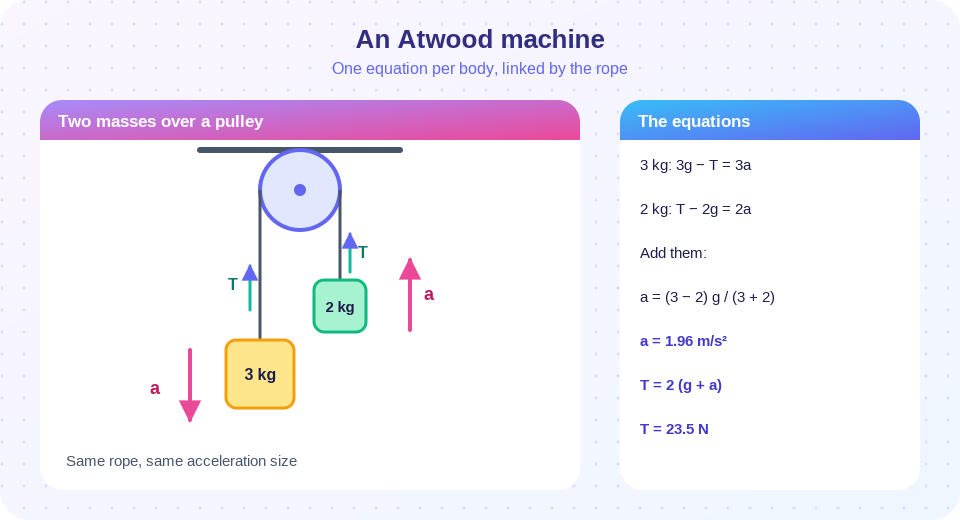
Two masses, 3 kg and 2 kg, hang over a pulley (figure above). For the heavier mass (down positive): m1 g − T = m1 a. For the lighter mass (up positive): T − m2 g = m2 a. Adding the equations, the tension cancels:
a = (m1 − m2) g / (m1 + m2) = 1 × 9.81 / 5 = 1.96 m/s²
and T = m2 (g + a) = 2 × 11.77 = 23.5 N. Note that T is less than m1 g = 29.4 N (otherwise the heavy mass would not accelerate down) and more than m2 g = 19.6 N.
Extreme checks: if m1 = m2, a = 0 (balanced). If m2 → 0, a → g (free fall).
Example 3: a block on a table pulled by a hanging mass
A 4 kg block rests on a table with μk = 0.1; a rope over a pulley attaches it to a hanging 2 kg mass. With a the common acceleration and T the tension:
- Block:
T − μ m_A g = m_A a - Hanging mass:
m_B g − T = m_B a
Adding: a = (m_B g − μ m_A g)/(m_A + m_B) = (19.62 − 3.92)/6 = 2.62 m/s², and T = 4 (2.62 + 0.98) = 14.4 N.
Solving with a matrix
When there are many unknowns it helps to write the equations as A x = b and let a computer solve it. The code below does that for Example 3.
Common misconceptions
"Tension equals the hanging weight." Only when the hanging mass does not accelerate. Once it accelerates, T = m (g − a) and it is smaller.
"The normal force always equals mg." Not when you pull or push at an angle, accelerate vertically or stand on a slope.
"Friction is a fixed number." It is μ N only while sliding, and N itself changes with the loading.
Try it
First, the pull-angle optimum. The plot shows a against the pull angle; the best angle matches atan(μ).
Press Run (or Ctrl + Enter) to see the result here.
Program input · what you'd type while the program runs
Type the answers before you press Run, one per line. Each time the program reads a line (with input()), it gets the next line from this box.
Second, solve the connected-body problem with linear algebra. Change the masses or friction and see the new acceleration and tension.
Press Run (or Ctrl + Enter) to see the result here.
Program input · what you'd type while the program runs
Type the answers before you press Run, one per line. Each time the program reads a line (with input()), it gets the next line from this box.
Check your understanding
Quick check · 5 questions
of 5 answered You scored / 5 · perfect!
-
1. A 50 kg crate is pulled by a rope at 30° above the horizontal with 300 N. Compared with a horizontal pull of 300 N, the normal force is
The vertical component of the pull (150 N) carries part of the weight, so N = 340.5 N instead of 490.5 N. -
2. For an Atwood machine with 3 kg and 2 kg masses (g = 9.81 m/s²), the acceleration of each mass is
a = (m1 − m2) g / (m1 + m2) = 9.81 / 5 = 1.96 m/s². -
3. In the Atwood machine, the rope tension is
T = 23.5 N lies between 19.6 N and 29.4 N. -
4. The pulling angle that maximizes a crate's acceleration satisfies
Setting da/dθ = 0 for a = [F cos θ − μ(mg − F sin θ)]/m gives tan θ = μ. -
5. When a hanging mass accelerates downward, the rope tension holding it is
m g − T = m a with a downward, so T = m (g − a) < m g.
Summary
- One FBD per body; one equation per axis; add constraint equations for ropes.
- An upward pull reduces
Nand friction; the best pull hastan θ = μ. - Atwood machine:
a = (m1 − m2) g / (m1 + m2),Tlies between the two weights. - Several unknowns can be handled with a matrix solve.
अपनी प्रगति ट्रैक करें
मुफ़्त अकाउंट बनाएँ, लेसन पूरे के रूप में चिह्नित करें और किसी भी डिवाइस पर वहीं से शुरू करें जहाँ छोड़ा था।