
























Leçon 34 · Practice and Review
Building a Practice Plan
Create a realistic piano practice plan with warm-ups, technique, pieces, reading and review, set clear goals, and track progress in a simple log.
Progress at the piano comes mostly from what you do between lessons. Time matters, but how you use it matters just as much. A practice plan tells you what to do when you sit down, so you do not spend the session playing only your favorite part.
Your plan should fit your real life. A small plan that you follow is better than a large one that you drop after a week.
What you will learn
- How to set clear, small goals
- The parts of a balanced session
- How to plan a week
- Why spacing and mixing help
- How to keep a practice log
Set clear goals
"Get better at piano" does not tell you what to do today. Compare these:
| Vague goal | Clear goal |
|---|---|
| Practice my scale | Play G major, right hand, three times evenly at a slow, steady beat |
| Work on my piece | Join measures 9 to 12, hands together, without stopping |
| Learn chords | Change C, F, G and C on beat 1 in time |
A clear goal says what, how well and under which conditions. You can tell at the end whether you reached it.
A balanced session
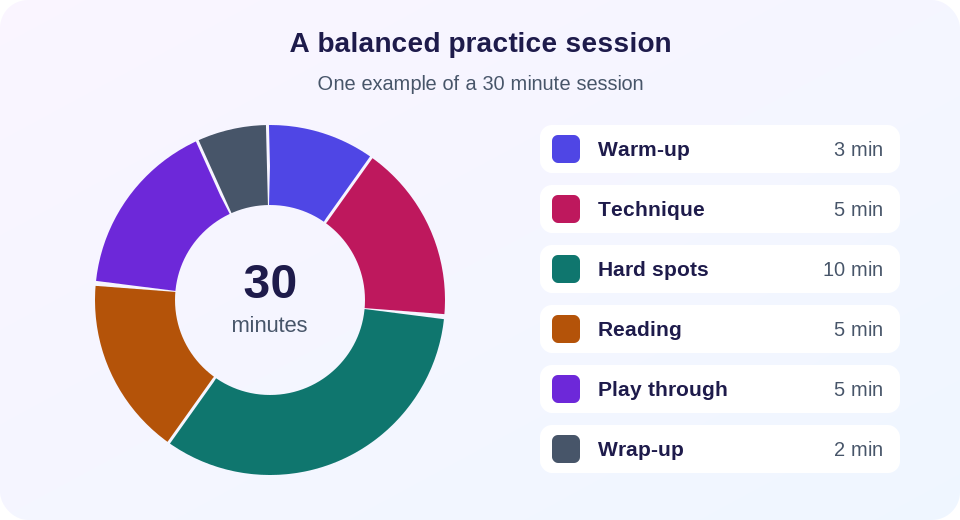
Here is one way to share 30 minutes. It is an example, not a rule.
| Part | Minutes | Purpose |
|---|---|---|
| Warm-up | 3 | settle your posture and move gently |
| Technique | 5 | scales, chords or coordination |
| Hard spots | 10 | your most difficult measures |
| Reading | 5 | new, easy music |
| Playing through | 5 | review and performance practice |
| Wrap-up | 2 | write notes for next time |
If you have only ten minutes, choose one technique item and one hard spot. Short sessions count.
Plan a week
Not every skill needs the same time every day. You might practice one major scale on Monday, a minor scale on Tuesday, and chord changes on Wednesday. Keep the current piece in most sessions. Leave one day for older pieces, and take rest days if you need them.
Spacing means returning to something several times with breaks between. Sleeping and coming back the next day often shows you that a hard spot feels easier. Long cramming right before a lesson usually works less well.
Mixing means switching between a few tasks, for example three hard spots in turn, instead of doing one for a very long time. It can feel harder, because you have to find each skill again. That effort can help memory. When a skill is completely new, a few focused repeats in a row are still useful.
Repeat with care
Your hands learn what you repeat, including mistakes. So:
- Slow down until you can play correctly.
- Aim for several correct repetitions in a row.
- If a mistake returns twice, stop and find the cause. Is it fingering, a note you have not read well, rhythm or tension?
- Change something: a smaller section, a slower speed or one hand alone.
Keep a log
Write three short lines after practice:
- Worked on: measures 9 to 12, G major scale
- Better: left hand change in measure 10
- Next time: thumb move in measure 11
The log shows progress that is hard to feel from day to day. It also tells you exactly where to start next time.
When motivation drops
Everyone has slow weeks. Progress can seem flat for a while and then improve. Try these:
- Make the first task tiny, such as "play one scale".
- Leave the instrument ready to use, if that is safe in your home.
- Keep one fun piece that you play just for pleasure.
- Play for a friend or with another musician.
- Take a short break if you feel exhausted, and set a day to return.
Remember your body too. Take short pauses, and stop if you feel pain, numbness or tingling. See healthy technique and safe practice.
End the session on something that works, even a short one. It makes it more pleasant to sit down again next time.
Worked example: three days
Say you have 20 minutes, three times a week. You are learning a piece with a hard left hand change, and the C, F and G chords.
| Day | Plan |
|---|---|
| First | warm-up; chord changes; hard change, left hand alone; read one easy line |
| Second | warm-up; hard change, hands together; a new phrase; play a known piece |
| Third | warm-up; test the hard change first, cold; join sections; play through |
On the third day, testing the hard change before you warm into it shows what has really stayed with you. If it still works slowly, you can raise the goal. If not, return to the left hand alone without blaming yourself.
Review your plan
Once a week, read your log and ask two questions. Which goal did you reach? Which one has not moved? For a stuck goal, make it smaller, change the method or ask a teacher to watch and listen.
Common mistakes
- Playing pieces from start to finish and never working on the weak parts.
- Setting a daily target so large that you skip practice altogether.
- Repeating fast and sloppy runs.
- Skipping reading and review until they become a problem.
- Comparing your progress with other people who have different time and experience.
Try it
Choose your available time and your main focus. The planner splits the time for you. Then start the timer for any part. The timer is silent.
Check your understanding
Quick check · 4 questions
of 4 answered You scored / 4 · perfect!
-
1. Which is the clearest practice goal?
It states what to do and how you will know that it worked. -
2. What is spaced practice?
Coming back later helps you build lasting memory. -
3. A mistake keeps returning. What should you do?
Repeating a mistake can make it a habit. -
4. What belongs in a short practice log?
A few focused lines tell you where to begin next time.
Summary
- Set small goals that you can check.
- Balance warm-up, technique, hard spots, reading and playing.
- Return to skills over several days.
- Repeat correctly and log what comes next.
- Make a plan that fits your life and your body.
Suivez votre progression
Créez un compte gratuit pour cocher vos leçons et reprendre où vous vous étiez arrêté, sur n'importe quel appareil.