
























Leçon 27 · Both Hands Together
Putting Your Hands Together
Learn a step-by-step method for playing piano with both hands: separate practice, slow combining, counting out loud and fixing hard spots calmly.
Playing with both hands is often the point where beginners feel stuck. Each hand may work well alone, and then everything falls apart when they meet. This is completely normal.
The difficulty is mostly about attention. At first, your mind tries to control two separate tasks at once. With practice, the two parts join into one movement. This lesson gives you a method that makes the joining easier.
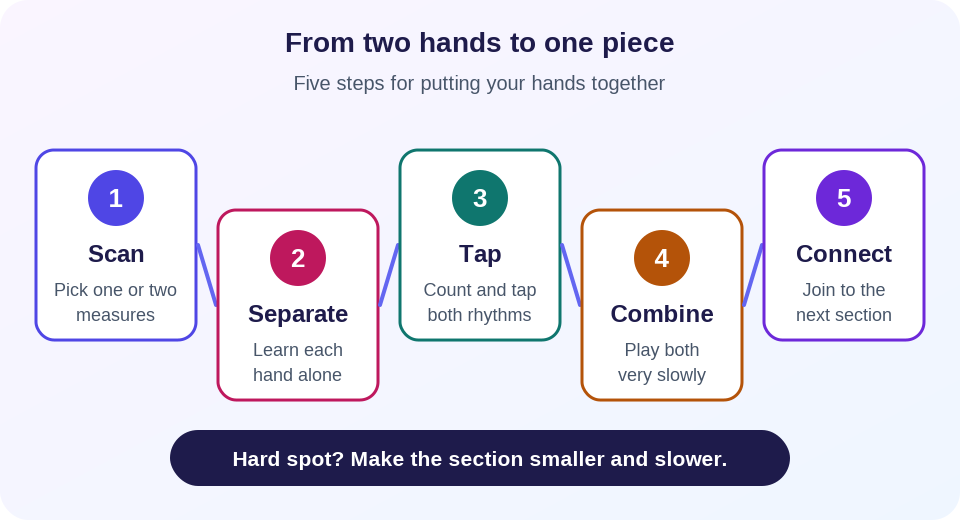
What you will learn
- How to prepare each hand alone
- How to use a map of which notes sound together
- How to tap a rhythm before playing it
- The types of two-hand coordination, from easy to hard
- How to fix one hard spot without replaying the whole piece
Step 1: Choose a small piece of music
Take two measures, or even one. A short section lets you repeat it many times with full attention. A whole page is too much to hold in your mind at once.
Include the first note of the next measure. If you practice from the first beat of one section to the first beat of the next, the sections will connect without gaps later.
Step 2: Learn each hand alone
Play the right hand until you can do it three times in a row with the correct notes, rhythm and fingering. Then do the same with the left hand. "Almost" is not enough here. If a single hand still needs all your attention, there is none left for the other.
Count aloud while you play each hand. The count is the link that will hold both parts together.
Step 3: Find what happens together
Look at the music from left to right. Notes that line up vertically sound at the same time. Mark each moment in one of three ways:
- B for both hands
- R for right hand only
- L for left hand only
For example, in 4/4 time, say the left hand holds one whole note C while the right hand plays four quarter notes, E F G E. The map is: B, R, R, R. Both hands start together, then only the right hand moves while the left holds.
| Beat | 1 | 2 | 3 | 4 |
|---|---|---|---|---|
| Right hand | E | F | G | E |
| Left hand | C | holding | holding | holding |
| Map | B | R | R | R |
Step 4: Tap before you play
Rest your hands on your knees or on the closed lid. Tap each hand's rhythm while you count. If you can tap it, the keys become much easier. If you cannot tap it yet, the problem is rhythm, and it is best solved here.
Step 5: Combine very slowly
Now play both hands at a speed that feels almost too slow. A useful test is this: can you think about the next note before you play it? If not, slow down more.
You can also stop and prepare. Play one moment, freeze, find the notes for the next moment with both hands, and only then play. The rhythm will not be steady yet, and that is fine for this stage. After a few rounds, bring back a steady count.
Repeat the small section until it works several times in a row. One lucky success is not the same as learning it. Then join it to the next section.
From easier to harder
| Kind of coordination | Example |
|---|---|
| Hands take turns | left hand answers the right |
| One hand holds | long bass note under a melody |
| Hands move together | same rhythm in both hands |
| One hand repeats | steady chords under a changing tune |
| Independent rhythms | each hand has its own shape |
The order is a rough guide. Playing in the same rhythm can still be hard if the two hands use different fingers, as in scales.
First exercise
Left hand: C and G held together for four beats. Right hand: C D E D, one per beat. Next measure, left hand: the same two notes. Right hand: E F G, with G held for two beats.
After it works, invent your own version. Keep the left hand the same and change the right hand notes within C D E F G.
When you get lost, do not go back to the very beginning. Find the exact moment where the trouble starts, practice the move into it, and then widen the section again.
Worked example: two measures
Here is an original two-measure exercise in 4/4 time. The right hand plays quarter notes E, D, C, D in the first measure. In the second measure it plays E, E, then holds E for two beats. The left hand plays C for two beats and G for two beats in measure one, then holds C for the whole second measure.
| Measure 1 beat | 1 | 2 | 3 | 4 |
|---|---|---|---|---|
| Right hand | E | D | C | D |
| Left hand | C | holding | G | holding |
| Map | B | R | B | R |
In the second measure the map is B, R, R, holding. On beat 1 both hands play, on beat 2 only the right hand plays again, and on beat 3 only the right hand starts a long note. Say the map aloud while you tap, and then move to the keys.
Common mistakes
- Joining the hands before each one is secure.
- Practicing at the final speed from the start.
- Always restarting from measure one, so the beginning improves and the rest does not.
- Stopping the count whenever a note is hard.
- Holding your breath and tensing your shoulders.
Try it
Choose a pattern and tap it on your knees. Start with the first one, then move on when it feels easy.
Check your understanding
Quick check · 4 questions
of 4 answered You scored / 4 · perfect!
-
1. When should you start combining the hands?
A hand that still needs full attention leaves none for the other. -
2. In a two-hand map, what does B mean?
Notes that line up vertically sound together. -
3. You cannot think ahead while playing both hands. What should you do?
A slower speed gives you time to prepare each move. -
4. A mistake always happens in the third measure. What is the best response?
Work directly on the cause, then widen the section.
Summary
- Work on one or two measures at a time.
- Make each hand secure alone.
- Map which hand plays at each moment, then tap it.
- Combine very slowly and bring back a steady count.
- Fix hard spots directly.
Suivez votre progression
Créez un compte gratuit pour cocher vos leçons et reprendre où vous vous étiez arrêté, sur n'importe quel appareil.