
























Leçon 7 · Pronunciation
Plain, Tense and Aspirated Consonants
Hear and say the three-way Korean consonant contrast with paper and throat tests, word groups such as 불, 뿔 and 풀, and listening tips.
Many languages have pairs such as "b" and "p." Korean often has three choices: plain, tense and aspirated. Changing from one to another can change the meaning of a word.
This contrast is one of the harder parts of Korean for many learners. Be patient. Your ears and mouth need time.
What you will learn
- The meaning of plain, tense and aspirated
- Simple tests for air and tension
- Word groups that differ by one consonant
- A practice method for your ears and mouth
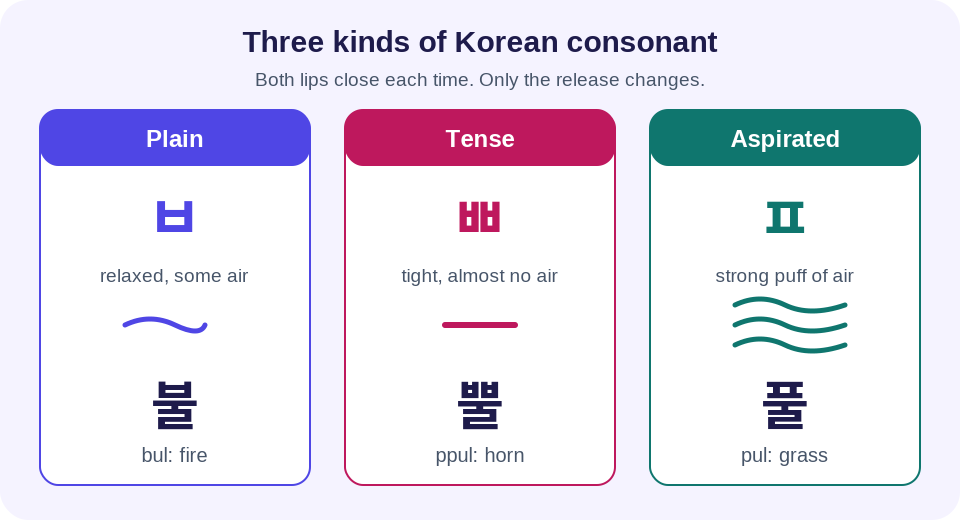
The three types
| Plain | Tense | Aspirated | Where the sound is made |
|---|---|---|---|
| ㄱ | ㄲ | ㅋ | back of the tongue |
| ㄷ | ㄸ | ㅌ | tongue tip |
| ㅂ | ㅃ | ㅍ | both lips |
| ㅈ | ㅉ | ㅊ | front of the tongue |
| ㅅ | ㅆ | none | tongue near the front |
ㅅ has only a plain and a tense form.
Plain
Plain sounds are relaxed. At the start of a word, they release some air. Between vowels, ㄱ, ㄷ, ㅂ and ㅈ usually become voiced, so they sound like g, d, b and j. ㅅ does not turn into a "z."
Tense
Tense sounds are tight and crisp. Press your lips or tongue firmly, tighten your throat a little, then release cleanly with almost no puff of air.
An English hint: the "p" in "spy," the "t" in "stay" and the "k" in "sky" have very little air. That can help you start. A Korean tense sound has more tightness than these.
Aspirated
Aspirated sounds release a strong puff of air, similar to or stronger than the "p" in the English word "pie."
The paper test
Hold a thin strip of paper a few centimeters from your lips. Say 바, 빠, 파.
- For 파, the paper should jump clearly.
- For 바 at the start, it may move a little.
- For 빠, it should hardly move.
The paper test checks air only. It cannot prove that 바 and 빠 are right. You also need to listen for tightness and pitch.
Listen for pitch
In Seoul speech, the pitch of the following vowel is an important clue, especially for many younger speakers. At the start of a phrase, vowels after tense and aspirated consonants usually begin higher. Vowels after plain consonants usually begin lower. Copy the whole melody of a short word, not only the consonant. Accents differ, so treat this as a helpful clue and not as a strict law.
Word groups
Say each row slowly. Then say it at a natural speed.
| Plain | Tense | Aspirated |
|---|---|---|
| 불 (bul), fire | 뿔 (ppul), horn | 풀 (pul), grass |
| 달 (dal), moon | 딸 (ttal), daughter | 탈 (tal), mask |
| 자다 (jada), to sleep | 짜다 (jjada), to be salty | 차다 (chada), to be cold |
| 개 (gae), dog | 깨 (kkae), sesame | 캐다 (kaeda), to dig up |
And two pairs with ㅅ:
| Plain | Tense |
|---|---|
| 살 (sal), flesh; years of age | 쌀 (ssal), uncooked rice |
| 사다 (sada), to buy | 싸다 (ssada), to be cheap |
Practice in three steps
First practice the consonant before the vowel ㅏ: 가, 까, 카. Next, use it in single words: 개, 깨. Finally, put the word in a short phrase that you can copy from native audio.
Try these everyday words too:
| Word | Meaning | Listen for |
|---|---|---|
| 아빠 (appa) | dad | tense ㅃ in the middle |
| 아파요 (apayo) | it hurts | aspirated ㅍ |
| 오빠 (oppa) | a female speaker's older brother | tense ㅃ |
| 토끼 (tokki) | rabbit | aspirated ㅌ, then tense ㄲ |
| 코끼리 (kokkiri) | elephant | aspirated ㅋ, then tense ㄲ |
A listening method
- Play one word from a trusted dictionary with audio. Ask a friend to choose it, or look away from the screen.
- Guess which type you heard.
- Check your answer.
- Repeat the word three times.
- Record yourself and compare.
Work on one row at a time. If you cannot hear a difference yet, keep listening. It often takes many sessions.
Position matters
The contrast sounds different in different places.
- At the start of a word, plain sounds have some air, so beginners often confuse them with aspirated sounds. Pitch and the strength of the air help.
- Between vowels, plain ㄱ, ㄷ, ㅂ and ㅈ are usually voiced and soft. Tense sounds stay tight and voiceless, so the difference is often easier to hear. Compare 아기 (baby) with 아끼다 (to save, to treasure).
- At the bottom of a block, the contrast disappears. You will see this in the lesson on final consonants.
Self-correction guide
| If you hear that your sound is... | Try this |
|---|---|
| too breathy for a plain sound | relax and release more gently |
| too soft for a tense sound | press more firmly before you release |
| too weak for an aspirated sound | let more air flow after the release |
Change only one thing at a time, then record again. Small adjustments are easier to control than big ones, and they help you notice what made the difference.
Common mistakes
Do not make tense sounds by shouting. They need tightness in a small area, not volume. Do not strain your throat: stop and rest if it feels sore. Do not add a vowel before a tense sound, and do not trust romanization alone, because letters such as "b," "pp" and "p" cannot show the real contrast.
Try it
Check your understanding
Quick check · 4 questions
of 4 answered You scored / 4 · perfect!
-
1. Which consonant is aspirated?
ㅍ releases a strong puff of air. -
2. How should a tense consonant sound?
Tension, not a puff of air, marks these sounds. -
3. Which letter has a tense form but no aspirated partner in the table?
The pair is ㅅ and ㅆ. -
4. What does 딸 mean?
딸 has a tense ㄸ and means daughter.
Summary
- Many Korean consonants come in plain, tense and aspirated versions.
- Use air, tension and vowel pitch as clues.
- A single consonant change can change a word's meaning.
- Train with native audio and do not strain your voice.
Suivez votre progression
Créez un compte gratuit pour cocher vos leçons et reprendre où vous vous étiez arrêté, sur n'importe quel appareil.