
























Leçon 1 · Hangul
Korean for Beginners: Course Map
See the full Korean for beginners path: Hangul, pronunciation, greetings, particles, numbers, verbs and daily life, plus a simple study routine.
Welcome to your first Korean course. You do not need any Korean to start. You only need a little time, a notebook and the courage to say new sounds aloud.
Korean has its own alphabet, called Hangul (한글). It is logical, and many learners can sound out simple words after a short period of regular practice. Reading slowly comes first. Speed comes later.
What you will learn
- The order of the topics in this course
- What each stage helps you do
- A short daily study routine
- How this course shows Korean words
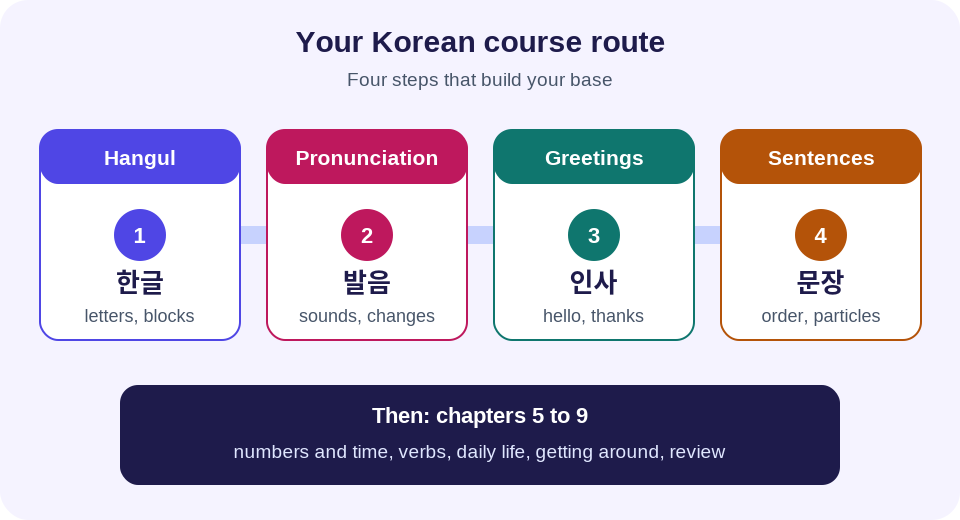
The route
The first four chapters build your base.
- Hangul. You learn vowels, consonants and how they fit into syllable blocks. Start with how Hangul works.
- Pronunciation. You practice sounds that may be new to you, final consonants and common sound changes.
- Greetings and introductions. You say hello, thank people, apologize and introduce yourself.
- Basic sentences and particles. You learn Korean word order and the small markers that show each word's job.
The later chapters cover numbers and time, verbs and politeness, daily life, getting around, and practice and review. Take the chapters in order the first time. Each one uses words and skills from the earlier ones.
How Korean is shown here
You will often see three things together:
| Korean | Romanization | Meaning |
|---|---|---|
| 안녕하세요 | annyeonghaseyo | hello |
| 감사합니다 | gamsahamnida | thank you |
| 네 | ne | yes |
Romanization means writing Korean with Latin letters. This course follows the Revised Romanization system, which is the official system in South Korea. Other books may use a different system, so one word can have several spellings.
Romanization is only a temporary helper. The letters do not always sound like English letters. For example, eo stands for one Korean vowel, not for two sounds. Try to read the Hangul first, and look at the romanization only to check yourself.
Sometimes you will also see a pronunciation in square brackets. For example, 감사합니다 is said [감사함니다]. The brackets show how it sounds, not how you spell it.
Which Korean is this?
This course teaches the standard Korean of South Korea, which is based on the speech of Seoul. People speak with different regional accents, and North Korea has some differences in spelling and vocabulary. What you learn here is a good base for talking with Korean speakers.
You will mainly learn the polite 요 style. Many of its sentences end in 요 (yo). It is friendly and respectful, so it works well in many everyday situations. You will also meet some formal phrases and learn to recognize a few casual ones.
A study routine that works
Short, frequent practice is usually easier to keep up than one long session a week. Here is a plan for about 20 minutes. Change the times to fit your life.
| Minutes | Activity |
|---|---|
| 5 | Review old letters or words with flashcards |
| 8 | Read one lesson section and say each example aloud |
| 4 | Write new words by hand |
| 3 | Do the quiz or a Try it exercise |
Audio matters. This course explains sounds in writing, but writing cannot replace your ears. Listen to Korean speakers as often as you can, for example with a trusted dictionary that has audio. If possible, record yourself and compare.
An example week
On Monday, you learn a few vowels. On Tuesday, you review them and read practice syllables. On Wednesday, you add a few consonants. On Thursday, you combine them into real words such as 나무 (namu, tree). On the weekend, you test yourself without romanization.
If you miss a day, simply continue the next day. Begin with a quick review, then move on. A calm, steady pace is better than trying to learn all the letters in one tired evening.
Keep a word notebook
Give each new word one line: Hangul, meaning and one short example. When you learn sound changes, add the pronunciation in brackets. Cover one side of the page and try to remember the other side. Mark the words you miss and review them first next time.
How to know you are ready to move on
You do not need to be perfect before you start the next lesson. Use three simple checks instead.
| Check | Ask yourself |
|---|---|
| Read | Can I read the examples slowly without romanization? |
| Say | Can I say them aloud after listening to a model? |
| Use | Can I change one word and make a new example? |
If you can say yes to most of these, go on. You will meet the same letters and words again, so your skill keeps growing. If most answers are no, repeat the lesson on another day.
Common mistakes
Staying with romanization too long can give you an accent based on your own spelling habits, and it leaves you unready for real signs and menus. Skipping the speaking is another trap. Reading silently does not train your mouth.
Try it
Flip these cards to meet three words and three course terms. Do not worry about reading them yet.
Check your understanding
Quick check · 4 questions
of 4 answered You scored / 4 · perfect!
-
1. What is Hangul?
Hangul is the alphabet used to write Korean. -
2. What is the best way to use romanization?
Romanization helps at first, but it cannot show every sound well. -
3. What do square brackets show in this course?
Brackets show the sound, which can differ from the spelling. -
4. Which style does this course mainly teach?
The polite 요 style is useful in many everyday situations.
Summary
- The course starts with Hangul and sounds, then moves to greetings and sentences.
- You learn standard South Korean, mainly in the polite 요 style.
- Romanization is a temporary helper. Square brackets show pronunciation.
- Practice often, speak aloud and listen to real Korean audio.
Next: How Hangul Works
Suivez votre progression
Créez un compte gratuit pour cocher vos leçons et reprendre où vous vous étiez arrêté, sur n'importe quel appareil.