
























Lección 15 · Stories and Persuasion
Shape a Story That Makes a Point
Tell short, honest stories in a talk with a setting, a problem, key actions, a result and a clear point, while respecting privacy and keeping to your time.
"Check your backups" is advice. "I opened my laptop the night before a deadline, and the file was gone" makes people want to know what happened next.
Stories give ideas a person, a moment and consequences. In a talk, a story is not there only to entertain. It should help listeners understand or care about your point.
What you will learn
- A five-part shape for a short story
- How to make a story vivid without making it long
- Where to place stories in a talk
- How to find your own material
- How to stay honest and respect others
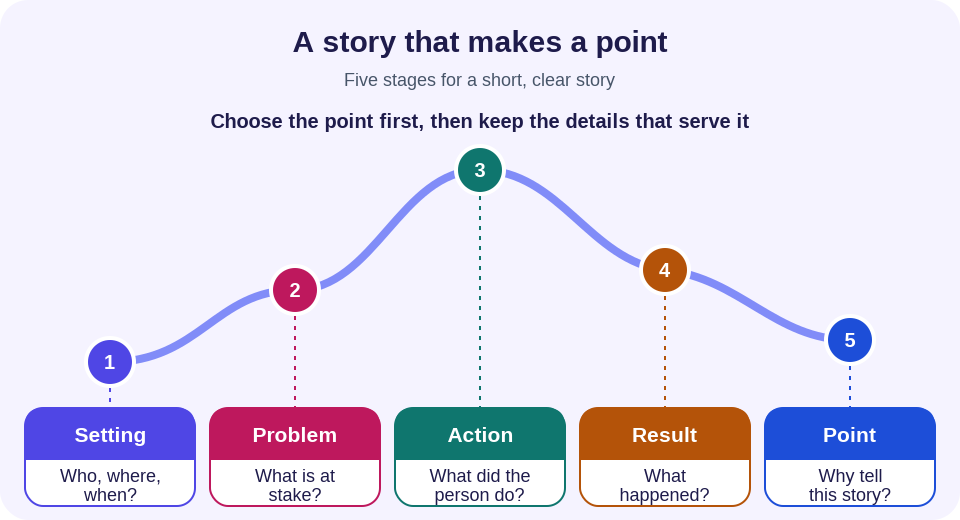
A five-part shape
| Part | Question it answers | Example |
|---|---|---|
| Setting | Who, where and when? | "Last spring, I was finishing a class project at home." |
| Problem | What went wrong, or what was at stake? | "The night before it was due, the file would not open." |
| Action | What did the person do? | "I searched my email and found an older copy that I had sent to a teammate." |
| Result | What happened? | "I rebuilt the missing part. It took most of the evening." |
| Point | Why are you telling this? | "Now I keep a second copy while I work, not after." |
There are many ways to tell stories. This shape is a simple, reliable start. The heart of it is the problem. Without a question, a difficulty or a change, you may only have a list of events: "I woke up, I ate, I went to class."
Choose the point first
Ask: "What should this story help my listeners see?" Then keep details that serve that point.
The same event could support different points. The lost file might be about keeping backups, asking a teammate for help or starting work earlier. Choose one.
Make it vivid with a few details
Concrete details help listeners picture the moment.
- General: "I was very stressed."
- Concrete: "It was almost midnight, and I clicked the same file again and again."
Pick two or three details that matter. A long description of your room, your lunch and your laptop's color will slow the story if they play no part.
Short dialogue can bring a moment to life: "My teammate wrote back, 'I think I still have last week's version.'" Report words truthfully. If you do not remember the exact words, say so, or use "she told me that..."
Control the length
In a short talk, many useful stories take well under a minute or two. These tips help:
- Start close to the problem. Skip long background.
- Name only the people the listener needs.
- Remove side events.
- Reach the result, then state the point in one or two sentences.
Do not memorize the story as a stiff script. Learn the order of the five parts. Knowing the first and last sentences well can also help.
Where stories work
- In the opening, to make listeners care about the problem.
- In the body, to show what a point looks like in real life.
- In the closing, to return to an opening story and show how it turned out.
One well-chosen story is often stronger than several loosely connected ones.
Find your material
You do not need an amazing life. Small, ordinary moments often work because listeners recognize them. Think about:
- a first attempt at something;
- a misunderstanding that taught you something;
- a time you changed your mind;
- a small problem you or your team solved;
- someone's helpful action that you noticed.
Keep a simple story file. For each idea, write one line about what happened and one line about what it could show.
Tell the truth
Listeners usually assume that a personal story really happened. Respect that trust.
- Do not present someone else's experience as your own.
- Do not invent results to make your point stronger.
- If you combine events or change details to protect someone, tell listeners.
- Label imagined examples: "Imagine a new student on the first day."
- Remember that one story is one example. It does not prove that something always happens.
Respect privacy
Before you share a story about another person, ask yourself whether you have permission and whether the person could be recognized. Be especially careful with stories about health, family problems, money, mistakes at work or children. Changing a name may not be enough if other details reveal who it is. Rules about privacy and recording differ between countries and organizations.
Be kind to yourself as well. Share only what you are comfortable sharing. A painful experience that still feels raw may be hard to tell in public. You can choose another example.
Also think about your listeners. If a story includes distressing events, consider whether it is needed and appropriate, and leave out graphic details.
Deliver the story
- Tell it as if you are speaking to one interested person.
- Slow down before the most important moment.
- Pause briefly before the result or the point.
- Use gestures only when they come naturally.
- If you use dialogue, a small change in voice is enough.
Worked example: Cutting a long story
Draft: Zara describes her whole trip: booking, packing, the taxi, breakfast, three friends, then arriving at the wrong station.
Her point is "Check the full station name before you travel." So the new version begins at the ticket screen. Two stations have similar names, she chooses quickly, arrives at the wrong one and misses her connection. She ends with the point. The packing and breakfast are gone.
The story is shorter, and the lesson is easier to see.
Common mistakes
- Telling a story that does not support the message.
- Spending so long on background that the problem arrives late.
- Making up or borrowing an experience and presenting it as your own.
- Sharing details that could embarrass or identify someone without permission.
Try it
Put the parts of this story in the five-part order.
Next, tell your own story aloud with a one-minute target.
Check your understanding
Quick check · 4 questions
of 4 answered You scored / 4 · perfect!
-
1. Which part usually creates interest in what happens next?
A difficulty or open question gives listeners a reason to follow. -
2. Which details should you keep?
A few relevant details make a story vivid without slowing it. -
3. You invent a situation to explain an idea. What should you do?
Labeling it keeps listeners' trust. -
4. What can one personal story do?
A story illustrates, but one case cannot show how common something is.
Summary
- Use setting, problem, action, result and point.
- Choose the point first and cut details that do not serve it.
- Add a few concrete details and keep the story short.
- Collect ordinary moments in a story file.
- Be truthful, label imagined examples and protect people's privacy.
Sigue tu progreso
Crea una cuenta gratis para marcar lecciones y retomar donde lo dejaste en cualquier dispositivo.