
























Lektion 24 · Verbs and Politeness
The Polite Present Tense
Turn Korean dictionary verbs into polite present forms with 아요, 어요 and 해요, learn common vowel contractions and meet frequent irregulars.
Dictionaries list Korean verbs in a form that ends in 다 (da). People do not usually talk to each other with that form. To talk politely, you change the ending.
The most useful style for beginners ends in 요 (yo). It is friendly and polite, and it fits many daily situations. Korean adjectives such as "good" or "cold" change in the same way, so one rule works for two kinds of words.
What you will learn
- How to find a verb stem
- When to use 아요, 어요 or 해요
- How vowels combine
- Some frequent irregular patterns
Step 1: find the stem
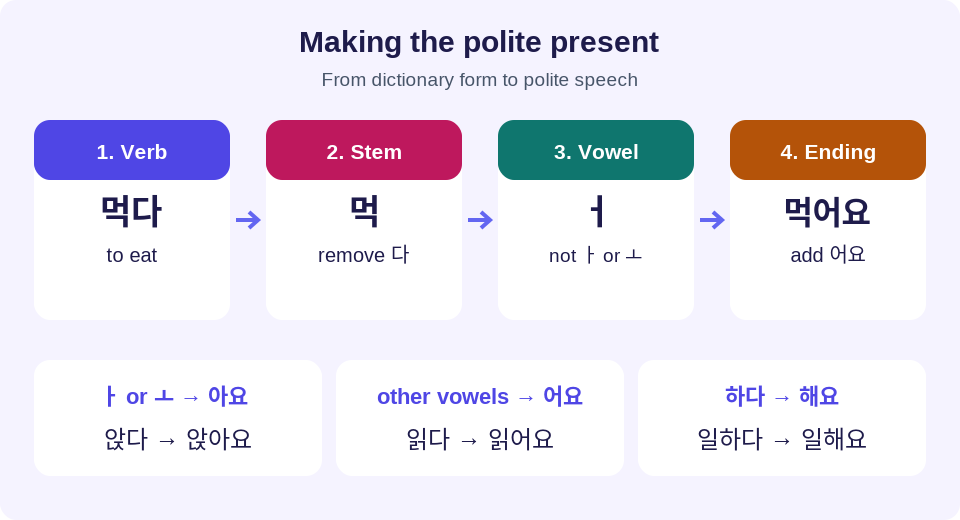
Remove 다. What remains is the stem.
| Dictionary form | Stem | Meaning |
|---|---|---|
| 먹다 | 먹 | to eat |
| 가다 | 가 | to go |
| 읽다 | 읽 | to read |
| 공부하다 | 공부하 | to study |
Step 2: choose the ending
Look at the last vowel in the stem.
- If it is ㅏ or ㅗ, add 아요.
- For other vowels, add 어요.
- If the word is 하다 or is made with 하다, it becomes 해요.
| Word | Polite form | Meaning |
|---|---|---|
| 앉다 | 앉아요 (anjayo) | sit |
| 좋다 | 좋아요 (joayo) | is good |
| 먹다 | 먹어요 (meogeoyo) | eat |
| 읽다 | 읽어요 (ilgeoyo) | read |
| 있다 | 있어요 (isseoyo) | there is, have |
| 없다 | 없어요 (eopseoyo) | there is not, do not have |
| 하다 | 해요 (haeyo) | do |
| 일하다 | 일해요 (ilhaeyo) | work |
Step 3: combine the vowels
When a stem ends in a vowel, the two vowels often join into one syllable.
| Pattern | Verb | Polite form | Meaning |
|---|---|---|---|
| ㅏ + 아 | 가다 | 가요 (gayo) | go |
| ㅓ + 어 | 서다 | 서요 (seoyo) | stand |
| ㅗ + 아 | 오다 | 와요 (wayo) | come |
| ㅗ + 아 | 보다 | 봐요 (bwayo) | see, watch |
| ㅜ + 어 | 배우다 | 배워요 (baewoyo) | learn |
| ㅜ + 어 | 주다 | 줘요 (jwoyo) | give |
| ㅣ + 어 | 마시다 | 마셔요 (masyeoyo) | drink |
| ㅣ + 어 | 기다리다 | 기다려요 (gidaryeoyo) | wait |
| ㅐ + 어 | 보내다 | 보내요 (bonaeyo) | send |
| ㅚ + 어 | 되다 | 돼요 (dwaeyo) | become, be okay |
One form, many meanings
The same polite form can be a statement, a question, a suggestion or a request. Your voice and the context do the work.
- 가요. (I am going.)
- 가요? (Are you going?)
- 같이 가요. (Let's go together.)
It can also cover both "I eat" and "I am eating". Korean often drops "I" and "you" when the meaning is clear.
- 뭐 해요? (Mwo haeyo?) What are you doing?
- 한국어를 공부해요. (Hangugeoreul gongbuhaeyo.) I am studying Korean.
The verb normally comes at the end of the sentence. An object can take 을 after a consonant and 를 after a vowel: 밥을 먹어요, 커피를 마셔요.
Common irregular patterns
Some stems change before a vowel. Learn these as vocabulary at first. Not every verb with the same final letter is irregular.
The ㅡ stem
The vowel ㅡ drops before 아 or 어. If there is a syllable before it, the vowel of that syllable chooses the ending.
| Word | Polite form | Meaning |
|---|---|---|
| 쓰다 | 써요 | write, use |
| 크다 | 커요 | is big |
| 바쁘다 | 바빠요 | is busy |
| 아프다 | 아파요 | hurts, is sick |
| 예쁘다 | 예뻐요 | is pretty |
Some ㅂ stems
In many words, ㅂ turns into 우.
| Word | Polite form | Meaning |
|---|---|---|
| 춥다 | 추워요 | is cold |
| 덥다 | 더워요 | is hot |
| 맵다 | 매워요 | is spicy |
| 어렵다 | 어려워요 | is difficult |
A well-known special case is 돕다, which becomes 도와요 (help). Some words are regular, such as 입다, which becomes 입어요 (wear).
Some ㄷ stems
In some verbs, ㄷ changes to ㄹ. For example, 듣다 becomes 들어요 (listen). 걷다, meaning "walk", becomes 걸어요. Other verbs such as 받다 (receive) are regular: 받아요.
Worked examples
- 저는 아침에 빵을 먹어요. (I eat bread in the morning.)
- 친구가 와요. (My friend is coming.)
- 오늘은 추워요. (It is cold today.)
- 음악을 들어요. (I listen to music.)
- 지금 바빠요? (Are you busy now?)
Learn each new verb as a pair, the dictionary form and the polite form: 마시다, 마셔요. This helps you remember the changes without thinking through the rules every time.
Building longer sentences
A simple Korean sentence often follows this order: topic or subject, then time and place, then the object, then the verb. The order can change, but the verb normally stays at the end.
| Part | Example |
|---|---|
| Topic | 저는 |
| Time | 저녁에 |
| Place | 집에서 |
| Object | 밥을 |
| Verb | 먹어요 |
Put them together: 저는 저녁에 집에서 밥을 먹어요. (In the evening I eat at home.) Now change one part at a time. Change 집에서 to 식당에서. Then change 밥을 to 빵을. Each change gives you a new, correct sentence.
You do not need every part. A friend who asks 뭐 해요? may get the short answer 밥 먹어요. In everyday speech, particles such as 을 and 를 are often left out when the meaning stays clear. As a learner, practicing with the particles first is a good way to understand how the sentence works.
Common mistakes
- Saying the dictionary form to a person, as in 저는 가다. Say 저는 가요.
- Adding 아요 to every stem. Check the last vowel.
- Making a 하다 verb into 하아요. The form is 해요.
- Adding 이에요 to an adjective, as in 좋다예요. Say 좋아요.
Try it
Check your understanding
Quick check · 4 questions
of 4 answered You scored / 4 · perfect!
-
1. What is the polite present of 앉다?
The last vowel of the stem is ㅏ, so add 아요. -
2. What is the polite present of 마시다?
ㅣ and 어 combine into ㅕ. -
3. Which dictionary form gives 해요?
하다 has the special polite form 해요. -
4. Where does the verb usually go in a Korean sentence?
Korean sentences normally end with the verb or adjective.
Summary
- Remove 다 to find the stem.
- Use 아요 after ㅏ or ㅗ, 어요 after other vowels, and 해요 for 하다.
- Vowels often combine, as in 와요 and 마셔요.
- Learn irregular words with their polite forms.
Next: The Past Tense
Verfolge deinen Fortschritt
Erstelle ein kostenloses Konto, hake Lektionen ab und mach auf jedem Gerät dort weiter, wo du aufgehört hast.