
























Lektion 35 · Practice and Review
Practice: Dialogues in Daily Situations
Practice Korean with four short dialogues about meeting a classmate, a cafe visit, making plans and finding a place, with role-play tasks.
Words and rules become useful when you use them in a conversation. This lesson puts your skills together in four short dialogues.
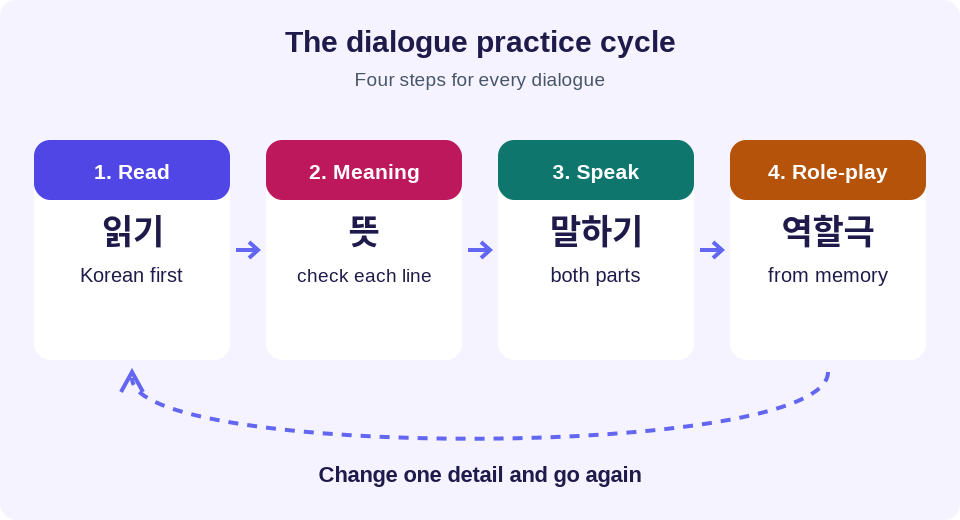
Do each dialogue in four steps: read it, check the meaning, say it aloud, and then say your own part without looking.
What you will learn
- How to follow complete short conversations
- How to swap words to make your own versions
- How to keep going when you miss something
- How to practice alone or with a partner
How to practice
- Read the Korean once without checking the English.
- Understand each line. Notice the particles and endings.
- Speak both parts aloud, slowly and then at a natural speed.
- Role-play one part from memory. Change one detail.
If you record your own voice with a device, listen once and compare it with a native speaker you trust.
Dialogue 1: Meeting a new classmate
- 지수: 안녕하세요. 저는 지수예요.
- Alex: 안녕하세요. 저는 알렉스예요. 반갑습니다.
- 지수: 반가워요. 어느 나라에서 왔어요?
- Alex: 캐나다에서 왔어요.
- 지수: 한국어를 얼마나 공부했어요?
- Alex: 삼 개월 공부했어요. 아직 잘 못해요.
- 지수: 아니에요. 아주 잘해요!
Meaning: Jisu and Alex introduce themselves. Alex comes from Canada and has studied Korean for three months. Alex says that they are not good yet, and Jisu answers that Alex does very well.
Useful notes: 어느 나라 means "which country". 개월 counts months and takes Sino-Korean numbers.
Dialogue 2: At a cafe
- Staff: 어서 오세요. 주문하시겠어요?
- You: 아이스 아메리카노 한 잔 주세요.
- Staff: 네. 드시고 가세요?
- You: 아니요, 포장해 주세요.
- Staff: 사천 원이에요.
- You: 카드 돼요?
- Staff: 네, 돼요.
Meaning: You order one iced americano to go. It costs 4,000 won, and you can pay by card. The price here is only an example.
Swap it: Order two warm teas: 따뜻한 차 두 잔 주세요.
Dialogue 3: Making plans
- A: 이번 주말에 뭐 할 거예요?
- B: 아직 몰라요. 왜요?
- A: 토요일에 같이 영화 볼 수 있어요?
- B: 토요일은 바빠요. 일요일은 어때요?
- A: 좋아요. 몇 시에 만날까요?
- B: 두 시에 만나요. 지하철역 앞에서요.
- A: 네, 그때 봐요!
Meaning: The friends choose Sunday at two o'clock in front of the subway station.
Useful notes: 어때요? asks "how is it?" or "how about it?" 만날까요? suggests meeting and asks for the other person's opinion. 그때 봐요 means "see you then".
Dialogue 4: Finding a place
- You: 실례합니다. 이 근처에 약국이 있어요?
- Person: 네. 쭉 가세요. 그리고 왼쪽으로 가세요.
- You: 왼쪽이요? 멀어요?
- Person: 아니요. 걸어서 삼 분쯤 걸려요.
- You: 감사합니다.
- Person: 아니에요.
Meaning: The pharmacy is nearby. Go straight, then go left. It takes about three minutes on foot.
Keeping the conversation going
If a line goes too fast, use one of these phrases. They are part of good speaking, not a sign of failure.
| Phrase | Meaning |
|---|---|
| 네? | Pardon? |
| 다시 한번 말해 주세요. | Please say it once more. |
| 천천히 말해 주세요. | Please speak slowly. |
| 그게 무슨 뜻이에요? | What does that mean? |
| 아, 알겠어요. | Ah, I understand. |
Build your own version
Change one thing at a time. This keeps your sentences correct while you gain confidence.
| Slot | Choices |
|---|---|
| Day | 금요일, 토요일, 일요일 |
| Activity | 영화를 보다, 밥을 먹다, 산책하다 |
| Time | 한 시, 두 시, 세 시 반 |
| Place | 지하철역 앞, 카페 앞, 공원 입구 |
For example: 금요일에 같이 밥을 먹을 수 있어요? (Can we eat together on Friday?)
Practice with a timer. Give yourself two minutes to role-play one dialogue. Then do it again with a new day, time or place.
Notice how the lines work
Each dialogue reuses patterns that you already know. Finding them shows you that a conversation is built from familiar parts.
| Line | Pattern |
|---|---|
| 캐나다에서 왔어요. | 에서 for "from", plus the past tense |
| 삼 개월 공부했어요. | length of time and the past tense |
| 포장해 주세요. | polite request |
| 뭐 할 거예요? | plan |
| 영화 볼 수 있어요? | ability or possibility |
| 걸어서 삼 분쯤 걸려요. | travel time |
Dialogue 3 shows one way to invite someone: ask if they can, listen to the answer, then agree on a day. When the other person is busy, there is no need to push. A simple 괜찮아요. 다음에 봐요. (That is okay. See you another time.) closes the topic warmly.
If you practice with a partner, swap roles after each round. The person who asks questions practices different skills from the person who answers, and you need both.
Make a fifth dialogue
Now write your own conversation with six lines. Pick a situation from this course, such as buying a T-shirt or asking about a bus. Use only patterns you know. Start with a greeting or 실례합니다, include one question with a number, and finish with thanks. Read it aloud, then ask a skilled speaker to check it if you can. If a sentence feels too hard, split it into two short ones. A short correct sentence is more useful than a long one with several mistakes.
Common mistakes
- Memorizing lines as sounds without knowing what each part does.
- Changing many words at once and losing the structure.
- Translating each English word in order. Keep the Korean order, with the verb at the end.
- Staying silent when you do not understand. Ask for a repeat.
Try it
Check your understanding
Quick check · 4 questions
of 4 answered You scored / 4 · perfect!
-
1. In dialogue 3, when do the friends meet?
Saturday is busy, so they choose Sunday at two o'clock. -
2. What does 일요일은 어때요? mean?
어때요 asks how something is, and here it proposes a day. -
3. In the cafe dialogue, how much is the drink?
사천 원 is four thousand won. -
4. What can you say when you want a word explained?
This phrase asks what something means.
Summary
- Work through each dialogue by reading, understanding, speaking and role-playing.
- Change one detail at a time to make your own version.
- Repair phrases keep a conversation alive.
- Korean sentences keep the verb at the end.
Verfolge deinen Fortschritt
Erstelle ein kostenloses Konto, hake Lektionen ab und mach auf jedem Gerät dort weiter, wo du aufgehört hast.