
























第 31 课 · Study Plans and Test Day
Set your goal and find your starting point
Start your TOEFL study plan well: check what your programs require, take a diagnostic practice test, compare scores and choose your priorities.
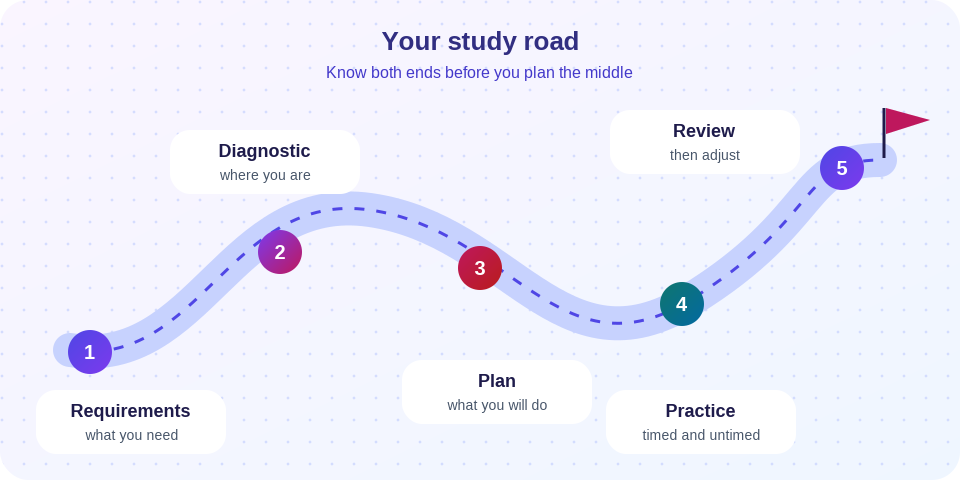
A study plan answers three questions: Where do you need to be? Where are you now? What will you do in between? Many learners skip the first two and simply "study English". That feels productive, but it often misses the real gap.
This tutorial is independent and cannot measure or predict your score. For a score estimate, use official practice material from ETS.
What you will learn
- How to read a score requirement
- How to run a fair diagnostic test
- How to compare your gap section by section
- How to set weekly goals that you control
Three questions
Goals you control
Step 1: Check the requirement
Visit the official admissions page of each university, program, or organization. Write down:
- the minimum overall score
- any minimum for each section
- which scale they quote
- how old a score may be
- the deadline by which scores must arrive
- whether they accept the test version that you plan to take
The scale matters. Since January 21, 2026, the TOEFL iBT reports section and overall scores from 1 to 6 in half steps. ETS says that reports also include a comparable overall score on the older 0 to 120 scale through January 2028. If a web page lists only one number such as 90, it uses the older scale. If you are unsure how a program treats the new scale, ask it.
| Program | Overall | Section minimums | Deadline for scores |
|---|---|---|---|
| Program A | write it here | write them here | write it here |
| Program B | write it here | write them here | write it here |
Also remember timing. ETS's bulletin says that scores are posted about 3 days after the test, but sending them and processing them can take longer. Scores remain valid for 2 years after the test date.
Step 2: Take a diagnostic
A diagnostic is a practice test that you take before serious study, to learn your starting point.
- Use official material in the current format.
- Take it in one sitting, with the real timing.
- Use no dictionary, pause, or help.
- Wear headphones and type your writing.
- Record your speaking answers so that you can listen again.
Afterward, do not only note the score. For every wrong or weak answer, write a reason.
| Reason code | Meaning |
|---|---|
| V | I did not know key words. |
| S | I could not follow a sentence or speaker. |
| Q | I misunderstood the question. |
| T | I ran out of time. |
| G | My grammar broke down. |
| I | I had no idea what to say or write. |
Step 3: Compare the gap
Subtract your current estimate from your target for each section. For example (invented numbers):
| Section | Now | Target | Gap |
|---|---|---|---|
| Reading | 4.5 | 4.5 | 0 |
| Listening | 4 | 4.5 | 0.5 |
| Speaking | 3 | 4 | 1 |
| Writing | 3.5 | 4.5 | 1 |
Here, speaking and writing need the most time. Reading still needs light practice, so that the skill does not slip. Your reason codes show how to work on each gap.
Step 4: Set goals that you control
"Get a 5" is a result. You cannot do it directly today. A process goal is an action that you can complete:
- Write two timed emails each week and log the errors.
- Record three speaking answers on Tuesday and Friday.
- Learn and review 40 vocabulary records this month.
How long will it take?
There is no honest single answer. It depends on your starting level, your gap, your hours, and the quality of your practice. Check your progress every few weeks and change your date or plan if needed. Be careful with anyone who promises a fixed score gain in a fixed number of days.
A worked reason log
Suppose Hana misses a reading question about why a custom changed. She first thinks, "I am bad at reading." On review, she sees that she understood every word but chose an answer that is true in real life and not stated in the passage. Her code is Q, and her action is clear: find the supporting sentence before choosing. A specific reason leads to a specific fix.
Common mistakes
Do not take a diagnostic in the old format, pause it often, or take one official practice test again and again as a measure. Remembering the answers can raise your result without raising your English.
Try it
Pick the best action for each learner.
Check your understanding
Quick check · 4 questions
of 4 answered You scored / 4 · perfect!
-
1. What is a diagnostic test for?
It shows where to begin. -
2. How long do TOEFL scores remain valid, according to the ETS bulletin?
The bulletin says 2 years after the test date. -
3. Which requirement detail is easy to miss?
A high total may not satisfy a section minimum. -
4. Why write a reason for each weak answer?
Different causes need different fixes.
Summary
- Check requirements, scales, and deadlines first.
- Take a timed diagnostic in the current format and record reasons.
- Find your largest gaps by section.
- Set process goals and review them regularly.